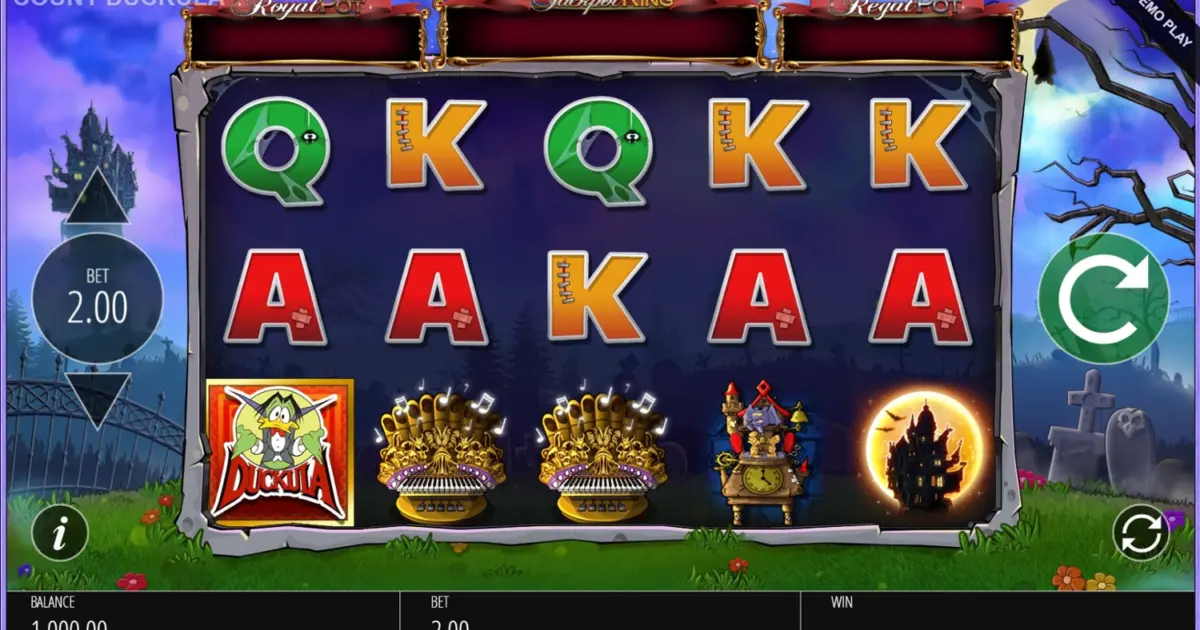
The number that matters most about the count duckula slot is 92.55%. That is the published return to player, and it sits 3.16 percentage points below the 95.71% average across the games catalogued here. Blueprint Gaming has released 201 titles with an average RTP of 95.35%, so this one is an outlier within its own maker’s range. If you are comparing games purely on long-run cost, that is a meaningful strike against it — though at rank 2020 and the 89.9th popularity percentile, plenty of people still load it up.
The 5-reel grid explained
Five reels is the standard layout for video slots and has been since the format moved off mechanical drums. Symbols land in five vertical columns, and wins are assessed across those columns according to whatever paying structure the game uses. The practical effect of five reels rather than three is more symbol positions, which allows a designer to spread the same total return across more frequent small outcomes, fewer large ones, or any mix in between.
Blueprint has not published a row count for this title in the data available here, so the exact grid size — 5×3, 5×4 or something taller — is not something you can confirm before loading it. That is worth knowing rather than guessing at, because row count changes the number of symbol positions substantially, and with it the shape of the paytable. The reel count tells you the format. It tells you nothing on its own about how often the game pays or how large those payments are. Two games can share an identical 5-reel grid and behave completely differently over a thousand spins.
| Provider | Blueprint Gaming |
|---|---|
| RTP | 92.55% |
| Reels | 5 |
| Free demo | Yes |
| Site-wide average RTP | 95.71% |
Paylines, ways and how Count Duckula pays
No payline or ways figure is published for this game in the facts available, so treat any specific number you see quoted elsewhere with caution until you have checked it on the game’s own info screen. What can be said is how these structures work in general.
Most 5-reel slots use one of three approaches. Fixed paylines award wins when matching symbols land on defined patterns, usually left to right, and the stake is divided across every active line. All-ways or “pay anywhere” systems drop the line concept and pay on symbol counts across adjacent reels instead. Megaways-style engines vary the symbol count per reel each spin, producing a different number of active combinations every time.
Many slots also layer in wilds that substitute for paying symbols, scatters that trigger free spins, and multipliers that scale wins. Those are common industry conventions, not confirmed features of this game. Whatever structure sits underneath, every paying combination is already priced into the 92.55% figure. A game with thousands of ways is not more generous than one with ten lines; the return is set at the maths level, not the line-count level.
92.55% RTP put in context
Return to player is a long-run statistical average, not a session promise. At 92.55%, the expected return is £92.55 for every £100 staked across a very large sample — hundreds of thousands of spins, not hundreds. Over a short session the variance around that figure dwarfs the figure itself, which is why two players can walk away from the same game with wildly different results.
The gap still matters. Wager £1,000 through a 92.55% game and the expected cost is £74.50. Do the same at 95.71% and it is £42.90. That is a difference of roughly £31.60 per £1,000 staked in expectation, and it compounds across every session you play. If you are a volume player, this is one of the more expensive titles you could choose.
Blueprint’s own catalogue offers cheaper options. Rome Rise of the Empire is published at 96.94%, about 4.4 points higher, while Fishin Frenzy Megaways sits at 96.1% and uses a variable-ways engine rather than a fixed structure. Same studio, materially different long-run cost.
Volatility and hit patterns
No volatility rating is published for this title, and no hit frequency figure either. That absence is genuinely limiting, because volatility is the number that tells you how a session is likely to feel. Low-volatility games pay small amounts often, so a fixed bankroll lasts a long time and the swings stay shallow. High-volatility games pay rarely and larger, which means long dry stretches punctuated by occasional bigger hits, and a bankroll that can evaporate quickly if the hits do not arrive.
Two games with identical RTP can sit at opposite ends of that scale. Without the rating, the only reliable way to gauge the behaviour of this game is to watch it in the demo over a few hundred spins and note how often anything pays and how large those payments tend to be relative to your stake. That gives you an impression, not a measurement.
One thing is certain regardless of volatility: each spin is an independent event. The reels carry no memory of what came before. A game is never due, never warm, never overdue for a correction, and no sequence of losses makes the next spin more likely to pay.
Choosing a stake when limits are unpublished
Minimum and maximum bet figures are not listed for this game in the data available, so you will need to read them off the stake selector once the game loads. Check before your first spin rather than after.
The principle for setting a stake does not depend on the game. Decide the total you are willing to spend, then divide it by the number of spins you want the session to last. A £40 budget across 200 spins means 20p per spin. That arithmetic is the entire method. Stake size does not alter the 92.55% return — it only changes how fast the expected cost accrues and how much variance you feel per spin.
Avoid any staking pattern sold as a system. Raising your bet after losses, lowering it after wins, or switching games on a schedule cannot change expected value, because the outcome of each spin is independent of every other. The only levers that genuinely affect what a session costs you are the stake you pick, the number of spins you take, and the RTP of the game you choose.
Demo play versus real money
A Count Duckula free demo is available, and it is the sensible first stop. Demo mode runs the same game logic with play-money credits, so you can see the interface, the paytable and the pacing without spending anything. It is the cheapest way to find out whether you actually enjoy a game before it costs you money.
What the demo cannot do is forecast your real-money results. Play-money and cash sessions are both governed by the same independent random outcomes, so a strong demo run carries no information about what follows, and a dead one carries none either. No demo session can pay out real winnings.
Slots are paid entertainment, priced at roughly 7.45% of everything you stake on this particular title. Set a budget before you start, treat it as spent the moment you sit down, and stop when it is gone rather than topping up. Play only if you are 18 or over.
Verdict on Count Duckula Slot
The theme and the name will carry some appeal, and the demo costs nothing to try. But the numbers do not make a strong case. 92.55% RTP is 2.8 points below Blueprint Gaming’s own 201-game average and 3.16 below the wider average here, which makes it a comparatively expensive way to spend spins. Volatility, paylines and stake limits are all unpublished, so you go in with less information than most titles give you.
If you want the same studio at a lower long-run cost, King Kong Cash Even Bigger Bananas at 96.0% is a straightforward comparison. Try this one in demo for curiosity. For sustained play, the maths points elsewhere.
More from Blueprint Gaming
- Fishin Frenzy The Big Catch — 95.32% RTP
- Rome Rise of the Empire — 96.94% RTP
- King Kong Cash Even Bigger Bananas — 96.0% RTP
Frequently Asked Questions
Can you play Count Duckula for free?
A free demo is available, running on play-money credits with the same game logic as the cash version. It is the practical way to check the interface, paytable and pacing before committing anything. Demo credits carry no cash value and cannot be withdrawn, but they also cost nothing to lose.
What is the RTP of Count Duckula?
The published return to player is 92.55%, meaning an expected return of £92.55 per £100 staked across a very large sample of spins. That is 3.16 points below the 95.71% average across the games listed here, so the long-run cost is higher than most titles you could pick instead.
Is Count Duckula high or low volatility?
No volatility rating has been published for this game, which is a genuine gap. Volatility determines whether wins arrive often and small or rarely and large, and two games at identical RTP can differ completely. Watching a few hundred demo spins gives you an impression of the pattern, though not a measurement.
Who makes Count Duckula and what else do they have?
Blueprint Gaming developed it, and they have 201 titles catalogued here with an average RTP of 95.35%. Higher-returning examples from the same studio include Rome Rise of the Empire at 96.94% and Fishin Frenzy Megaways at 96.1%, both notably above this game's 92.55%.
How much should you bet per spin on Count Duckula?
Stake limits are not published for this title, so check the selector in-game before your first spin. Set the amount by dividing your session budget by the spins you want: £40 over 200 spins is 20p each. Stake size does not change the 92.55% return, only how quickly cost accrues.