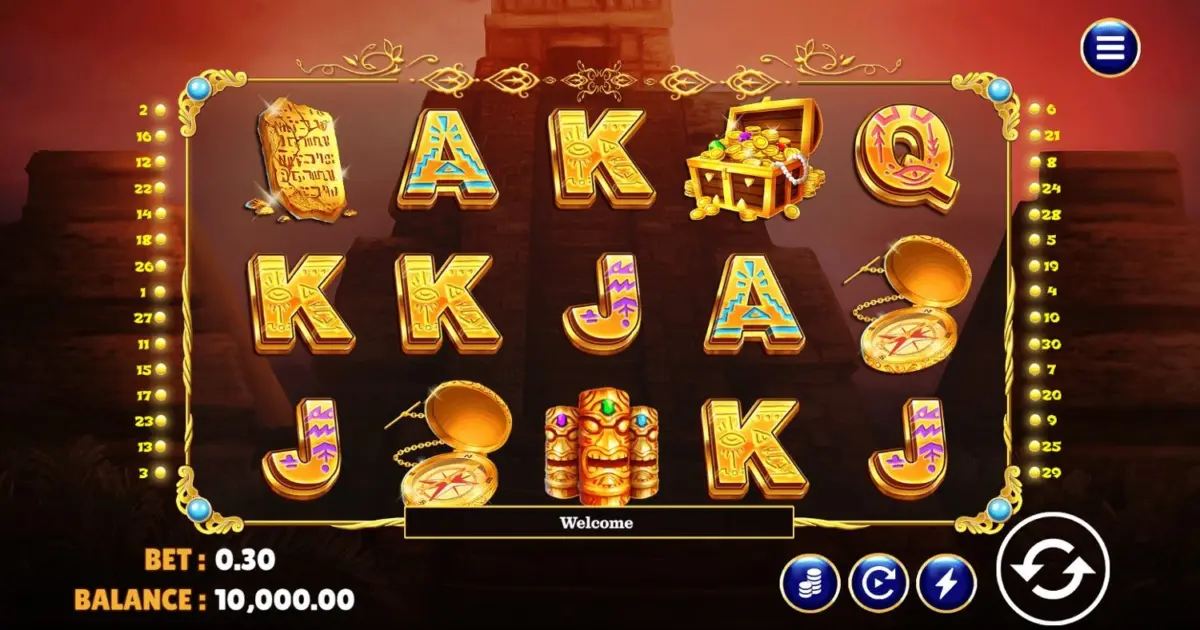
City of Gold is a 5-reel Aztecs-themed slot from Vela Gaming that you can try as a free demo without wagering. Because the studio has not published an RTP or volatility rating, the smartest way to judge it is to test the demo, check how the reel layout feels in practice, and compare what you see against better-documented alternatives before you risk a bankroll. The city of gold slot therefore suits curiosity-driven demo play more than data-driven session planning.
City of Gold versus the average slot
Most players start by comparing a new game to the corpus average, which across this site sits at 95.71% RTP. That average means that, over tens of millions of spins, a typical game would return £95.71 for every £100 wagered, keeping £4.29 as house edge, with individual sessions swinging wildly above or below that line because each spin is independent.
City of Gold cannot be placed on that scale yet because Vela Gaming has not published a verified RTP figure for this title. That matters more than it sounds. Without an RTP you cannot estimate long-run expected loss per £100 wagered, you cannot work out how many spins a fixed budget might theoretically support, and you cannot rank its value against the corpus average or against higher-RTP peers. Missing data is itself a signal: treat any RTP number you see for City of Gold on forums, videos or aggregator pages with caution until the provider lists it in the official paytable or help file.
Popularity is one concrete point you can use. City of Gold ranks at 2018 overall and sits in the 89.9th percentile for visibility, which puts it well above the median for discovery despite its limited data disclosure. In plain terms, many players are finding it, even though the core maths remain unpublished. There are 273 games tagged to the Aztecs theme in this database, so you are not short of documented alternatives if you want an Aztecs game where the return figure is spelled out.
Until an official RTP appears, any comparison to the 95.71% average has to stay hypothetical. If Vela Gaming later publishes, for example, a 96.00% figure, you could say the game would return about 29p more per £100 wagered than the average over a very large sample, and about 50p less than a 96.50% title. Until then, you cannot do that maths for City of Gold specifically, and you should base decisions on the free demo feel and on games where the numbers are transparent.
RTP breakdown: RTP not published in context
Vela Gaming has not published an RTP for City of Gold, so there is no breakdown to give in the usual sense. This section explains what that absence means for your session planning and what you can still infer from how RTP works in general.
RTP is a long-run statistical average, not a promise for a single session. A 96% RTP does not mean you will get £96 back from £100 today. It means that, if you and thousands of other players spun the reels tens of millions of times at the same stake, the total returned to players would tend toward 96% of total wagered, with the remaining 4% retained as house edge. Short-term variance dominates. You could double your balance or lose it in 50 spins on either a 95% or a 97% game because each outcome is random and independent.
When a provider does publish an RTP, you can translate it into expected loss per volume. For illustration only, and not a claim about City of Gold: a 96% game has an expected loss of £4 per £100 wagered over a huge sample, or about £8 per 200 spins at £1 a spin in theoretical terms. A 95% game would have an expected loss of £5 per £100, so the difference is £1 per £100 wagered. Those small differences only become visible over thousands of spins; in a single 100-spin session the swing from volatility dwarfs the RTP gap.
Because City of Gold has no published figure, you cannot make that calculation for this title. You also cannot verify whether different casinos might offer different RTP configurations, a practice some providers use. The most useful step is to open the in-game help or paytable in the demo and look for an RTP line. If it is not there, assume no verified figure is available and weigh that against alternatives in the same theme where the figure is stated, such as those listed below.
Volatility profile
Volatility, also called variance, describes how a slot distributes returns over time. It does not change the long-run RTP, but it changes the shape of your sessions: how often wins occur, how large they tend to be when they do, and how quickly a bankroll can rise or fall.
In general terms, low-volatility slots tend to produce more frequent, smaller wins that keep your balance ticking over and extend session length on a fixed budget. High-volatility slots tend to produce longer dry spells punctuated by larger swings, which means you need a larger bankroll or a lower stake to comfortably ride out the gaps between hits. Medium volatility sits between the two, mixing steadier small returns with occasional bigger spikes. Every spin remains independent, so no pattern of wins or losses makes the next spin more or less likely to pay.
Vela Gaming has not published a volatility rating for City of Gold. That leaves you without the two key maths inputs you normally use together — RTP for long-run value and volatility for short-run risk. Without them, you cannot estimate whether a £20 budget at 20p stakes might typically last 100 spins or 400 spins, nor can you judge whether the game is likely to suit a short, low-risk session or demand a deeper bankroll for longer droughts.
The practical workaround is to use the free demo to observe behaviour, but without treating that as predictive. Use the demo to see how the 5-reel layout paces itself and whether you enjoy the rhythm, then stop. Demo play uses the same random number generator logic as real play where implemented, but it tells you nothing about what your next real-money session will do. If you prefer to plan risk precisely, choose a game where the provider states low, medium or high volatility explicitly.
Vela Gaming as a studio
Vela Gaming is credited as the provider of City of Gold and is listed with 19 games in this database. That makes it a small-to-mid sized catalogue compared with large studios that run into hundreds of titles, but size alone does not indicate quality; many focused studios maintain a tight, consistent approach across a smaller range.
A provider average RTP is often used to gauge whether a studio tends to price toward the higher or lower end of the market. For Vela Gaming, no provider-level average RTP is available in FACTS, so you cannot make that comparison here. Again, missing data is the point: without aggregated return figures you must judge each title on its own published numbers, and in this case City of Gold itself has no published RTP to judge.
What you can do is compare within the studio on theme and format, even where maths are missing. If you want to stay with Vela Gaming, the catalogue includes titles such as Princess of Angkor Wat and Fortune Dragon, both from the same provider and therefore useful for getting a sense of how the studio structures its 5-reel games, even though neither has a published RTP in this data set either. A third option from the same stable is The Witch Must Be Crazy, which gives you another point of reference inside the Vela Gaming range.
The lack of published return figures across these related Vela Gaming titles suggests you should rely on direct demo inspection and on transparent alternatives from other providers when value comparison matters to you. Studio familiarity is useful for interface and pacing expectations, but it cannot substitute for a stated RTP when you are calculating expected cost per session.
Three Aztecs alternatives worth comparing
Aztecs is a crowded theme with 273 titles in the corpus, so you have plenty of documented options to weigh against City of Gold, especially where RTP is stated.
One of the better-documented peers is Gems Bonanza, which carries a published RTP of 96.51%. That is 0.80 percentage points above the corpus average of 95.71%, which in theoretical terms equates to about 80p more returned per £100 wagered over a very large sample. It is not a prediction for your next session, but it does let you put a number on long-run value in a way City of Gold currently does not.
Another direct thematic alternative is Hypercharged Inca Jungle at 96.00% RTP. That sits 0.29 points above the corpus average, or about 29p per £100 wagered in the long run, and it keeps the jungle-temple setting if that is what draws you to Aztecs-style games. Because the RTP is published, you can at least frame session cost before you play.
A third option is Kukulkan’s Queen at 96.06% RTP, 0.35 points above the corpus average, again with a clear published figure. All three alternatives make it possible to compare value on paper, whereas City of Gold requires you to play the demo and decide on feel alone until Vela Gaming publishes its maths. If knowing the return matters to your bankroll plan, start with one of these documented games and return to City of Gold once its figures are disclosed.
Getting the most out of the free demo
City of Gold is listed as free demo available with no download required in this data set, which makes risk-free inspection straightforward. The demo is the best tool you have while RTP and volatility remain unpublished, because it lets you see reel behaviour, paytable layout and overall pacing without spending.
Use the demo with a plan. Set a spin count in advance, for example 100 to 200 spins, and a fixed demo stake that mirrors what you would use for real play, such as 20p or 40p. Track how often the 5-reel grid produces any return and how your demo balance moves, not to predict real results but to decide whether you enjoy the rhythm enough to consider real-money play later. Remember that each spin is independent and that demo outcomes do not make real-money wins more likely.
Check the in-game information screens while you are in the demo. Look for a line stating RTP, volatility and maximum exposure, and note whether any of those fields are marked as variable or casino-configurable. If they are absent, you have confirmed the gap noted in this review.
Keep demo play as entertainment, not preparation for profit. Set a time limit as well as a spin limit, take breaks, and remember that free play cannot tell you how a future paid session will go. You must be 18+ to gamble in the UK. Set a budget you can afford to lose, treat slots as paid entertainment rather than a way to make money, and use deposit limits or time-outs if play stops feeling controlled. If you need support, contact GambleAware or the National Gambling Helpline.
Should you play City of Gold slot?
City of Gold makes sense if you want a 5-reel Aztecs-themed demo to explore and you are comfortable playing without published maths. The free demo is available, the theme is well represented elsewhere if you want to pivot, and the game’s visibility suggests many players are at least sampling it.
It is harder to recommend on value grounds right now. Without a published RTP you cannot calculate expected loss per £100 wagered, you cannot compare it to the 95.71% corpus average, and without a volatility label you cannot plan bankroll or session length. Vela Gaming has not published a max win figure for this title either, so treat any number you see quoted elsewhere with caution.
If you need transparency before committing funds, choose a documented Aztecs alternative where the maths are stated, then revisit City of Gold if the provider later discloses its figures. If you are happy to play for theme and reel feel and to judge purely on the demo, give the no-download demo a measured try and decide from there.
| Feature | Detail |
|---|---|
| Provider | Vela Gaming (19 games in database) |
| Reels | 5 |
| Themes | Aztecs, 5-Reels |
| Type | Slot Machine |
| RTP | Not published |
| Volatility | Not published |
| Free demo | Available (no download) |
| Popularity | Rank 2018 / 89.9th percentile |
| Aztecs theme count | 273 games |
| Corpus average RTP | 95.71% |
Frequently Asked Questions
Can I play City of Gold for free before wagering?
Yes, City of Gold is listed as free demo available with no download required. The demo lets you see the 5-reel Aztecs layout and check the paytable without risk. Use a set spin count that mirrors real stakes, and remember demo outcomes do not predict real-money results because each spin is independent.
What is the RTP of City of Gold and what does it mean?
Vela Gaming has not published a verified RTP for City of Gold, so no figure can be stated here. RTP is the long-run average returned to players over millions of spins; for example 96% would mean £96 returned per £100 wagered in theory. Without a published number you cannot calculate expected loss or compare to the 95.71% corpus average.
What volatility is City of Gold and how will that affect my session?
No volatility rating has been published for City of Gold. In general, low volatility tends to give frequent small wins and longer sessions on a fixed budget, while high volatility brings longer dry spells with larger swings and needs a bigger bankroll. Without a stated level for this 5-reel game you should use the demo for feel only.
Who makes City of Gold and what else do they offer?
City of Gold is made by Vela Gaming, a studio with 19 games in this database. No provider-average RTP is listed, so studio-wide value cannot be averaged. Related titles from the same provider include Princess of Angkor Wat, Fortune Dragon and The Witch Must Be Crazy, though none have published RTPs in the current data set.
How does City of Gold compare to other Aztecs slots?
City of Gold has no published RTP, while several Aztecs alternatives do. Gems Bonanza is published at 96.51%, Kukulkan’s Queen at 96.06% and Hypercharged Inca Jungle at 96.00%, all above the 95.71% corpus average. Those figures let you estimate long-run value, while City of Gold must be judged on its free demo until its maths are disclosed.