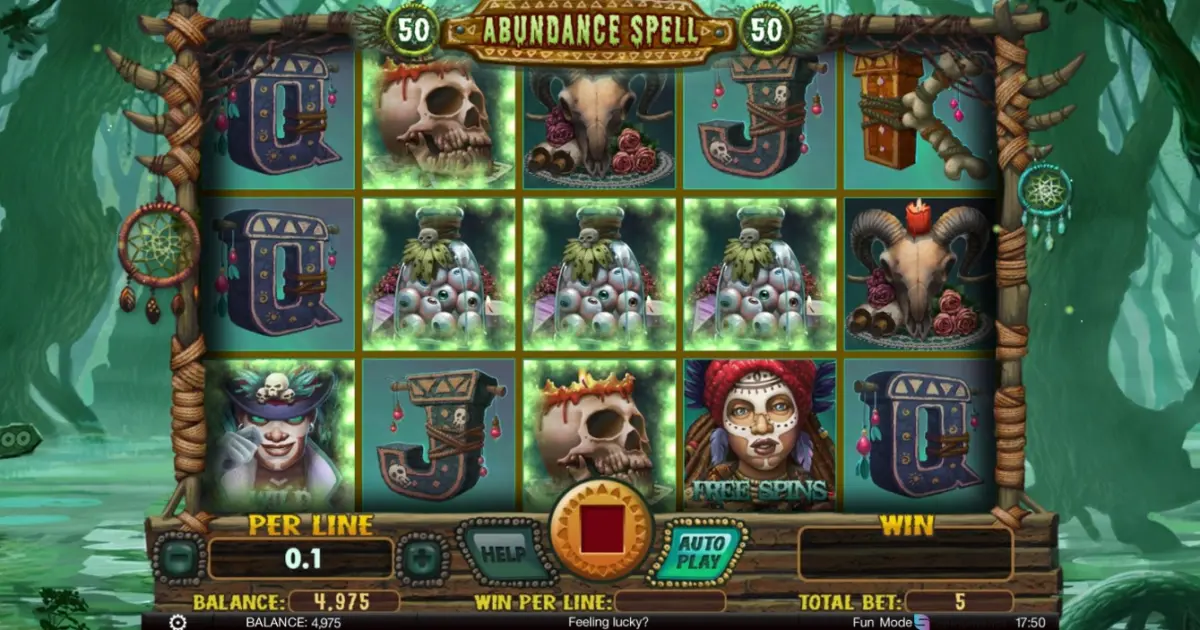
The number that should decide this one for you is 95.1%. That is the theoretical return on the abudance spell slot, and it lands 0.61 percentage points below the average of the games catalogued on this site. Spinomenal has put it on five reels with a horror theme, and the free demo is available if you want to see the reels move before committing money. Everything else about the game — payline count, features, symbol behaviour — is not published in the data available here, which is worth knowing up front.
First look at Abudance Spell
Here is the full picture of what is confirmed about this title:
| Detail | Value |
|---|---|
| Provider | Spinomenal |
| RTP | 95.1% |
| Reels | 5 |
| Primary theme | Horror and scary |
| Type | Slot machine |
| Popularity rank | 2005 (90th percentile) |
| Free demo | Available |
A rank of 2005 puts it in the 90th percentile for popularity, so a reasonable number of people are playing it — but that reflects traffic, not quality, and certainly not the odds you face. Spinomenal has 548 titles logged here, and the average return across all of them is 95.11%. This game sits at 95.1%, which is to say it is exactly a typical Spinomenal release by return. If you have played their catalogue before, you already know roughly what the maths looks like.
The theme label is “Horror and scary”. That tells you the art direction leans dark, and nothing more. There is no published detail here about which characters, sounds or set pieces appear, so treat any specific description you read elsewhere as unverified.
How a round plays out
Five reels is the standard modern layout, and it is the frame every other mechanic sits inside. What is not available in the data is the payline or “ways” count, which is the figure that actually determines how many combinations each spin evaluates. A 5-reel game might run 10 fixed lines, 25 lines, or a 243-ways structure, and those behave very differently: fewer lines means fewer but larger hits at the same stake, more lines means more frequent small returns. Without that number, you cannot predict the texture of a session in advance. The demo is the practical answer — a few hundred spins will show you the rhythm faster than any spec sheet.
Feature information is also absent. Many slots in this category use wilds that substitute for regular symbols, scatters that trigger a free-spin round, and multipliers applied inside that round. Some newer releases add a buy-feature button that skips straight to the bonus for a fixed multiple of your stake. None of that is confirmed for this game, so do not assume any of it is present. What is universal: each spin is resolved independently by a random number generator. The reels have no memory of the previous outcome, and nothing you saw ten spins ago changes what happens next.
Reading the 95.1% return figure
RTP is a long-run average, not a session forecast. At 95.1%, the game is built to return £95.10 for every £100 wagered across a sample far larger than any individual will ever play — millions of spins, not thousands. The remaining 4.9% is the house edge, and it is the only part of the figure that is certain.
Scale it to something usable. On 1,000 spins at £0.50, you wager £500 and the expected return is £475.50, an expected loss of £24.50. That is the centre of a very wide distribution. Real outcomes over 1,000 spins scatter heavily on either side, and short sessions can finish well up or well down purely through variance. The average only asserts itself over volumes no player reaches.
The comparison worth holding onto: the corpus average across games listed here is 95.71%, so this title gives back 0.61 points less. On £500 wagered that is roughly £3 in extra expected cost. Small per session, and it compounds if this becomes a regular game for you. If return is your primary filter, Hand of Anubis runs 96.24% within the same horror-and-scary category — over a point better, on the same £500 that is around £5.70 less expected loss.
Why unpublished volatility changes your bankroll maths
No volatility rating is published for this game, and that gap is genuinely inconvenient, because volatility affects your session more directly than RTP does. Two games can both return 95.1% and feel nothing alike.
Low volatility means frequent small wins, a balance that drifts down slowly, and long sessions on a modest bankroll. High volatility means long dry stretches punctuated by rare larger hits — the same average return, delivered in lumps. A high-volatility game can take 200 spins off you without a meaningful return and still be behaving exactly as designed. That is not the game being cold or tight; those descriptions do not correspond to anything real in how slot software works.
Since you cannot look the figure up, the sensible move is to assume higher variance and size accordingly. A common rule of thumb is a bankroll of 200 to 300 times your spin stake, which gives enough spins for the swings to play out without the session ending in five minutes. Or run the demo and watch the pattern of hits yourself.
Bet sizing from an unlisted minimum upwards
The stake range for this title is not published in the data here, so you will see the actual minimum and maximum on the bet panel when the game loads. Do not guess from other Spinomenal releases — limits vary title by title and by operator.
The arithmetic to run once you see the number is simple. Decide your session budget first, then divide by the spins you want. £40 for 400 spins means £0.10 per spin. £40 at £1 per spin is 40 spins, which at any meaningful volatility is barely a sample. Stake size does not change the 95.1% return — it only changes how fast that edge is applied and how long you get to play. Doubling your stake doubles your expected loss per hour.
One thing worth stating plainly: no staking pattern alters expected value. Increasing bets after losses, decreasing after wins, waiting for a “due” moment — none of it works, because each spin is independent of every spin before it. Pick a flat stake you are comfortable losing and leave it there.
Where Abudance Spell sits among horror and scary slots
There are 479 games in the horror-and-scary category here, so this is a crowded shelf and you have real alternatives. On published return, this one is mid-pack at best.
Hand of Anubis is the standout on numbers, at 96.24% against 95.1% here — 1.14 points is a meaningful gap if you play regularly. Going the other way, Trickstar Spins sits at 94.0%, a point worse, which makes 95.1% look reasonable by comparison. Halloween Crystals shares the theme but has no published RTP at all, so there is nothing to compare against.
Within Spinomenal’s own 548-game catalogue, 1 Reel – Demi Gods 7 returns 95.42% on a single-reel format — a stripped-back structure if the five-reel layout does not appeal. Two other Spinomenal titles listed here, Hades’ Infernal Blaze and Story of The Little Mermaid, have no RTP published, which makes them harder to assess on the one metric that is objective.
The honest verdict
This is an average Spinomenal slot by the only hard number available. 95.1% is bang on their catalogue average of 95.11% and 0.61 points under the wider average here. It is not a bad return — plenty of games sit lower, including one in its own theme — but nothing about the published data makes a case for choosing it over Hand of Anubis at 96.24% if return is what you care about.
The larger issue is how much is unpublished: no volatility rating, no payline count, no stake range, no max win. That is not a criticism of the game, but it does mean you cannot make an informed decision from a spec sheet. The Abudance Spell free demo fills those gaps at no cost, and running a few hundred spins there will tell you more about hit rhythm and swing size than anything written about it.
Play only if you are 18 or over. Set a cash budget before you open the game and stop when it is gone, not when you feel you are owed a turn. Treat slots as paid entertainment with a known cost — at 95.1%, that cost averages £4.90 per £100 wagered — and never as a way to make money. Demo results tell you how a game feels; they carry no information about what real-money play will return.
Frequently Asked Questions
Can you play Abudance Spell for free?
Free demo play is available for this title, which means you can spin with virtual credits and no deposit. That is the most useful way to fill the gaps in the published data — there is no volatility rating or payline count listed, so watching a few hundred demo spins tells you more about the game's rhythm than the spec sheet does.
What is the RTP of Abudance Spell and is it good?
The RTP is 95.1%, meaning £95.10 returned per £100 wagered across a very large sample. That is average for Spinomenal, whose 548 games here average 95.11%, but 0.61 points below the site-wide average of 95.71%. On £500 wagered, the gap costs roughly £3 in extra expected loss.
How volatile is Abudance Spell?
No volatility rating is published for this game, so you cannot look it up before playing. The safest approach is to assume higher variance and budget 200 to 300 times your spin stake, giving enough spins for swings to play out. Alternatively, run the free demo and observe how often wins land yourself.
Who makes Abudance Spell and what else do Spinomenal slots include?
Spinomenal developed it, and 548 of their titles are catalogued here with an average RTP of 95.11%. Others include 1 Reel - Demi Gods 7 at 95.42% on a single-reel layout, plus Hades' Infernal Blaze and Story of The Little Mermaid, neither of which has a published RTP figure available.
How does Abudance Spell compare to Hand of Anubis?
Hand of Anubis returns 96.24% against 95.1% here, a 1.14 point advantage in the same horror-and-scary category. Over £500 wagered that difference is around £5.70 in expected cost. Both are five-reel horror slots, but on the one objective metric available, Hand of Anubis is the stronger pick.