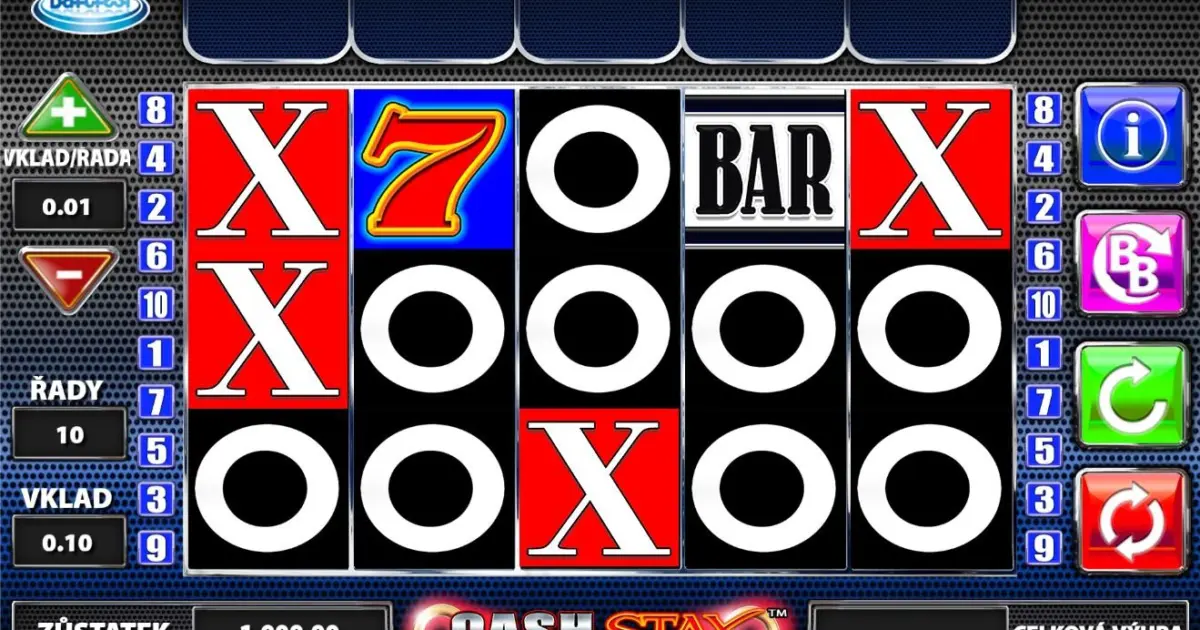
Here is the short version: the cash stax slot arrives with almost none of the numbers a comparison shopper needs. Barcrest has not published an RTP figure, a volatility rating, a reel or payline count, or a stake range for this title. What FACTS does confirm is that it is a Barcrest slot machine, it sits in the 90.1st popularity percentile of the games covered here, and a free demo exists.
That combination is worth taking seriously rather than dismissing. Missing data does not mean a game is bad; it means you cannot compare it on paper, and you have to substitute your own observation for the spec sheet. This review works through what is actually known, what each absent figure would have told you, and how to use the demo to fill the gaps yourself.
Cash Stax at a glance
The confirmed facts are few, so here they are in one place.
| Field | Value |
|---|---|
| Game | Cash Stax |
| Provider | Barcrest |
| Type | Slot Machine |
| RTP | Not published |
| Volatility | Not published |
| Reels and paylines | Not published |
| Stake range | Not published |
| Free demo | Available |
| Popularity rank | 1,980 (90.1st percentile) |
| Barcrest titles covered | 37 |
| Barcrest average RTP | 97.21% |
| Site-wide average RTP | 95.71% |
Who does this suit? Players who are comfortable judging a game by playing it rather than by reading its specification. If you build a shortlist from RTP tables and volatility labels, this title cannot be shortlisted — there is nothing to sort it by. Barcrest’s other games in the catalogue do carry published figures, and three of them are linked further down if you want a like-for-like comparison instead.
What an unpublished RTP actually returns
RTP, return to player, is the share of total wagered money a game returns across an extremely large sample of spins. It is a long-run average, not a session forecast. A published 96% RTP means £96 returned per £100 staked over millions of spins across all players combined — and it tells you almost nothing about your next hundred spins, where variance dominates entirely.
Because no RTP is published for this game, that calculation cannot be run for it. It can be run for the reference points. The site-wide average across all games covered here is 95.71%. At that rate, 1,000 spins at £0.20 stakes £200 and returns roughly £191 on average, an expected cost of about £9. Barcrest’s own published average across its 37 titles is 97.21%, which on the same £200 turnover implies a return closer to £194.40, or about £5.60 in expected cost. That 1.5-point gap between provider average and site average is real money over volume.
What it does not tell you is where this specific game falls. A provider average is an average, and individual titles sit above and below it. Treat 97.21% as context for Barcrest as a studio, not as a stand-in figure for Cash Stax. If you see an RTP quoted for this game elsewhere without a source, treat it as unverified.
Unpublished volatility and what your session will feel like
Volatility describes how a game distributes its returns over time. Low volatility means smaller, more frequent payouts and a bankroll that drains slowly and steadily. High volatility means long stretches with nothing followed by occasional larger payouts. Both can share an identical RTP — the maths of the long run is the same, the shape of the short run is completely different.
That shape is what determines how many spins a given budget survives. On a low-volatility game, £50 at £0.20 a spin will usually deliver something close to the 250 spins the arithmetic suggests, because small returns keep topping the balance up. On a high-volatility game, the same £50 can be gone in 80 spins or can last well past 400. Same expected value, very different sessions.
No volatility rating has been published here, so you cannot plan for either scenario in advance. The practical workaround is to watch the demo. Play a few hundred spins and note how often anything at all lands, and how big the biggest return is relative to your stake. Frequent small returns point one way; long dry runs point the other. Remember that every spin is independent — a dry run does not make the next spin more likely to pay, and a run of returns does not mean the game has warmed up.
The unpublished reel layout and how wins are counted
Reel and payline counts are not published for this title either, which is a genuine gap because layout drives cost per spin. Many slots use five reels with a fixed set of paylines, where the displayed stake covers every line. Others use “ways” or “all ways” systems that count any matching combination across adjacent reels, which usually produces more frequent, smaller returns. Cluster mechanics ignore lines entirely and pay on groups of touching symbols.
The distinction matters for two reasons. First, on some line-based games the total stake scales with the number of lines you activate, so the number on the button is not always the number leaving your balance. Second, the counting method partly explains how often you see a return, which feeds straight back into how a session feels.
None of that can be confirmed here, so check it on screen. Open the demo, read the paytable, and confirm the total bet per spin before you switch to real money. That is two minutes of work that removes the largest single source of unpleasant surprises in slot play.
Stake range and sizing a bankroll
No minimum or maximum stake is published for Cash Stax. Since bankroll planning starts from the minimum stake, that figure is the first thing to read off the demo screen.
The method itself is straightforward once you have the number. Decide the total you are willing to spend and treat it as the price of the entertainment, not as capital. Divide it by the number of spins you want the session to last, and that quotient is your maximum sensible stake. A £40 budget aimed at 400 spins means £0.10 a spin. If the game’s minimum is higher than the figure you arrive at, the honest conclusion is that this game is priced above your session, and a different title is the better fit.
No stake size, sequence or timing pattern changes the expected value of a slot. Raising stakes after a loss does not recover anything; it only increases the amount at risk per spin. Stake sizing controls how long your budget lasts, and nothing else.
Playing the Cash Stax demo before you commit
A free demo is available, and given how little has been published about this game it is the most useful thing on the page. The demo lets you confirm the minimum stake, read the paytable, see the reel layout, and get a feel for how frequently returns arrive — all the things the spec sheet does not tell you. There is no download required to try it.
One limitation to be clear about: demo play uses play-money credits and cannot predict real-money outcomes. A good demo run is variance, not a signal. The value of the demo is informational — layout, stake, pacing — not predictive.
Slots are 18+ entertainment with a built-in mathematical edge to the operator. Set a budget you would be content to spend on any other evening out, treat it as the price of the entertainment rather than an investment, and stop when it is gone. If tracking the spend stops being comfortable, that is the signal to close the game.
Verdict: who should play Cash Stax
This one is for players who are happy to evaluate a game hands-on. The 90.1st popularity percentile says a reasonable number of people are playing it, but popularity is not a quality measure and it certainly is not a substitute for an RTP figure. With no RTP, volatility, layout or stake range published, there is no paper case to make either for or against it.
If you would rather compare published numbers, Barcrest’s catalogue gives you that option. KingsTimer carries a stated 96.01% RTP, the highest of the three Barcrest titles here and above the 95.71% site average. Rainbow Riches Free Spins sits at 95.17%, and the original Rainbow Riches at 95.00%, both below that average. Note that all three fall short of Barcrest’s 97.21% studio average, which is another reminder that provider averages should never be read onto individual games.
The sensible route: run the Cash Stax demo, read the paytable, confirm the minimum stake, and decide from what you see rather than from what has been published — because on this title, almost nothing has been.
Frequently Asked Questions
Can you play Cash Stax for free?
A free demo of Cash Stax is available, and it is particularly worth using here. Barcrest has not published an RTP, volatility rating, reel layout or stake range for this title, so the demo is the only reliable way to confirm the minimum bet, read the paytable and see how the game actually plays.
What is the RTP of Cash Stax?
No RTP figure has been published for Cash Stax, so any number quoted elsewhere without a source should be treated as unverified. For context, Barcrest's 37 titles covered here average 97.21% and the site-wide average across all games is 95.71%. Provider averages are context only, not a substitute for a game-specific figure.
Is Cash Stax high or low volatility?
No volatility rating has been published for Cash Stax. Low volatility generally means smaller, more frequent returns and a slower bankroll drain; high volatility means longer dry stretches with occasional larger payouts. Watching a few hundred demo spins and noting how often anything lands is the practical way to gauge which pattern applies.
Who makes Cash Stax and what else do they make?
Barcrest developed Cash Stax, and 37 Barcrest slots are covered on this site with an average published RTP of 97.21%. Their better-known titles include Rainbow Riches at 95.00% RTP, Rainbow Riches Free Spins at 95.17%, and KingsTimer at 96.01% — the highest published figure of that trio.
How does Cash Stax compare to KingsTimer?
KingsTimer is the more comparable option on paper, because it publishes a 96.01% RTP while Cash Stax publishes none. That 96.01% also sits above the 95.71% site-wide average. Cash Stax cannot be ranked against it on any published metric, which is precisely why the demo matters before real money is involved.