If you want the short version: this is a five-reel Wishbone release with a published RTP of 96.2%, and it is available to play in free demo mode. That RTP sits 0.49 percentage points above the 95.71% average across the games catalogued on this site, which puts it on the better side of the middle without making it an outlier. Whether it suits you depends less on the return figure and more on details Wishbone has not published, which is worth knowing before you spend time on it.
9 Wiggly Worms at a glance
The confirmed numbers for the 9 wiggly worms slot are narrow but useful. Five reels, a 96.2% return, one of 23 titles from Wishbone, and a popularity rank of 1866 which places it in the 90.6th percentile of games tracked here. That ranking is a measure of how much attention the game gets, not a measure of quality or of how it pays.
| Figure | Value |
|---|---|
| Provider | Wishbone |
| RTP | 96.2% |
| Reels | 5 |
| Type | Slot Machine |
| Primary theme | Relax |
| Popularity rank | 1866 (90.6th percentile) |
| Provider average RTP | 96.22% across 23 games |
| Site average RTP | 95.71% |
| Free demo | Available |
Several things you might expect to see here are absent. Wishbone has not published a volatility rating, a paylines or ways count, a hit frequency, a maximum win multiplier, or a stake range for this title. None of those gaps is unusual for a smaller studio, but each one removes a piece of information you would normally use to plan a session. Treat any max win figure or volatility label you see quoted elsewhere for this game with real caution, because it did not come from the provider.
What a 96.2% RTP actually returns
Return to player is a long-run average, calculated by the developer across millions of simulated spins. A 96.2% RTP means the game is modelled to return £96.20 for every £100 wagered over that very large sample. The remaining £3.80 is the house edge.
Work it through at a stake of £0.20 per spin. A thousand spins puts £200 through the game. At 96.2%, the modelled return on that £200 is £192.40, an expected cost of £7.60 for a session that might run 45 minutes to an hour. That is the number to compare against other paid entertainment, because it is the closest thing to a price tag a slot has.
The important caveat: 1,000 spins is nowhere near a large enough sample for the average to assert itself. Real thousand-spin sessions land all over the place, from losing the full £200 to finishing well ahead. The RTP describes the shape of the distribution, not your afternoon. Every spin is an independent event, and nothing about previous spins changes the odds of the next one.
Against the 95.71% site average, 96.2% returns roughly an extra £0.49 per £100 staked. Wishbone’s own 23-game catalogue averages 96.22%, so this title is exactly typical of the studio rather than a standout. Their Kingfisher of the Sands edges slightly ahead at 96.24% if you want the highest published figure in the range.
Unstated volatility and what your session will feel like
Wishbone has not published a volatility rating, so anyone telling you how this game behaves is guessing. That absence matters, because volatility affects your session far more directly than RTP does.
Two games can share an identical 96.2% return and feel nothing alike. A low-volatility build pays small amounts often, so your balance drifts down gently with frequent small recoveries and a modest bankroll lasts a long time. A high-volatility build pays rarely but larger, which means long dry stretches punctuated by occasional spikes, and it needs a bankroll several times deeper to survive the gaps without ending the session early.
With no rating available, the practical response is to fund the session as if the game were volatile and let the demo tell you otherwise. Play a few hundred demo spins at a fixed stake and watch how often anything lands and how large the biggest returns are relative to your stake. That gives you a rough read on the swing size, which is more than a marketing label would.
If you want a published rating to work from instead, comparison titles with fuller documentation are the safer starting point.
The 5-reel layout and how wins are counted
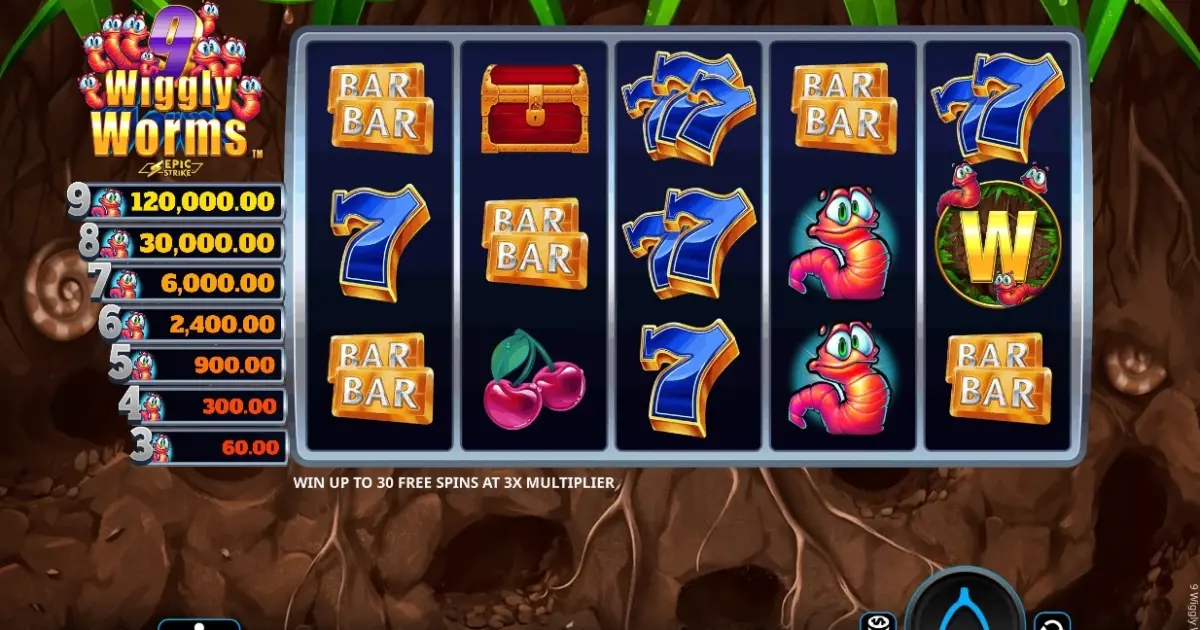
Five reels is the standard format and has been since video slots replaced mechanical ones. Symbols land in a grid, and the game evaluates the result against its own win rules.
Those rules come in two broad families. Payline games check a fixed set of defined paths across the reels, and a combination only pays if it sits on one of them. Ways or cluster games ignore paths and pay on symbol counts per reel or on adjacent groups, which is why you see figures like 243 or 1,024 ways quoted. The distinction changes how you read a near miss: on a payline game a symbol one row off the line is worth nothing, while on a ways game its row position may be irrelevant.
Wishbone has not published which system this title uses, nor a payline or ways count. The demo answers it in under a minute. Watch a few paying spins and see whether the wins trace defined lines or simply count symbols wherever they land, and check the in-game information panel, which will list the paytable and the win rules even when the marketing material does not.
Stake range and sizing a bankroll
No minimum or maximum stake has been published for this game, so confirm the range in the demo or the paytable before you plan anything around it.
Once you know the minimum, the arithmetic is straightforward. Decide the budget first, then divide it by the number of spins you want, and that quotient is your stake. A £40 budget over 400 spins means £0.10 per spin. Reverse the order and you end up choosing a stake that suits your patience rather than your wallet, which is how short sessions happen.
Because volatility is unpublished here, build in more headroom than you would for a documented game. A 300 to 500 spin buffer at your chosen stake is a reasonable default. No stake pattern, progression or timing changes the maths: raising your bet after losses or wins alters the size of the swings and nothing else, and the house edge stays at 3.8% of everything you wager regardless of how you arrange it.
Playing the 9 Wiggly Worms demo before you commit
Free play is available for this title, and it is genuinely the most useful step given how much is unpublished. The 9 Wiggly Worms free demo runs in the browser on virtual credits with no download and no account, which means you can establish the stake range, the win rules and the rough feel of the swings at no cost.
What demo play cannot do is predict what happens with real money. The demo runs the same certified maths, but the results you see are one small sample from a wide distribution, and a good or bad run in play credits carries no information about the next session. Use it to answer structural questions, not to form expectations.
Slots are entertainment you pay for, priced here at roughly 3.8% of everything you stake. Play only if you are 18 or over, set a budget you are comfortable losing before you start, and stop when it is gone rather than reaching for more. If the amount stops feeling like the cost of an evening out, that is the signal to walk away.
Verdict: who should play 9 Wiggly Worms
The return figure is solid and the documentation is thin, and how you weigh those two facts decides it. At 96.2% this game costs you less per £100 wagered than the typical title catalogued here, and it matches Wishbone’s own 96.22% studio average almost exactly. That is a fair deal on paper.
The problem is everything you cannot look up. No volatility rating, no win-rule count, no stake range, no max win. If you are the kind of player who wants to know the risk profile before funding a session, that absence is a real drawback, and the demo is the only way to close the gap.
For a higher published return in the same theme grouping, Big Bass Splash lists 96.71%, half a point above this one. Within Wishbone’s own range, Hermes Bonanza matches at 96.22% if you simply want another title from the same studio. Try this one free first, decide whether the feel suits you, and only then decide whether it deserves your budget.
Frequently Asked Questions
Can I play 9 Wiggly Worms for free?
Free demo play is available for this title, running on virtual credits in the browser with no download and no account needed. That is the practical way to check the stake range and win rules, since Wishbone has not published either. Demo results reflect the same certified maths but tell you nothing about future real-money sessions.
What is the RTP of 9 Wiggly Worms?
The published RTP is 96.2%, meaning the game is modelled to return £96.20 per £100 wagered across a very large sample. That leaves a house edge of 3.8%. It sits 0.49 points above the 95.71% average across games catalogued here, and matches Wishbone's own 96.22% studio average almost exactly.
Is 9 Wiggly Worms high or low volatility?
Wishbone has not published a volatility rating for this game, so any figure you see quoted elsewhere did not come from the provider. Since volatility drives swing size and how long a bankroll lasts, fund your session as though the game were volatile, then use a few hundred demo spins to gauge how often and how large wins land.
Who is Wishbone and what else do they make?
Wishbone is the studio behind this release and has 23 games catalogued here, averaging 96.22% RTP as a group. Kingfisher of the Sands leads that range at 96.24%, with Hermes Bonanza at 96.22% and Blazing Lake Link and Win at 96.21%. The spread is tight, so their titles are broadly consistent on return.
How does 9 Wiggly Worms compare to Big Bass Splash?
Big Bass Splash lists a higher published RTP at 96.71% against 96.2% here, a difference of about £0.51 per £100 staked. It is also a more widely documented game, which matters given that volatility, stake range and win-rule count are all unpublished for this Wishbone title. Both are five-reel slot machines.