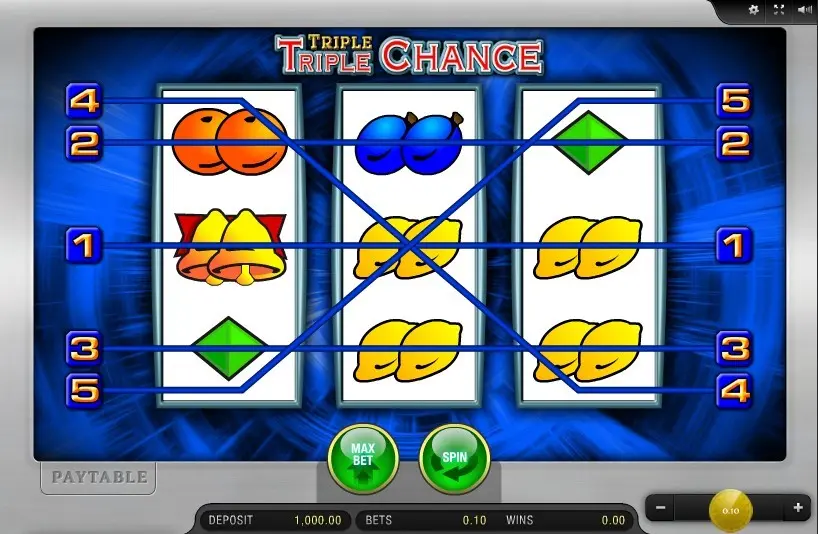
This is a three-reel fruit machine from Merkur Gaming with a published return of 96.09%. That figure sits marginally above Merkur’s own catalogue average of 96.04% and 0.38 points above the 95.71% average across the slots covered on this site. If you want a stripped-back three-reel format rather than a feature-heavy modern release, it is worth a few spins in demo mode first.
What follows is built only on the numbers Merkur has published. Where a figure has not been released, that gap is stated rather than filled in.
First look at Triple Triple Chance
The triple triple chance slot is a three-reel title categorised as a Slot Machine, carrying Fruits and 3-Reels theme tags. The fruit label is the oldest signpost in the category and it tells you what to expect structurally: a small symbol set, short reel strips, and a game built on straightforward line hits rather than layered bonus systems.
Three reels is the defining constraint. With fewer reels there are fewer possible symbol combinations, which means the paytable has less room to hide small consolation wins between the meaningful ones. Many three-reel games therefore concentrate value into a handful of outcomes.
Popularity-wise it ranks 1861 across the games tracked here, placing it in the 90.7th percentile. That is a top-tier position by traffic, though popularity is a measure of how many people look at a game, not of how it pays.
Merkur has not published a payline or ways count for this title, nor a maximum win multiplier. If you see a max-win figure quoted elsewhere, treat it sceptically unless it cites the provider’s own paytable.
| Provider | Merkur Gaming |
|---|---|
| RTP | 96.09% |
| Reels | 3 |
| Theme | Fruits |
| Free demo | Yes |
How a round plays out
The mechanics that can be stated with confidence are the ones in Merkur’s published data: three reels, one spin, symbols land, the paytable decides the outcome. There is no supplied information about wilds, scatters, respins, bonus rounds or a buy-feature price, so none of those should be assumed present.
It is worth separating general category knowledge from claims about this game. Across the slot market, many titles use a wild symbol that substitutes for others, a scatter that triggers free spins, or a purchasable feature entry. Plenty of three-reel classics use none of those and rely purely on line combinations. Which camp this one falls into is not something the published figures answer.
Two things do hold universally. First, each spin is resolved independently by the random number generator, so the previous result carries no information about the next one. Second, the RTP figure describes the game as a whole, feature included or not, over a sample far larger than any single session.
Hit frequency has not been published either. Without it, you cannot predict how often a spin returns something, and that is a genuine blind spot when planning a short session.
Reading the 96.09% return figure
A 96.09% return to player means that across an extremely large number of spins, the game is modelled to return £96.09 for every £100 staked. The remaining £3.91 is the house margin. That average is calculated over millions of spins, not over the fifty or five hundred you might play tonight.
Put concrete numbers on it. At a £1 stake, 1,000 spins puts £1,000 through the game and the long-run expectation is a return of £960.90, a £39.10 theoretical cost. Your actual result at that sample size will land somewhere well either side of it, because variance dominates short runs. At 10,000 spins the observed return typically edges closer to the modelled figure, but never lands on it exactly.
In context, 96.09% is slightly above average twice over: it beats the 96.04% mean across Merkur’s 182 games and clears the 95.71% site-wide average by 0.38 points. Within the Merkur range, Lucky Pharaoh is published at a higher 96.25% if return percentage is your deciding factor, while Centurio sits fractionally lower at 96.08%.
Small RTP gaps matter less than they appear. The difference between 96.09% and 96.25% is 16 pence per £100 wagered.
Why unpublished volatility changes your bankroll maths
Merkur has not published a volatility rating for this game, and no reliable rating can be inferred from three reels and a fruit theme alone. That absence has practical consequences, because volatility is the number that tells you how to size your session.
Here is what the concept controls. Low volatility means frequent, small returns: your balance drifts down gently and sessions last a long time on a modest bankroll. High volatility means long stretches of nothing punctuated by larger hits, which requires a bigger bankroll to survive the dry runs without being wiped out early. Medium sits between the two. Critically, volatility does not change the RTP. Two games at 96.09% with different volatility have identical long-run maths and completely different session feel.
With the rating unpublished, the sensible move is to treat the game as if it could be high volatility and size your bankroll accordingly. Assuming the safer end costs you nothing if you are wrong. Assuming the riskier end and being wrong ends the session in twenty spins.
The demo is the cheapest way to gauge swing size yourself, though results there are not predictive of anything.
Bet sizing from an unpublished minimum upwards
The stake range has not been released for this title, so the minimum and maximum bet will only become visible when the game loads. Check both before your first real-money spin, because the range determines how many spins your budget buys.
The arithmetic is simple and worth doing every time. A £50 budget at a £0.10 minimum stake buys 500 spins. The same £50 at £1 buys 50. Same game, same 96.09% return, session length differing by a factor of ten. Stake size is the single biggest lever you control over how long you play.
One thing stake size does not do is change your expected return per pound. The house margin of 3.91% applies identically at £0.10 and £10. There is no stake level, spin timing, or progression pattern that alters that figure, because every spin is an independent event drawn from the same distribution. Systems that raise stakes after losses increase how much you can lose in a bad run, and nothing else.
Set the budget first, then pick the stake that makes it last as long as you want to play.
Where Triple Triple Chance sits among Fruits slots
Fruits is one of the largest theme categories tracked here, with 2,560 titles carrying the tag, so a 96.09% return puts this game in the middle of a very crowded field rather than at the front of it.
Two comparisons make the spread clear. Hot Hot Fruit is published at 96.84%, three-quarters of a point higher, which over £1,000 wagered is a £7.50 difference in modelled return. At the other end, Trickstar Spins runs at 94.00%, more than two points below, so Triple Triple Chance is comfortably the better of that pairing on return alone. A third fruit title, Sevens High, has no published RTP at all, which is a reason to be cautious with it rather than a hidden advantage.
Return percentage is not the only axis, though. Reel count, feature depth and volatility all shape whether a game suits you, and a higher-RTP title with punishing variance can empty a small bankroll faster than a lower-RTP one. Compare the numbers, then compare the feel in demo mode.
The honest verdict
Triple Triple Chance is a competent, unfussy three-reel fruit machine with a slightly above-average return. The 96.09% RTP beats both the Merkur catalogue average and the site-wide average, and the free demo means you can assess the feel at no cost. That is the case for it.
The case against is the missing data. No published volatility rating, no stake range, no hit frequency, no max win. For a player who plans sessions around those numbers, that is a meaningful gap, and it makes bankroll planning guesswork until the game is open in front of you. Within Merkur’s range, Hide and Seek sits at a near-identical 96.07% if you want a comparison point from the same studio at the same return level.
Play only if you are 18 or over. Decide your budget before you open the game, treat the money as the cost of entertainment rather than an investment, and stop when the budget is gone rather than topping it up. Demo results tell you nothing about what real-money play will do.
Worth a demo spin. Worth checking the paytable and stake range carefully before anything else.
Frequently Asked Questions
Can I play Triple Triple Chance for free?
A free demo is available for this title, so you can spin it without staking money. The demo runs on the same RTP model at 96.09%, but demo sessions cannot pay out real money and short-run results there tell you nothing predictive about real-money play. Use it to check pace and paytable structure.
What is the RTP of Triple Triple Chance?
Merkur Gaming publishes 96.09%, meaning a modelled return of £96.09 per £100 wagered across a very large sample. That is fractionally above Merkur's 96.04% catalogue average and 0.38 points above the 95.71% average across slots on this site. Short sessions will deviate widely from that figure in either direction.
How volatile is Triple Triple Chance?
Merkur has not published a volatility rating for this game, and it cannot be reliably inferred from the three-reel format. Because volatility determines how large the swings are and how big a bankroll you need to absorb them, the safer approach is to plan as though it sits at the higher end until you have seen it run.
Who makes Triple Triple Chance?
Merkur Gaming, a studio with 182 titles tracked here at an average published RTP of 96.04%. Other Merkur games include Lucky Pharaoh at 96.25%, Centurio at 96.08% and Hide and Seek at 96.07%, so this release sits right in line with the rest of the studio's return figures rather than above them.
Is Hot Hot Fruit a better option than Triple Triple Chance?
On published return, Hot Hot Fruit is higher at 96.84% against 96.09%, a gap worth about £7.50 per £1,000 wagered in modelled terms. That does not make it the better session for everyone, since volatility and stake range also shape how long a bankroll lasts, and Triple Triple Chance has no published rating for either.