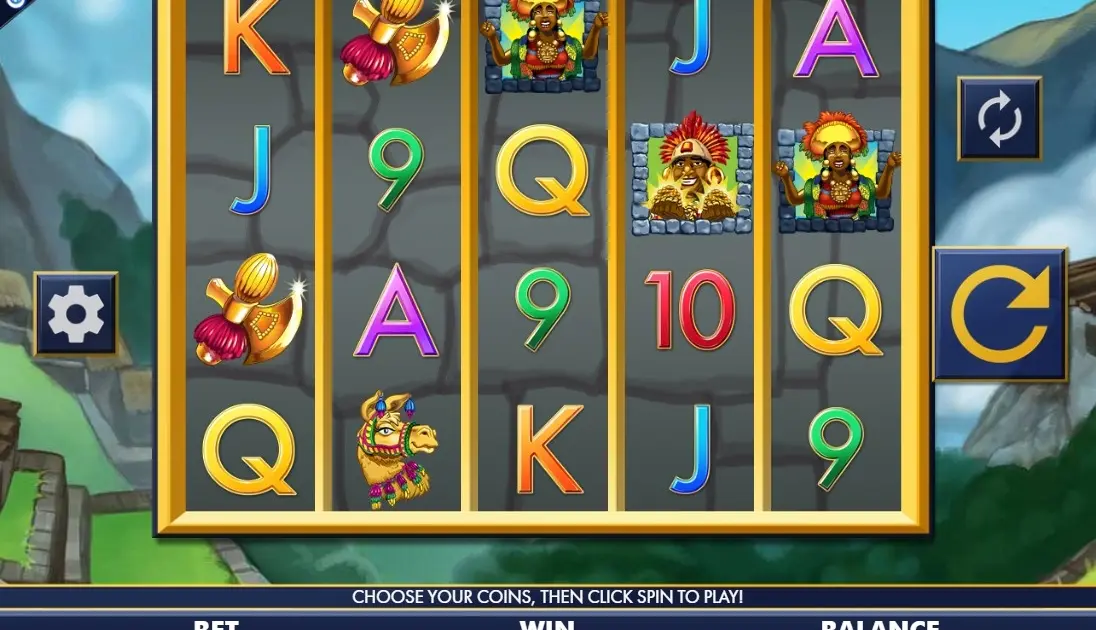
The reason to look at this game is a number: 97.01%. That is the published return-to-player figure, and it sits above both the Genesis Gaming house average of 96.88% and the 95.71% average across the slots catalogued on this site. If you sort games by RTP and nothing else, this one earns a place near the top of your shortlist.
Almost everything else about it is unpublished. Genesis Gaming has not released volatility, reel count, payline count, stake range or a maximum win multiplier for the machu picchu gold slot, so this review works with what exists and is explicit about what does not. A free demo is available, which matters more than usual when the specification sheet is this thin.
Machu Picchu Gold at a glance
Here are the figures that have actually been published. Every row below is sourced; anything absent from the table is absent because no figure exists to quote.
| Field | Value |
|---|---|
| Provider | Genesis Gaming |
| RTP | 97.01% |
| Game type | Slot Machine |
| Provider average RTP | 96.88% across 100 games |
| Site-wide average RTP | 95.71% |
| Difference vs site average | +1.3 percentage points |
| Popularity rank | 1,854 (90.7th percentile) |
| Free demo | Available |
The popularity percentile is worth a second look. Ranking 1,854th puts this title in the top tenth of games by traffic, which tells you people find it and return to it, but popularity is a measure of attention rather than of quality or payout. It carries no information about your results on any given session.
Who does the game suit? Anyone who screens on published return first and is comfortable filling in the remaining gaps by playing the demo rather than by reading a spec sheet. If you need to know free-spin counts, multiplier ceilings or a max win before you commit, this title will frustrate you.
What a 97.01% RTP actually returns
RTP is a long-run statistical average, not a session forecast. A 97.01% figure means that across a very large number of spins the game is designed to return £97.01 for every £100 wagered, keeping £2.99 as house edge. The word doing the heavy lifting is “large” — we are talking millions of spins across all players, not your evening.
Work it through. Stake £1 a spin for 1,000 spins and you have wagered £1,000. The mathematical expectation is £970.10 back, a £29.90 average loss. Real outcomes scatter widely around that: you might finish £200 up or £400 down, and both are ordinary. Stretch the same £1 stake to 10,000 spins and the spread narrows around the same 2.99% edge, because variance shrinks relative to turnover as the sample grows.
Against the 95.71% site-wide average, the 97.01% figure trims the theoretical cost of 1,000 £1 spins from about £42.90 to about £29.90 — roughly a 30% reduction in expected cost per unit staked. That is a genuine structural advantage, though it changes nothing about any individual spin. Each spin resolves independently of every spin before it.
Unpublished volatility and what your session will feel like
Genesis Gaming has not published a volatility rating for this game, so treat any variance claim you see quoted elsewhere as unsourced. What you can do is learn the vocabulary and then judge for yourself in the demo.
Low-volatility slots pay small amounts often. Balances drift down slowly, sessions run long on a given bankroll, and the largest single result is usually modest. Medium volatility spaces wins further apart and makes them larger. High volatility means long dry stretches punctuated by rare, disproportionate results — the same 97.01% RTP, delivered in a shape that demands a much larger bankroll to survive.
Two games can share an identical RTP and feel nothing alike. So run 200 or 300 demo spins and count: how often does anything land at all, and how big is the biggest thing that lands? That empirical read is more reliable than a label. What it will not do is predict your real-money session — a demo sample of a few hundred spins is far too small to reveal the underlying distribution, and every spin remains independent regardless.
The unpublished reel layout and how wins are counted
The reel and payline configuration is not documented either. In general, slot wins are counted one of three ways. Fixed paylines run a set number of defined patterns across the reels, and every line costs part of your stake whether or not it is active in a given spin. Ways or “all-ways” mechanics pay whenever matching symbols appear on adjacent reels regardless of row position. Cluster systems pay for groups of touching symbols anywhere on the grid.
Each method changes how a session reads. Twenty fixed lines produce frequent tiny returns that are often smaller than the stake — technically a win, practically a partial refund. All-ways layouts with more reels tend to concentrate value into fewer, larger events. Cluster grids sit somewhere between and often chain into cascades.
The paytable is the fastest way to settle this. Open it in the demo before spinning, and you will see the mechanic named, the symbol hierarchy and any special symbols the game uses. That single screen answers more questions than most review copy.
Stake range and sizing a bankroll
No minimum or maximum stake has been published, which makes bankroll planning a matter of arithmetic once you see the range in the game itself. The rule that works regardless of the numbers: divide your session budget by your stake to get spin count, then decide whether that spin count matches the session you want.
A £50 budget at £0.20 a spin buys 250 spins. The same £50 at £2 buys 25. On the 97.01% return, the expected cost of those 250 spins is about £1.49 in theory — but variance, not expectation, is what actually empties a balance over such a short run. That is why spin count matters more than expected loss when you are sizing a session.
A common approach is to cap any single spin at 1% or less of the session budget, which keeps a bad run survivable. No stake size or sequence changes the house edge. Raising your bet after losses does not make a correction more likely, because the game holds no memory of what came before.
Playing the Machu Picchu Gold demo before you commit
A free demo is available, and with this much of the specification missing it is the practical route to answering your own questions. Play it and you can read the paytable, identify the reel layout, count how often wins land, and see the stake range — four facts no published sheet currently gives you.
Use the demo as a specification check, not as a performance test. Demo results have no predictive value for real-money play; the sample is far too small and the outcomes are independent either way. The credits are also not real, which means the demo cannot show you how the same swing feels when the money is yours.
Slots are 18+ and priced entertainment, not a way to earn. Decide what an evening is worth to you before you open the game, stake only that, and stop when it is gone rather than reaching for a second deposit. If tracking the amount stops feeling optional, most operators offer deposit limits and self-exclusion — and using them early is easier than using them late.
Verdict: who should play Machu Picchu Gold
97.01% is the case for this game, and it is a solid one. It beats the Genesis Gaming average of 96.88% and clears the site-wide 95.71% by 1.3 points, which cuts the theoretical cost per £100 staked from £4.29 to £2.99. If return is your primary filter, it belongs on the list.
The case against is the missing paperwork. No volatility rating, no reel or payline count, no stake range, no max win. None of that changes the maths, but it does mean you are buying without a spec sheet, and some players reasonably refuse to.
Genesis Gaming has stronger numbers elsewhere in its 100-game catalogue. Tres Huevos is published at 97.1%, the highest of the three closest comparisons; Galapagos Islands sits at 97.07%; and The Boom Squad returns 97.06%. All three edge past this title, so if you are screening Genesis Gaming slots purely on RTP, compare the demos side by side before settling. The gaps are fractions of a percentage point and will not be visible in a single session, but they cost nothing to take.
Frequently Asked Questions
Can I play Machu Picchu Gold for free?
A free demo is available, so you can spin it without depositing. The demo is the fastest way to fill the gaps in the published data — it shows you the paytable, the reel layout and the stake range, none of which Genesis Gaming has documented. Demo credits carry no cash value and cannot be withdrawn.
What is the RTP of Machu Picchu Gold and is it good?
The RTP is 97.01%, meaning a theoretical return of £97.01 per £100 wagered across a very large sample. That is above the 95.71% average for slots on this site and above the 96.88% Genesis Gaming average, so it is a strong figure. It describes long-run mathematics, not any individual session.
Is Machu Picchu Gold high or low volatility?
Genesis Gaming has not published a volatility rating, so no reliable answer exists and any figure quoted elsewhere is unsourced. You can gauge it yourself by running a few hundred demo spins and noting how frequently wins land and how large the biggest one is. Volatility affects session shape, never the 97.01% return.
Who is Genesis Gaming and what else do they make?
Genesis Gaming is the studio behind this title and has 100 games listed here, averaging 96.88% RTP — above the 95.71% site-wide figure. Close comparisons include Tres Huevos at 97.1%, Galapagos Islands at 97.07% and The Boom Squad at 97.06%, all marginally higher than the 97.01% offered here.
How much bankroll do I need for Machu Picchu Gold?
No stake range has been published, so check it in the game before budgeting. The workable method is to divide your session budget by your chosen stake to get a spin count, then keep any single bet at or below 1% of that budget. No stake size alters the 2.99% house edge built into the 97.01% RTP.