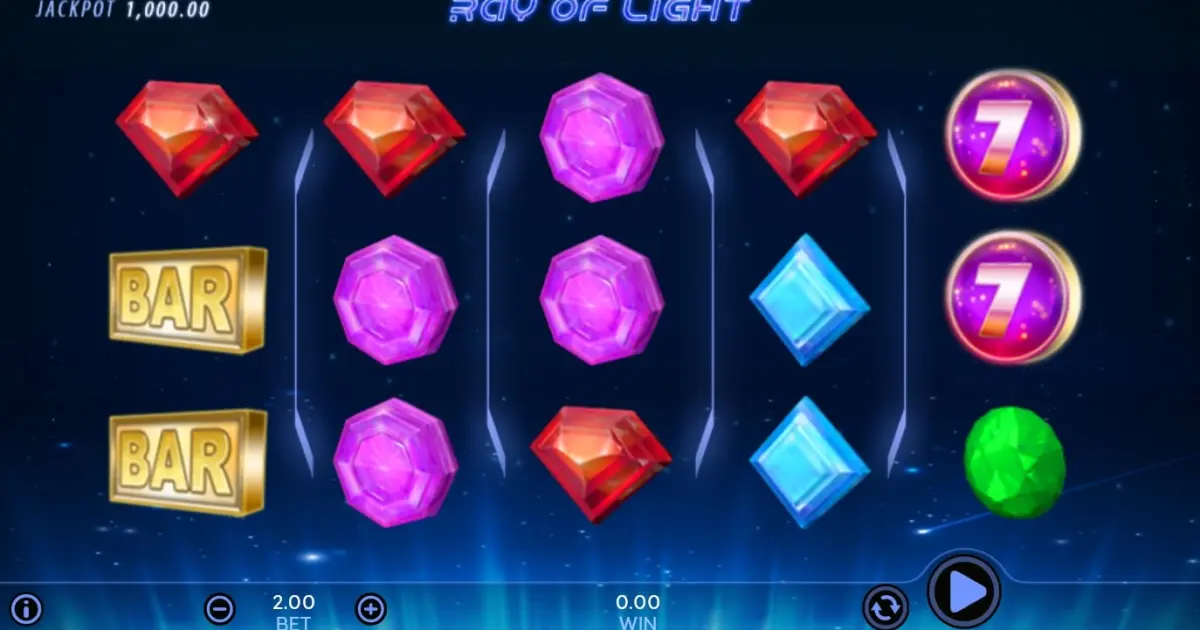
If you are comparing gems-and-diamonds slots on RTP, Ray of Light belongs on the shortlist. Its 96.32% return figure is 0.61 percentage points above the corpus average of 95.71%, meaning it gives back a small but real edge over the typical slot in this library over a very large sample. The trade-off is that 888 Gaming has not published volatility or hit-frequency data, so you are choosing a game where the math model underneath remains partly opaque. That matters less in a free demo than on a real-money balance, but it is worth knowing upfront.
First look at Ray of Light
Ray of Light is built on a standard five-reel grid and carries a gems-and-diamonds theme — a category with 484 games in the reviewed corpus, so it competes in one of the most crowded lobbies in online slots. The provider is 888 Gaming, a studio that operates just five slot titles in total, which makes this a small-portfolio release rather than a flagship product from a prolific studio.
The game ranks at position 1,801 in the overall popularity list, placing it in the 91st percentile. That is a decent showing for a studio with only five games: players who find it tend to stick around. Whether that signals genuine entertainment value or simply a loyal 888 Casino user base is impossible to separate from these numbers alone. What the numbers do confirm is that Ray of Light is not a buried deep-cut — it has a measurable audience.
A free demo is available, so you can evaluate the pacing, the reel speed, and the general feel of the game without committing any bankroll. That is the single best first step, especially when the provider has not supplied a full math-model breakdown.
| Provider | 888 Gaming |
|---|---|
| RTP | 96.32% |
| Reels | 5 |
| Theme | Gems and diamonds |
| Free demo | Yes |
How a round plays out
With five reels in play, each spin resolves a fixed number of symbol positions. The precise payline count and win-evaluation mechanic are not listed in the facts available for this game, so the specifics of how left-to-right combinations are assessed remain unclear from published data alone. Many five-reel slots use either fixed paylines or an all-ways system, but you should check the in-game help screen to confirm which model Ray of Light uses before placing any real stakes.
What you can observe in the free demo is the hit cadence — how often partial combinations land, how frequently any return occurs, and whether the balance tends to move in steady small increments or in long dry spells punctuated by larger swings. That observation will tell you more about the session character than any written description, because volatility data has not been disclosed by the provider.
Wilds, scatters, and bonus triggers are common features in this genre, but whether Ray of Light includes any of them is not confirmed in the available facts. Treat any external claims about free-spin rounds or multipliers with scepticism unless you can verify them inside the game itself.
Reading the 96.32% return figure
An RTP of 96.32% means that, across an extremely large number of spins — typically billions in lab testing — the game returns 96.32 pence for every pound wagered on average. That is a long-run statistical average, not a session guarantee. Over 500 spins at £1 a spin, you might see returns anywhere from £400 to £1,100 or more, because short-run variance dominates at those sample sizes.
Comparing Ray of Light to the wider corpus, its 96.32% RTP sits 0.61 points above the 95.71% corpus average. Against the 888 Gaming provider average of 95.52%, it runs 0.80 points higher. Both comparisons confirm that Ray of Light is a slightly better mathematical proposition than the average title in its studio and in the reviewed library, though the margin is slim enough that it will not transform a session on its own.
If RTP matters to you, Joker’s Jewels offers a 96.50% return in the same gems-and-diamonds category, and Love Gems Hold and Win pushes that to 97.10%. Both are worth a look if you want to squeeze a few more basis points out of your session, though RTP is only one variable among several.
Why volatility changes your bankroll maths
888 Gaming has not published a volatility rating for Ray of Light. That is the single most important missing data point for bankroll planning, because volatility determines whether your balance moves in gentle increments or in dramatic swings. A low-volatility slot with a 96% RTP tends to return close to that average in sessions of a few hundred spins. A high-volatility slot with the identical RTP can deviate wildly from that number in any given session.
Without a confirmed rating, the safest approach is to treat Ray of Light as unknown-volatility and size your session bankroll accordingly. A common rule of thumb is to carry at least 200 times your per-spin stake for a low-volatility game, 400 times for medium, and 800 times or more for high volatility. Since you cannot confirm which bracket applies here, budgeting toward the higher end protects you from the possibility that this is a swingy title masquerading behind a polished gemstone facade.
The free demo is the place to test this. Spin 500 rounds at your intended stake and watch the balance curve. If it drains quickly with occasional spikes, you are likely dealing with higher volatility. If it hovers around the starting point with small oscillations, the game is probably on the gentler end. Either way, you learn something without spending a penny.
Bet sizing from an undisclosed minimum upwards
The specific minimum and maximum bet for Ray of Light are not listed in the available facts. What matters for your planning is the relationship between per-spin stake and session length: halving your bet roughly doubles the number of spins your bankroll supports, which directly increases the chance that your actual session return moves closer to the long-run RTP figure. Doubling the bet has the opposite effect — bigger individual swings, shorter session, less convergence toward the published average.
If the demo lets you adjust stakes, test at two or three levels. A session at the lowest available stake gives you the longest runway and the best read on the game’s pacing. A session at a higher stake tells you whether the volatility is tolerable at a level you might actually play for real. Both tests are free, and both are more informative than any written review.
Where Ray of Light sits among gems-and-diamonds slots
The gems-and-diamonds theme is one of the most populated categories in online slots, with 484 games in the reviewed corpus. Ray of Light does not compete on visual innovation — it competes on maths. Its 96.32% RTP is above the corpus average of 95.71% and comfortably above 888 Gaming’s own provider average of 95.52%, placing it in the better half of the RTP distribution for its theme.
Against specific neighbours, the picture is mixed. Millionaire Genie and Irish Riches, both from 888 Gaming, carry a lower 95.02% RTP. Aztec Realm, also a provider sibling, sits close at 96.21%. From the broader gems category, Gemonex has not published its RTP, so no direct comparison is possible. Meanwhile, Love Gems Hold and Win at 97.10% offers a meaningfully higher theoretical return if that is your primary selection criterion.
Popularity data places Ray of Light at rank 1,801 with a 91st-percentile standing. That suggests it draws and retains players at a rate above most games in the corpus, even though 888 Gaming operates only five slot titles. For a small studio, that is a reasonable signal that the game has found its audience.
The honest verdict
Ray of Light delivers a mathematically above-average RTP for its theme and its provider, wrapped in a familiar five-reel gems-and-diamonds package. The main limitation is missing information: no volatility rating, no published hit frequency, no confirmed payline count. For a free demo session, that gap is manageable — you can observe the behaviour directly. For a real-money session, it means you should budget conservatively and size your bets as though the volatility could be higher than you expect.
If you value a published RTP you can compare across games, Ray of Light does the job. If you want a known volatility profile before you commit a bankroll, look elsewhere or rely entirely on your own demo observations. The game is not a bad choice — it is simply an incomplete picture, and honest play starts with acknowledging that.
Set a budget before you spin, treat every session as paid entertainment, and stop when the budget is gone. 18+ only. Play responsibly.
Frequently Asked Questions
Can I play the Ray of Light slot for free without downloading anything?
A free demo of Ray of Light is available and requires no download. You can open it directly in your browser, which is the standard way to test the game's pacing and mechanics before deciding whether it suits your preferences.
What is the RTP of Ray of Light and is it above average?
Ray of Light has an RTP of 96.32%, which is 0.61 percentage points above the corpus average of 95.71% and 0.80 points above the 888 Gaming provider average of 95.52%. It is a slightly better mathematical proposition than the average slot in its library.
Is Ray of Light a high-volatility or low-volatility slot?
888 Gaming has not published a volatility rating for Ray of Light. Without that data, you should size your bankroll conservatively and use the free demo to observe whether the balance swings are gentle or dramatic before committing real stakes.
Who makes Ray of Light and what other slots do they have?
Ray of Light is developed by 888 Gaming, a studio with five slot titles in the reviewed corpus. Other games from the same provider include Millionaire Genie, Irish Riches, and Aztec Realm, all with RTPs between 95.02% and 96.21%.
How does Ray of Light compare to Joker's Jewels?
Both are gems-and-diamonds slots, but Joker's Jewels carries a slightly higher RTP of 96.50% compared to Ray of Light's 96.32%. The difference is 0.18 percentage points — small in absolute terms, but meaningful if you are comparing long-run expected returns across similar titles.