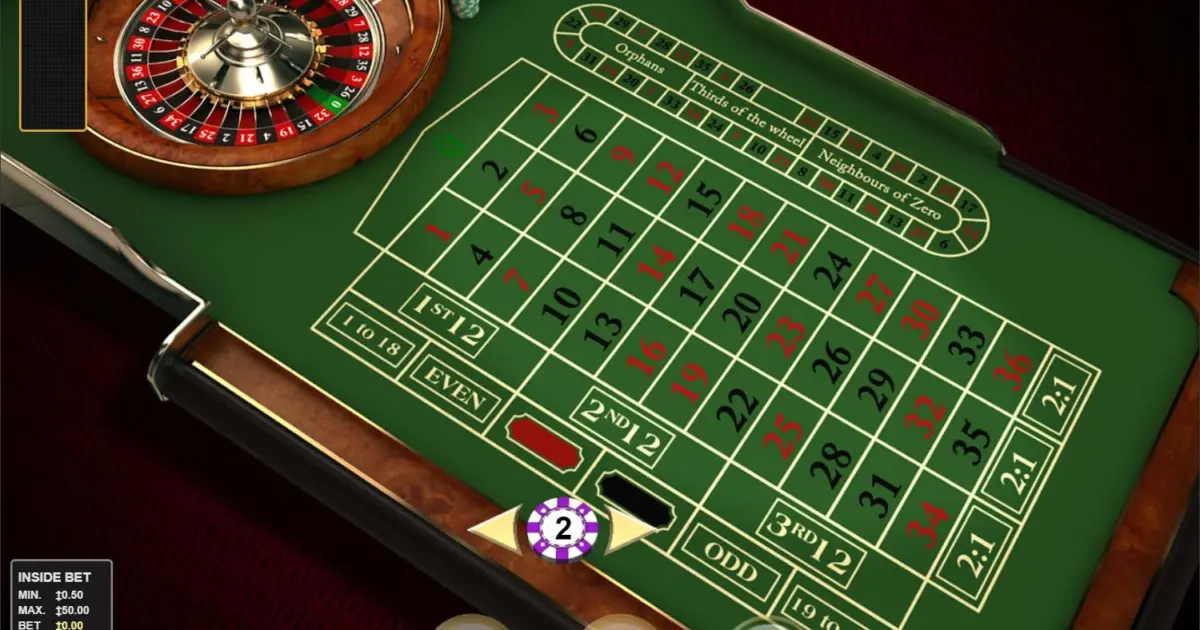
Roulette (Habanero) is the only roulette title in this provider’s catalog, and its 98.65% RTP puts it 1.68 percentage points above the corpus average. The name gives no wheel-type hint in the available data, but the return figure tells a useful story about what this table likely offers.
How Roulette (Habanero) plays
You place chips on a felt layout, the dealer spins the wheel and releases a ball, and you wait. No bonus rounds, no cascading reels, no feature triggers. The game consists of selecting positions—individual numbers, pairs, triples, corners, dozens, columns, or the even-money sections like red/black and odd/even—and matching where the ball settles.
Habanero built this as a straightforward digital roulette table with a clean interface, a history strip showing recent outcomes, and standard betting options. No multiplier overlays or side bets appear in the available data. If you want the mechanics without spectacle, this is what a classic table looks like in software form. The free demo is available, so you can examine the layout and betting controls before committing anything.
The pocket count is the whole story
The FACTS block for this game includes no variant_hints field, meaning the wheel type—single-zero, double-zero, or something else—has not been confirmed. This is a critical gap because the pocket count is the single variable that determines whether your session runs at roughly 2.70% loss per spin or roughly 5.26%.
The RTP of 98.65% is the strongest clue available. A standard European wheel without special rules produces 97.30%. A double-zero wheel produces 94.74%. Neither matches. The figure of 98.65% aligns with a single-zero wheel that applies La Partage or En Prison on even-money bets, cutting that edge to 1.35%. But alignment is not confirmation. The game’s own rules screen should state which pockets exist and whether any zero-return rule applies. Without that confirmation, you should treat the table as unverified until you read its help text or test the edge empirically in demo mode.
Compare this situation to European Roulette (Red Tiger), where the variant is explicit and the wheel type needs no inference. If certainty matters to you, a named-variant table removes this ambiguity entirely.
Reading the 98.65% RTP figure
The 98.65% RTP means the game returns €98.65 per €100 wagered over a very long run. That translates to a house edge of 1.35%—the best return you can get from a roulette-style table, assuming the figure reflects a blended average across all bet types rather than a single favorable bet category.
Two questions remain unanswered by the data. First: is 98.65% the edge on even-money bets specifically (consistent with La Partage), or is it a weighted average across all bet types on a standard single-zero wheel? Second: do inside bets carry a different edge from outside bets on this particular table? On most roulette implementations, every bet shares the same edge, but multiplier variants break that rule.
| Bet type | Payout | True odds (37 pockets) | House edge |
|---|---|---|---|
| Straight up | 35:1 | 36:1 | 2.70% |
| Split | 17:1 | 18:1 | 2.70% |
| Street | 11:1 | 12:1 | 2.70% |
| Corner | 8:1 | 9:1 | 2.70% |
| Dozen / Column | 2:1 | 2.92:1 | 2.70% |
| Even money (w/ La Partage) | 1:1 | 1.05:1 | 1.35% |
The table above shows standard European roulette mathematics. The even-money row reflects a La Partage return. Whether this game implements that rule remains unconfirmed.
Choosing bets for the session you want
On any roulette wheel, all standard bets carry the same house edge. What differs is variance—the shape of your session, not its expected value. Inside bets like splits and corners pay more when they hit but lose frequently, producing steep swings. Outside bets like dozens and red/black produce a smoother curve with more frequent small returns.
If your session goal is to stretch a fixed bankroll across many spins, even-money or column bets minimize the probability of an early dry streak. If the goal is to experience a large single payout, a straight-up number at 35:1 is the mechanism—but your expected loss per spin remains identical to every other bet. The maths does not reward courage, and the maths does not reward caution. Both paths arrive at the same destination; they just take different roads.
For players who want a structured wheel with call bets and a racetrack layout, French Roulette (NetEnt) is an established alternative with confirmed single-zero rules and La Partage.
Martingale and friends: the honest answer
Every progression system—Martingale, Fibonacci, D’Alembert, Labouchère—operates on the same premise: redistribute your bets across the session so that losses are recovered by a later win. The wheel has no memory. Each spin is independent. The probability of red on spin 201 is exactly the same as on spin one, regardless of what happened in between.
What these systems genuinely do is alter your risk profile. Martingale creates a high probability of small profit and a low probability of catastrophic loss bounded by table limits or bankroll exhaustion. Fibonacci and D’Alembert soften the recovery pressure but also flatten the upside. None of them change the expected value, which is negative on every spin, permanently. The 1.35% edge (if confirmed) applies whether you bet flat or escalate.
If someone sells you a system for roulette, the honest answer is that it cannot work because the game’s mathematics do not leave room for a betting pattern to exploit.
Bankroll and table limits
The FACTS block contains no table limits for Roulette (Habanero). Minimum and maximum stakes matter because they interact directly with any progression you might consider. A Martingale sequence on a table with a low maximum bet will hit a ceiling quickly. Without published limits, you cannot calculate whether a particular betting strategy is even mechanically possible at this table.
Check the game’s information panel for actual stake boundaries. If the minimum is low enough for 200+ spins on a modest bankroll, you will see the wheel’s true behavior over time rather than a handful of dramatic swings. European Roulette Pro offers a comparable single-zero structure with documented limits for comparison.
Play for entertainment, not income. Set a budget before you start and stop when it is reached. Roulette (Habanero) has a free demo, so explore the game mechanics without financial commitment. Players must be 18 or over.
Verdict on Roulette (Habanero)
With an RTP of 98.65%, this table returns more than the average roulette game in our catalog. The figure is genuinely attractive—but only if the underlying rules confirm a player-favorable wheel. Until you verify the pocket count and any zero-return rule on the game’s own help screen, treat the number as promising rather than proven.
If the rules check out, this is a competitive table from a provider with only this one roulette entry, making it their flagship and likely their most polished effort. If you want certainty from the first click, a named-variant table like French Roulette (NetEnt) removes the inference step. Either way, the free demo is available here, so there is no reason to skip verification.
Frequently Asked Questions
Can I play Roulette (Habanero) for free?
Yes. The game's free demo is available with no real-money stake required. You can examine the layout, test the interface, and observe the spin sequence without depositing. This is also the practical way to check whether the wheel type matches what the RTP figure implies before you commit real money.
What is the RTP of Roulette (Habanero)?
The RTP is 98.65%, which sits 1.68 percentage points above the corpus average of 96.97%. That figure corresponds to a house edge of 1.35%—the best return in standard roulette—provided the game applies a zero-return rule such as La Partage. Verify this on the game's own rules screen.
Which wheel does Roulette (Habanero) use, and what is the house edge?
The available data does not include a variant_hints field confirming the wheel type. The 98.65% RTP is consistent with a single-zero wheel featuring La Partage or En Prison on even-money bets, producing a 1.35% edge. Without explicit confirmation, you should read the in-game rules before staking real money.
Does the Martingale system work on Roulette (Habanero)?
No. Each spin is independent and the wheel has no memory. Martingale redistributes variance—raising your probability of small wins while increasing exposure to table limits and bankroll ruin—but never changes the negative expected value. The house edge applies identically to every spin regardless of your betting pattern.
How does Roulette (Habanero) compare to other roulette tables in the catalog?
At 98.65% RTP, it exceeds European Roulette (Red Tiger), European Roulette Pro, and French Roulette (NetEnt), all of which sit at 97.3%. The gap suggests a more player-favorable rule set. If that rule set is confirmed in-game, this is the strongest return of any roulette table reviewed here.




