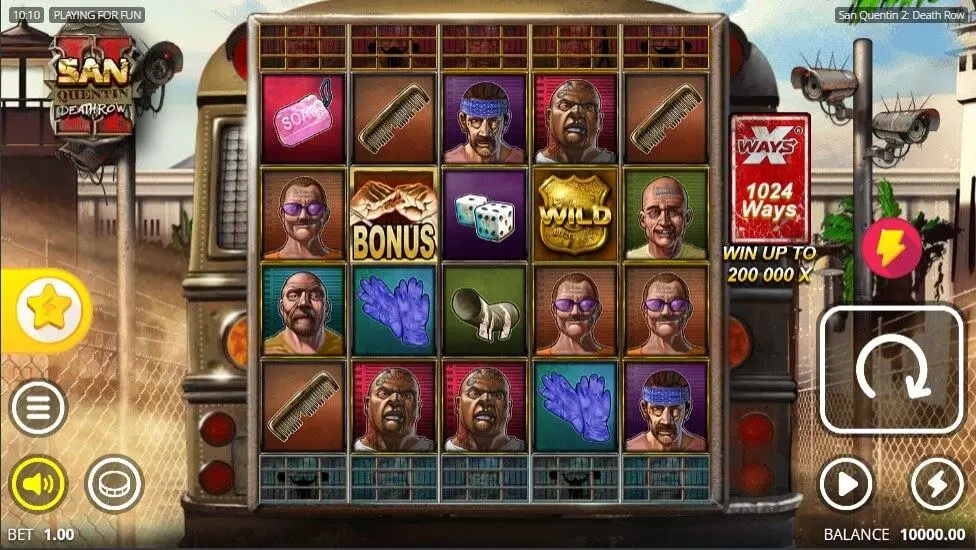
If you want the short version: the san quentin 2 death row slot carries a stated RTP of 96.13%, runs on five reels, and comes from Nolimit City. A free demo is available, so you can see how it behaves without staking anything.
That RTP sits a fraction above the 96.03% average across Nolimit City’s 129 titles listed here, and 0.42 percentage points above the 95.71% average across the whole corpus. Its popularity rank of 1750 puts it in the 91.2nd percentile, so plenty of people have looked at it. Beyond those figures, several details Nolimit City has not published are worth flagging as you read.
The 5-reel grid explained
Five reels is the standard layout for modern video slots, and it is what this game uses. The reel count on its own tells you the width of the grid, not the height, and not how many symbol positions land on each spin. Those are separate specifications, and they are not published in the data available here.
That matters more than it sounds. A five-reel game with three visible rows offers 15 symbol positions; one with four or five rows, or one that expands the grid during play, offers considerably more. Some five-reel titles use fixed grids from the first spin to the last. Others change shape as the round progresses. Without a published row count or grid description for this title, you cannot tell which category it falls into from the reel count alone.
The practical step is to open the demo and count the positions yourself on a still screen. It takes ten seconds and it tells you more than any spec sheet summary. If you want a Nolimit City point of comparison while you are at it, Fire in the Hole returns a very similar 96.06%, so any difference you notice between the two is about structure and feel rather than long-run return.
| Provider | Nolimit City |
|---|---|
| RTP | 96.13% |
| Reels | 5 |
| Theme | Crime |
| Free demo | Yes |
Paylines, ways and how San Quentin 2 Death Row pays
The payline or ways count for this title is not published in the data here, so treat any specific figure you see quoted elsewhere with caution until the provider confirms it.
Generally speaking, slots resolve wins in one of a few ways. Fixed-payline games pay when matching symbols land along defined lines, usually left to right, and the line count is constant. Ways games drop the lines entirely and pay for matching symbols anywhere on adjacent reels, which is where figures like 243 or 1,024 ways come from. Cluster games pay for groups of touching symbols regardless of reel position.
Each structure changes what a result looks like without changing the underlying return. A 1,024-ways game tends to produce more frequent small returns than a 10-line game at the same RTP, because the same total payback is distributed across more outcomes. Neither is better value. They just feel different across a hundred spins.
The same applies to features. Many slots use wilds, scatters and free-spin rounds, and some sell direct entry to a bonus. Whether this one does, and on what terms, is not something the available data states, so the demo paytable is the place to check rather than a review.
96.13% RTP put in context
RTP is a long-run theoretical average. At 96.13%, the model returns £96.13 for every £100 wagered across a sample far larger than any single player produces. Over 1,000 spins at £1, that is £1,000 staked and £961.30 expected back in theory, with real results scattered widely either side because variance dominates at that sample size.
The house edge is the remaining 3.87%. It applies to every spin, independently, whatever happened before. There is no accumulation and no correction owed.
Against the field, the number is mildly favourable. It beats the 95.71% corpus average by 0.42 points and edges past Nolimit City’s own 96.03% average. On £1,000 of turnover, the gap to the corpus average is about £4.20 in theory. Real enough to note, small enough that it should not decide anything on its own.
If RTP is your main filter, Le Bandit is another crime-themed release at 96.34%, roughly £2.10 better per £1,000 wagered. Monkey Heist shares the theme but has no published RTP here, which makes it impossible to compare on this measure.
Volatility and hit patterns
No volatility rating is published for this title in the data available, and no hit frequency figure either. That absence is worth taking seriously, because volatility affects your session more directly than RTP does.
Volatility describes how the return arrives. Low-volatility games pay small amounts often, so a fixed bankroll lasts longer and the balance moves in shallow steps. High-volatility games pay rarely and larger, which means long stretches with nothing back, and a bankroll that can drain quickly at a stake that felt reasonable on paper. Two games with identical 96.13% RTP can deliver completely different experiences depending on where they sit on that scale.
Because no rating is stated, the demo is your measuring tool. Run a few hundred spins at a flat stake and watch how often anything returns, how deep the losing runs get, and whether the balance grinds or lurches. That gives you a usable feel for the risk profile, though the sample is far too small to say anything about RTP.
One thing to be clear about: no pattern in past spins predicts the next one. Each spin is independent, and no staking sequence changes the expected return. Adjusting bet size changes how fast money moves, not how much comes back.
Choosing a stake between the published minimum and maximum
The stake range is not published in the data here, so the bet limits will need reading off the game’s own interface. That is a genuine gap, since minimum and maximum bet are among the first things worth knowing before committing a bankroll.
The arithmetic still works without them. Decide your session budget first, then divide by the spins you want from it. A £50 budget across 300 spins puts you at roughly 16p per spin; the same £50 at £1 a spin is 50 spins before the theoretical return even starts to matter. Whichever bet size the game supports, that division is the calculation that keeps a session inside its limits.
Where volatility is unknown, the cautious choice is the lower end of the range while you learn how the game behaves. If you want a Nolimit City comparison with a documented similar return, Tombstone RIP sits at 96.08%, close enough that stake planning transfers between the two.
Demo play versus real money
A free demo is available for this title, which is the sensible starting point. Playing San Quentin 2 Death Row free of charge lets you read the paytable, confirm the grid dimensions, see what features exist and get a rough sense of hit patterns before any money is involved.
What demo play cannot do is forecast cash results. Demo and real-money modes use the same mathematics, but a demo session that ran well says nothing about the next real session. Independent spins do not carry results forward, and a lucky few hundred spins in practice mode is just a small sample landing where it landed.
Slots are paid entertainment, not income. Play only if you are 18 or over, set a budget you are comfortable losing before you start, and stop when you reach it rather than when the balance changes. If the spending stops feeling like the price of an evening, that is the point to walk away.
Verdict on San Quentin 2 Death Row
The case for it rests on one solid figure and a lot of blanks. 96.13% RTP is modestly above both the Nolimit City average of 96.03% and the corpus average of 95.71%, which is a small but genuine edge over the typical release. Five reels, a crime theme, and a rank of 1750 in the 91.2nd percentile tell you it has found an audience.
Against that, the volatility rating, hit frequency, payline structure, stake range and maximum win are all unpublished in the data here. That is a lot to establish yourself, and volatility in particular is the figure that determines whether your bankroll lasts an hour or ten minutes.
The recommendation is straightforward: use the demo as your spec sheet, since it answers those questions faster than any review can. If you would rather start from a published number, Book of Shadows from the same studio returns 96.01%. Otherwise, the RTP here is sound and the rest is worth checking with your own eyes before you stake anything.
More from Nolimit City
- Tombstone Slaughter: El Gordo’s Revenge — 96.01% RTP
- Blood and Shadow — 96.13% RTP
- Misery Mining — 96.09% RTP
- Mental — 96.08% RTP
- San Quentin Xways — 96.03% RTP
- Tombstone RIP — 96.08% RTP
- Tomb of Akhenaten — 96.29% RTP
- Book of Shadows — 96.01% RTP
Frequently Asked Questions
Can I play San Quentin 2 Death Row for free?
A free demo is available for this title, so you can spin it without staking money. The demo runs the same mathematics as the paid version, which makes it the practical place to check the grid layout, paytable and feature set before deciding whether the 96.13% RTP release suits you.
What does the 96.13% RTP actually mean for me?
It means the game is modelled to return £96.13 per £100 wagered across a sample far larger than any individual plays. The remaining 3.87% is the house edge. That figure sits above the 95.71% corpus average, but short sessions are dominated by variance, not by the theoretical rate.
How volatile is San Quentin 2 Death Row?
No volatility rating is published for this title in the available data, so it cannot be stated here. Since volatility determines how long a bankroll lasts and how deep losing runs get, the demo is the way to gauge it: run a few hundred flat-stake spins and watch how the balance moves.
Who is Nolimit City and what else do they make?
Nolimit City is the studio behind this release, with 129 titles listed here at an average RTP of 96.03%. Other games from them include Fire in the Hole at 96.06%, Tombstone RIP at 96.08% and Book of Shadows at 96.01%, so this title's 96.13% is slightly above their own house average.
What is the minimum and maximum bet?
The stake range is not published in the data available, so you will need to read the limits off the game's own bet panel. Plan around your budget instead: dividing a £50 session bankroll across 300 spins works out near 16p a spin, whatever the game's own floor and ceiling turn out to be.