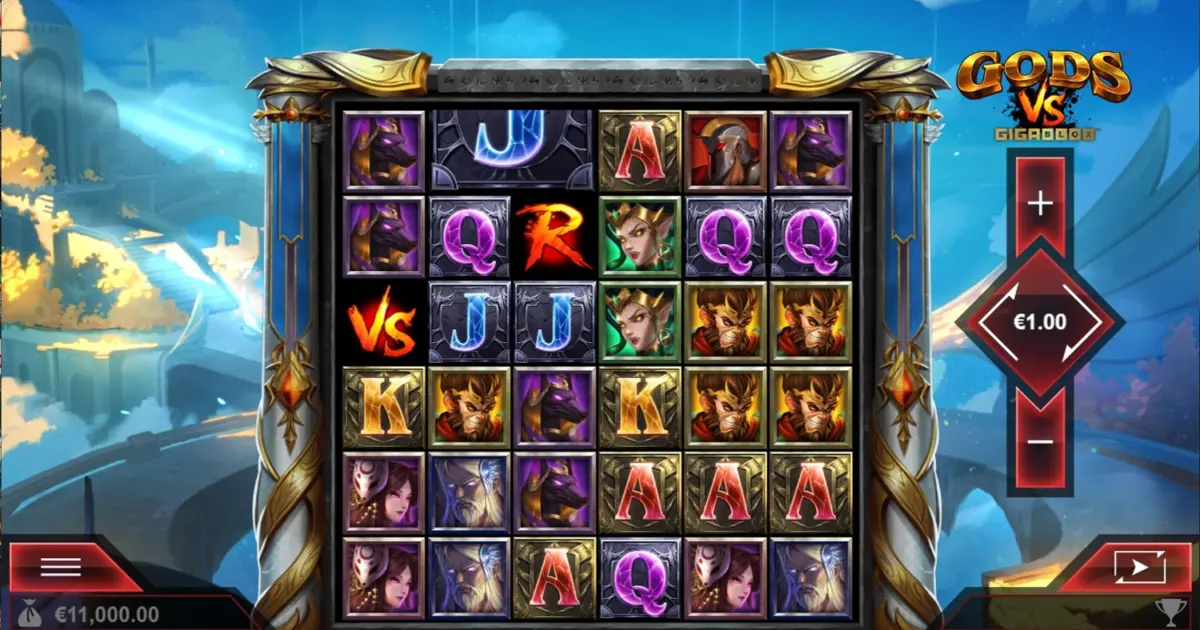
Gods vs Gigablox is a Mythology-themed slot from Reel Play with a 5-reel layout and a published RTP of 94.0%. That return figure sits below both the provider’s own average and the broader corpus average, which is the first thing worth knowing before you spin. If you are choosing between Mythology slots, this one trades a higher theoretical return for whatever the Gigablox mechanic brings to the reels — and the free demo is available if you want to see that in action without spending anything.
Gods vs Gigablox at a glance
Reel Play has built a catalogue of 64 games, and their average RTP across that portfolio sits at 96.0%. Gods vs Gigablox comes in two full percentage points below that mark. The broader corpus average across all tracked slots is 95.71%, so this title also trails the wider market by 1.71 percentage points. It ranks at 1680 in overall popularity, placing it in the top 8.4% of games by player interest — a solid showing for a Mythology slot that does not lead on return rate.
Here are the core numbers in one place:
| Detail | Value |
|---|---|
| Provider | Reel Play |
| Reels | 5 |
| Theme | Mythology |
| RTP | 94.0% |
| Corpus average RTP | 95.71% |
| Provider average RTP | 96.0% |
| Popularity percentile | 91.6% |
| Free demo available | Yes |
With 801 Mythology-themed slots in the corpus, this is a crowded niche. The game’s popularity shows it has found an audience despite the lower RTP, so it is clearly doing something right in its presentation or mechanics. Whether the numbers work for you depends on how much weight you give to theoretical return versus session entertainment.
What a 94.0% RTP actually returns
RTP stands for Return to Player and it describes the long-run statistical average of money wagered that a slot is expected to pay back. At 94.0%, Gods vs Gigablox returns £94.00 per £100 wagered across a very large sample of spins. That is not a promise for any individual session — you could win more or lose everything in a single spin — but it is the mathematical baseline the game is built around.
Run the numbers through a concrete example. If you play 1,000 spins at the minimum stake of £0.20, you will wager £200 in total. At a 94.0% RTP, the expected return over those 1,000 spins is £188, meaning a theoretical loss of £12. Compare that to the corpus average of 95.71% on the same wagering volume: you would expect £191.42 back, a theoretical loss of £8.58. The difference is £3.42 on a £200 wager — small in absolute terms, but it compounds over longer sessions and larger stakes.
Over 10,000 spins at £0.20 per spin, you wager £2,000. The expected loss at 94.0% RTP is £120, compared to £85.80 at the corpus average. That £34.20 gap is meaningful and worth understanding before committing real money. The gap between this game and Reel Play’s own 96.0% provider average is even wider: £200 in expected losses versus £80 on the same £2,000 wagered. Every percentage point matters when the sample size grows.
If you want a Mythology slot with a higher return, Gates of Olympus from the same theme family runs at 96.5% RTP — a full 2.5 percentage points above Gods vs Gigablox. That difference translates to £50 less expected loss per £2,000 wagered.
Medium volatility and what your session will feel like
Reel Play has not published an official volatility rating for Gods vs Gigablox, so there is no confirmed classification to report. Volatility — sometimes called variance — describes how far individual session results tend to deviate from the RTP average. High-volatility slots deliver fewer wins but larger individual payouts; low-volatility slots pay out more frequently in smaller amounts. Medium volatility sits between the two.
Without an official rating, you cannot know the exact swing profile from the numbers alone. The best approach is to use the free demo and observe the hit rate and payout distribution for yourself. Pay attention to how many spins go without a win, how large the occasional payouts are, and whether your demo balance tends to drain steadily or in sudden drops. That pattern tells you more about the game’s volatility than any label would.
What you can say with certainty is that every spin is independent. A run of losses does not make a win more likely on the next spin, and a recent win does not make the next spin colder. The RTP figure only applies across a very large sample — thousands or tens of thousands of spins. In any single session of a few hundred spins, the actual return could be anywhere from well below 94% to well above it.
The 5-reel layout and how wins are counted
Gods vs Gigablox uses a 5-reel layout. Reel Play has not published the specific payline count, number of ways, or the exact win mechanics for this title, so the precise method by which matching symbols produce payouts is not confirmed in the available data. Many 5-reel slots use anywhere from 10 to 243 paylines or ways, but the actual configuration for this game is not something I can state.
The game name includes “Gigablox,” which in Reel Play’s portfolio typically refers to oversized symbols that can land on the reels and cover multiple standard symbol positions. That mechanic can create larger clusters of matching symbols on a single spin. However, the specific implementation — how large those blocks can get, whether they appear on every spin or only during certain features — has not been published in the data available here.
What matters for your session planning is that the reel count and win mechanic determine hit frequency and payout structure. A 5-reel game with more ways to win tends to pay out more frequently in smaller amounts, while fewer paylines can mean bigger individual wins but longer dry spells. Without confirmed details on this game’s payline count, the demo is again the most reliable way to see how the reels actually behave.
Stake range and sizing a bankroll
The minimum stake for Gods vs Gigablox is £0.20 per spin, but the maximum stake has not been published in the available data. A £0.20 minimum is fairly standard for online slots and makes the game accessible for players who want to stretch a smaller bankroll across more spins.
Bankroll planning starts with the minimum stake and the RTP. If you play 1,000 spins at £0.20, you wager £200. At a 94.0% RTP, the expected cost of that session is £12 — but the actual result could vary widely. A sensible approach is to set a budget you are comfortable losing entirely, because that is always a possibility in any session. A common guideline is to bring enough for at least 200 spins at your chosen stake, which at the £0.20 minimum means a bankroll of £40. That gives you a reasonable sample of the game’s behaviour without risking more than you planned.
If you increase your stake, scale your bankroll proportionally. A £1.00 stake requires a £200 bankroll for the same 200-spin cushion. The expected loss per 200 spins at that stake is £60 at 94.0% RTP. These are mathematical expectations, not guarantees — any individual session can end well above or well below the average.
Playing the Gods vs Gigablox demo before you commit
A free demo of Gods vs Gigablox is available, so you can test the game without spending real money. Demo play uses the same random number generator and the same payout structure as the real-money version, so the RTP and volatility profile are identical. The difference is that demo credits have no cash value — you cannot withdraw anything you win in demo mode.
Use the demo to get familiar with the reel layout, the win frequency, and how the Gigablox mechanic actually plays out. Spin at least 200 to 500 times to get a feel for the game’s rhythm. Watch for how often wins land, how large they tend to be relative to your stake, and whether your balance tends to drop quickly or slowly. That information is worth more than any written description.
Set a budget before you move to real money and stick to it. Treat slot play as paid entertainment, not as a way to make money — the house edge is built into every spin. If gambling stops being fun, step away. You must be 18 or older to play. If you want to compare the feel of this game against another Mythology slot, 9 Arrows of Odysseus shares the same theme at an identical 94.0% RTP, while 1 Reel – Demi Gods 7 offers a different Mythology experience at 95.42% RTP.
Verdict: who should play Gods vs Gigablox
Gods vs Gigablox is a reasonable pick if you are drawn to Mythology slots and want to try the Gigablox mechanic, but the 94.0% RTP is the trade-off. That figure is 1.71 percentage points below the corpus average and two full points below Reel Play’s own portfolio average of 96.0%. For every £1,000 wagered, you give up roughly £17 more in expected losses compared to an average slot, and £20 more compared to Reel Play’s typical output. The game’s 91.6th-percentile popularity ranking shows it has found fans despite that gap, so the presentation and mechanics clearly appeal to many players.
If RTP is your primary filter, Reel Play offers stronger options within their own catalogue. Hypernova Infinity Reels runs at 96.2% RTP, and Age of Beasts Infinity Reels sits at 95.57% — both above the corpus average and well above this game. If you are choosing between Mythology slots specifically, Gates of Olympus at 96.5% RTP gives you a meaningfully better expected return on the same wagering volume.
The best move is to play the free demo first. See whether the Gigablox mechanic and the Mythology presentation keep you engaged, and decide whether that entertainment value justifies the lower return rate for your bankroll. Every spin is independent, so no amount of demo play will predict your real-money results — but it will tell you whether you enjoy the game enough to keep playing.
Frequently Asked Questions
Can I play Gods vs Gigablox for free without downloading anything?
A free demo of Gods vs Gigablox is available on this page, and it runs directly in your browser with no download required. The demo uses the same mechanics and RTP as the real-money version, so it gives you an accurate picture of how the game plays before you commit any funds.
What is the RTP of Gods vs Gigablox and how does it compare to other slots?
Gods vs Gigablox has a published RTP of 94.0%, which is below the corpus average of 95.71% and below Reel Play's own provider average of 96.0%. Over a large sample, you can expect to lose roughly £6 per £100 wagered, compared to about £4.29 at the corpus average.
What volatility does Gods vs Gigablox have?
Reel Play has not published an official volatility rating for Gods vs Gigablox. Without that classification, the best way to gauge the game's swing profile is to play the demo and observe how frequently wins land and how large they tend to be relative to your stake.
Who is Reel Play and what other games do they make?
Reel Play is the provider behind Gods vs Gigablox and has produced 64 games to date. Their portfolio includes titles like Hypernova Infinity Reels at 96.2% RTP and Age of Beasts Infinity Reels at 95.57%, both of which offer a higher return than this game.
Can I win real money playing the Gods vs Gigablox demo?
No, demo play uses virtual credits that have no cash value and cannot be withdrawn. The demo is a risk-free way to learn the game's mechanics and decide whether you want to play for real money at a licensed casino, where outcomes are the same but your own funds are at stake.