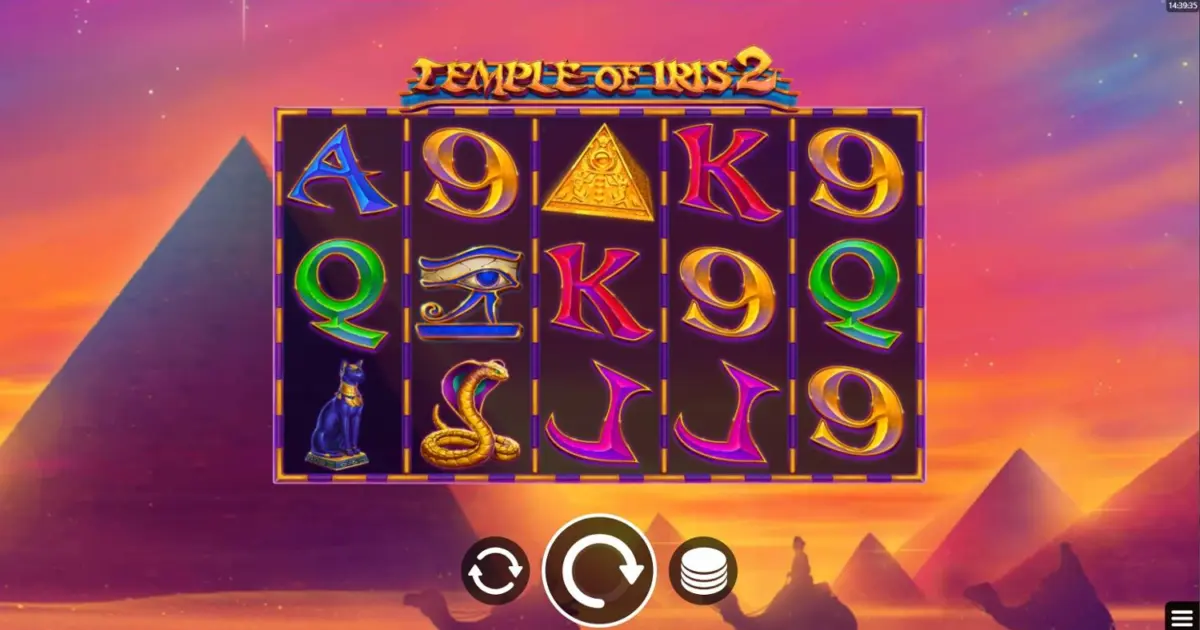
The single number that should shape your decision here is 95.0%. That is the published return-to-player figure for this game, and it sits 0.71 percentage points below the 95.71% average across the slots in our database. A free demo is available, so you can see how the game behaves without committing any money.
What follows is what that RTP figure actually means across a session, what Eyecon has and has not published about this title, and where the gaps in the data should make you cautious.
Temple of Iris 2 at a glance
Here are the confirmed figures. Anything not listed below has not been published, and you should treat numbers you see quoted elsewhere with suspicion.
| Detail | Value |
|---|---|
| Provider | Eyecon |
| RTP | 95.0% |
| Game type | Slot Machine |
| Free demo | Available |
| Popularity rank | 1,668 (91.6th percentile) |
| Provider average RTP | 95.0% across 79 games |
| Database average RTP | 95.71% |
Note what is absent. Eyecon has not published a volatility rating, a reel or payline count, a stake range, a maximum win, or a hit frequency for this title. That is a meaningful amount of missing information, and it means several of the questions you would normally ask before playing can only be answered by loading the demo and watching it yourself.
The popularity rank of 1,668 puts the game in the 91.6th percentile of titles we track, so plenty of people are finding it. Popularity tells you nothing about return, though. It is a measure of traffic, not of maths.
What a 95.0% RTP actually returns
RTP is a long-run statistical average, calculated across millions of simulated spins. It describes the behaviour of the game over an enormous sample, not the behaviour of your afternoon.
Work it through. At 95.0%, every £100 staked returns £95.00 on average across a very large number of spins, leaving a £5.00 house margin per £100. If you were to place 1,000 spins at £0.20 each, that is £200 wagered, and the expected return across an infinite number of such 1,000-spin blocks is £190. The £10 difference is the cost of the entertainment.
The word “average” is doing heavy lifting. Any individual block of 1,000 spins can land well above or well below £190, and short sessions deviate wildly from the theoretical figure. Convergence towards 95.0% requires far more spins than any person plays in a lifetime.
Against the field, 95.0% is 0.71 points below the 95.71% database average. Over £1,000 wagered, that gap costs you roughly £7.10 in expected value compared with an average-RTP game. It is not a dramatic shortfall, but it is a real one, and it compounds the longer you play.
Worth noting: Eyecon’s 79-game catalogue averages 95.0% RTP, so this title is exactly on the studio’s own par rather than a weak entry in the range. Among their other games, Unicorn Bliss lands at 94.9% and Sands of Fortune at 93.7%, both below this one.
Unpublished volatility and what your session will feel like
No volatility rating has been published for this game, so anyone telling you it is low, medium or high is guessing. Here is what the concept means so you can judge it from the demo yourself.
Volatility describes the size and spacing of wins rather than their total. Low-volatility slots pay small amounts often, which keeps a balance ticking over and stretches a session across more spins. High-volatility slots pay rarely but larger, which means long stretches of nothing punctuated by occasional bigger returns, and a bankroll that can drain fast before anything lands. Two games with identical 95.0% RTP can feel completely different depending on where they sit on that scale.
Because the rating is missing, run the demo for a few hundred spins and watch the balance line. If it drifts down gently with frequent small returns, you are looking at lower volatility. If it drops in long flat stretches and then jumps, that is a higher-variance profile and you should size your stake accordingly.
One thing volatility never means: every spin is independent, and no sequence of losses makes a return more likely on the next one. A game is never due.
The unlisted reel layout and how wins are counted
Eyecon has not published a reel count or payline count for this title either, which is unusual and worth flagging. In general terms, most online slots resolve wins across a fixed grid, with matching symbols on adjacent reels reading from the leftmost reel rightwards along defined paylines. Others use a “ways” system, where any combination of positions counts as long as the symbols land on consecutive reels.
The distinction matters for how a session reads. A fixed-payline game charges a stake per line, so the displayed bet covers all active lines at once. A ways game bundles everything into one total stake. Neither approach changes the RTP figure; they change how wins are described on screen.
Many slots also carry wilds, scatters and free-spin rounds, and some newer titles sell a bonus entry directly. None of that is confirmed for this game, so do not assume any of it is present. The demo will show you the paytable and the mechanics in a couple of minutes, which is faster and more reliable than any secondhand description.
Stake range and sizing a bankroll
The minimum and maximum stake for this game have not been published, so check the bet selector in the demo or the real-money lobby before you plan anything.
The sizing principle holds regardless of the range. Decide your total budget first, then divide it by the number of spins you want the session to last. A £40 budget at £0.20 per spin gives roughly 200 spins before the theoretical margin bites, though real results will scatter either side of that. Halve the stake and you double the spins.
At 95.0%, the expected cost is £5 per £100 wagered. Turnover is what matters, not deposit size, and turnover accumulates quickly at high stakes and fast spin speeds. If a stake level makes you hesitate before pressing spin, it is too high. No staking pattern, progression or timing adjustment changes the expected value of a single spin, because the outcome of each one is independent of every spin before it.
Playing the Temple of Iris 2 demo before you commit
The free demo is the most useful tool available here, precisely because so much of the specification is unpublished. Play money mode lets you read the paytable, count the reels, find the stake range and get a feel for how often wins land, all without risking anything. For a game with no published volatility rating, that is close to essential.
Demo play uses the same underlying maths, but it does not predict real-money results and it cannot pay real money. A hot run in the demo means nothing about what happens with your own funds; you are simply seeing a different short sample from the same distribution.
Slots are 18+ and should be treated as paid entertainment, not a way to make money. Set a budget you are comfortable losing before you start, keep it separate from money you need, and stop when it is gone rather than topping it up. If play stops feeling like a choice, deposit limits and self-exclusion tools exist at every licensed operator.
Verdict: who should play Temple of Iris 2
This suits you if you want an Egyptian-themed Eyecon slot and are comfortable with a 95.0% return, which is the studio’s standard rather than a bargain. It is a fair rate for the catalogue it comes from and only marginally under the wider average.
It suits you less if you want to know exactly what you are getting before you load it. No published volatility, reel count, payline count, stake range or max win is a lot of blank fields, and the demo is the only way to fill them in.
If RTP is your main filter, look wider than Eyecon’s range, since the studio’s 79 games average the same 95.0% and their closest alternatives, Kitty Payout at 94.9%, sit slightly lower. Start with the demo, decide whether the rhythm suits you, then set a budget before you switch to real stakes.
Frequently Asked Questions
Can I play Temple of Iris 2 for free?
A free demo is available, so you can spin the game in play money mode without depositing. That is particularly useful here because Eyecon has not published a volatility rating, reel count or stake range for the title, so the demo is the only reliable way to see the paytable and mechanics for yourself before committing real funds.
What is the RTP of Temple of Iris 2?
The published RTP is 95.0%, meaning the game returns £95.00 per £100 wagered as a long-run statistical average across millions of spins. That leaves a £5.00 house margin per £100 of turnover. It sits 0.71 percentage points below the 95.71% average across the slots in our database.
Is Temple of Iris 2 high or low volatility?
Eyecon has not published a volatility rating for this game, so treat any figure quoted elsewhere with caution. Watch the demo balance over a few hundred spins instead: frequent small returns point to lower variance, while long flat stretches broken by larger wins indicate a higher-variance profile that needs a bigger bankroll.
Who is Eyecon and what other slots do they make?
Eyecon is the studio behind this title and 79 games in our database, averaging 95.0% RTP as a catalogue, which is exactly where this game lands. Their other releases include Sands of Fortune at 93.7%, Unicorn Bliss at 94.9% and Kitty Payout at 94.9%, all slightly below this one on return.
How does Temple of Iris 2 compare to Kitty Payout?
This game returns 95.0% against 94.9% for Kitty Payout, a difference of 0.1 percentage points or about £1 in expected value per £1,000 wagered. Both come from Eyecon's 79-game range and both sit under the 95.71% database average, so the gap between them is smaller than the gap to the wider field.