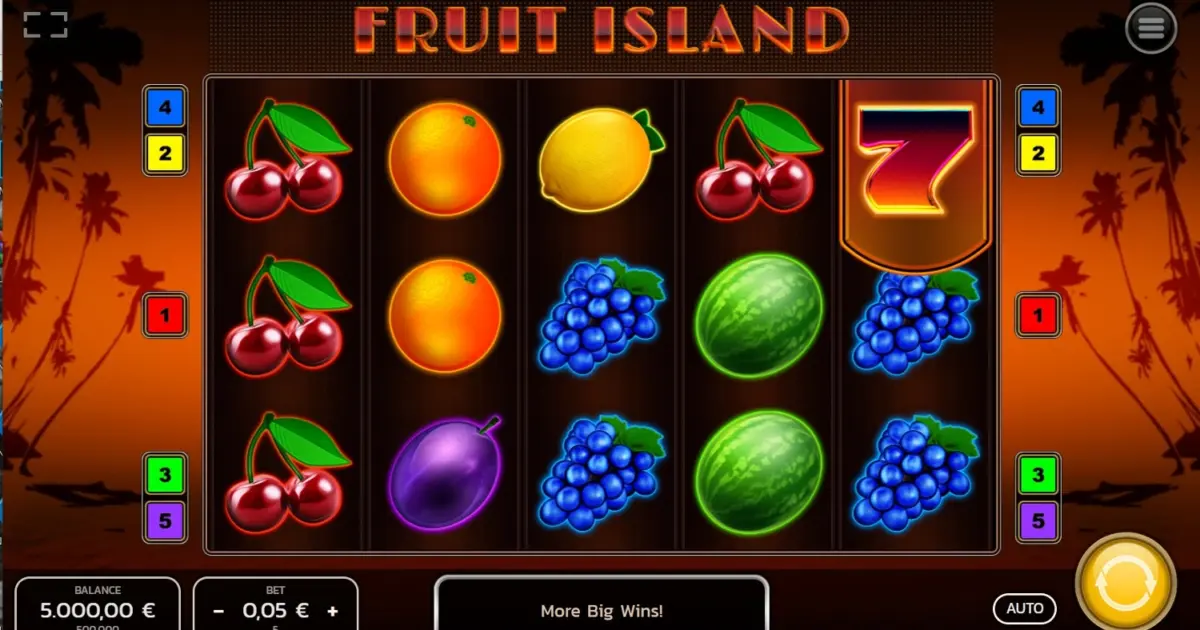
Here is the short version. The fruit island slot from TipTop runs a 96.0% RTP across five reels, which is 0.29 percentage points above the 95.71% average of every game in our database. That is the one hard number available. Volatility, stake limits, paylines, max win and feature detail have not been published, so anyone quoting them is guessing.
Fruit Island at a glance
What is on record is narrow but useful. TipTop is the studio behind it, the layout is five reels, the theme is Fruits, and the game sits in the Slot Machine subcategory. It ranks 1,548 for popularity, placing it in the 92.2nd percentile — more traffic than roughly nine in ten titles we track.
| Field | Value |
|---|---|
| Provider | TipTop |
| RTP | 96.0% |
| Reels | 5 |
| Theme | Fruits, 5-Reels |
| Type | Slot Machine |
| Popularity rank | 1,548 (92.2nd percentile) |
| Free demo | Available |
| Volatility | Not published |
| Paylines | Not published |
| Max win | Not published |
| Stake range | Not published |
This suits a reader who wants a classic fruit look with a return figure at the category norm and is willing to establish the practical details by loading the demo rather than reading them off a spec sheet.
What a 96.0% RTP actually returns
RTP is a long-run statistical average, calculated across millions of simulated spins. At 96.0%, the game returns £96 for every £100 wagered over that kind of sample. The missing £4 is the house edge, and it is fixed in the maths of the game.
Work it through. Stake £0.20 a spin for 1,000 spins and you have wagered £200. The theoretical return is £192, a £8 expected cost. Your actual result will land nowhere near that, because 1,000 spins is a tiny sample. You might be £60 up or £120 down. The average only asserts itself over volumes no individual player reaches.
Against the 95.71% average across our whole database, 96.0% is 0.29 points better — about 58p per £200 wagered. Real, but not a reason to choose a game. TipTop’s 65-title catalogue averages exactly 96.0%, so this is the studio’s standard setting rather than a generous outlier. If a higher figure is what you are after, Hot Hot Fruit is another fruit machine running 96.84%.
Unpublished volatility and what your session will feel like
TipTop has not published a volatility rating, so treat any confident claim about swing size as invented. What you can do is infer the shape from the demo.
The mechanic matters more than the label. Low-volatility games pay small amounts often, so balances drift rather than lurch and a modest bankroll lasts. High-volatility games pay rarely and larger, which means long dry runs punctuated by occasional spikes — and a bankroll that needs to absorb those dry runs without running out. Medium sits between.
Run 200 to 300 demo spins and count. Frequent small returns that roughly hold your balance suggest the lower end. Balance sliding steadily with occasional sharp recoveries points higher. This is an impression, not a measurement — 300 spins cannot pin down a distribution — but it tells you whether your intended stake is realistic.
One thing volatility never changes: each spin is independent. Previous results carry no information about the next one. No game is ever due, warm or overdue for a correction.
The 5-reel layout and how wins are counted
Five reels is the standard modern configuration, and it accommodates most win-evaluation systems in use. Fixed paylines award prizes for matching symbols along defined patterns, usually left to right. Ways or all-ways games drop the fixed patterns and pay for matching symbols in any position on consecutive reels. Cluster systems pay on adjacent groups instead of lines.
Which of these Fruit Island uses is not in the published data, and the distinction changes how the paytable reads. A five-line game and a 243-ways game with the same RTP will feel completely different at the same stake, because the per-spin cost and the frequency of small returns differ.
The paytable inside the game is the authority here. Open it in the demo, note how wins are evaluated and what the symbol values are before you decide whether the game fits how you like to play. Two minutes of reading beats any third-party summary, including this one.
Stake range and sizing a bankroll
No minimum or maximum stake has been published, so check the bet selector in the demo — it is displayed there.
The sizing arithmetic works the same whatever those limits turn out to be. Decide the total you are prepared to spend, then divide by the number of spins you want from it. A £40 budget over 400 spins means £0.10 a spin. Want the same £40 to last longer, and the stake has to come down.
Because volatility is unpublished, err on the cautious side. If the demo suggests bigger swings, more spins of headroom protects the session from ending in five minutes. A common approach is treating the bankroll as buying a fixed number of spins, then stopping when they run out.
What does not work is any staking system. Raising stakes after losses, lowering them after wins, chasing a pattern — none of it alters the 4% house edge, because each spin is independent of every spin before it. Progressive systems only change how quickly you reach your limit.
Playing the Fruit Island demo before you commit
A free demo is available, and given how much is unpublished here it does more work than usual. It is the only way to confirm the stake range, the payline structure, the paytable values and any features the game actually contains. Play in the browser, no download required, with virtual credits rather than real money.
Demo results do not predict real-money results. A hot streak in the demo tells you nothing about your next session — the maths runs identically in both, and the outcomes are independent either way.
Slots are paid entertainment, not a way to make money. Play only if you are 18 or over, set a budget before you start, and treat what you spend as the cost of the session rather than a stake you expect back. If it stops being fun, close the game.
Verdict: who should play Fruit Island
The case for it is a 96.0% return, slightly above the database average, on a five-reel fruit layout with genuine popularity behind it — 92.2nd percentile is not a game nobody plays. The case against is how little TipTop has documented. No volatility rating, no stake range, no payline count, no max win figure.
If you want a straightforward fruit machine and are happy to establish the details yourself in the demo, this is a reasonable pick with no red flags in the numbers. If you plan sessions around a known volatility profile or a stated max win, you cannot do that here.
Worth a comparison either way. Fruit Wild Lines is TipTop’s other fruit title at the same 96.0%, while Trickstar Spins sits at 94.0% — two points lower, which is £4 more expected cost per £200 wagered.
Frequently Asked Questions
Can I play Fruit Island for free?
A free demo of Fruit Island is available to play in your browser with virtual credits, no download and no deposit required. It runs the same 96.0% RTP maths as the real-money version, which makes it the practical way to check the stake range, paytable and win structure that TipTop has not published anywhere.
What is the RTP of Fruit Island?
Fruit Island returns 96.0%, meaning £96 back per £100 wagered across a very large sample. That is 0.29 percentage points above the 95.71% average across our database, and exactly matches the 96.0% average of TipTop's 65-game catalogue. Over 1,000 spins at £0.20, the theoretical cost is roughly £8.
Is Fruit Island high or low volatility?
TipTop has not published a volatility rating for Fruit Island, so any figure quoted elsewhere is unverified. Running 200 to 300 demo spins gives you a rough sense: frequent small returns suggest lower volatility, while long gaps followed by sharp recoveries point higher. Treat that as an impression, not a measurement.
Who is TipTop and what else do they make?
TipTop is the studio behind Fruit Island, with 65 titles in our database averaging 96.0% RTP — the same figure as this game. Their catalogue spans fruit slots and dice titles, including Fruit Wild Lines at 96.0%, 5 Hot Strike Dice at 96.0% and Da Vinci Dice, also at 96.0%.
How does Fruit Island compare to Hot Hot Fruit?
Hot Hot Fruit runs a higher 96.84% RTP against Fruit Island's 96.0%, a gap of 0.84 points, or roughly £1.68 per £200 wagered. Both are fruit-themed slots. Neither has a published volatility rating in our data, so RTP is the only hard basis for comparing the two on cost.