Should you bother with this wizards of wild wood slot? The short answer: the maths behind it are unremarkable, the volatility data is absent, and the grid is wide enough to create genuinely large swing potential — but you are giving back roughly 1.2% more than the typical machine on the market. Read the numbers below and decide whether a 94.53% RTP on a seven-reel board is enough reason to spin.
The 7-reel grid explained
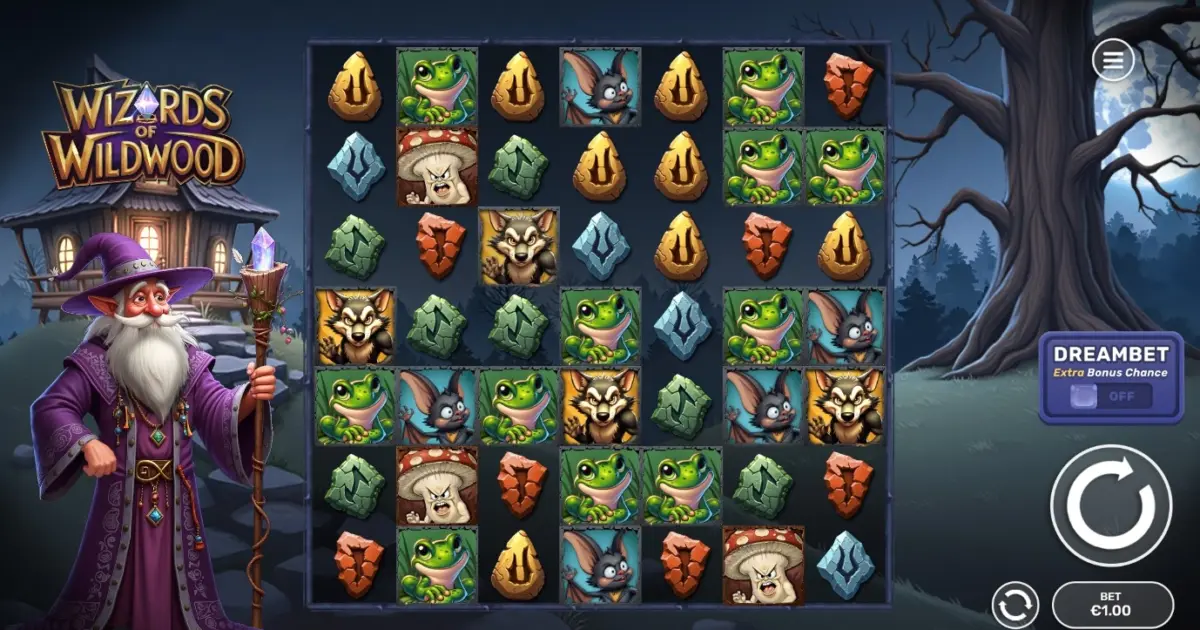
Most online slots land somewhere between three and five reels. Seven is a deliberate departure from that convention, and it changes the shape of the game before you place a bet. More reels means more symbols on screen simultaneously, which in turn expands the number of possible symbol combinations per spin — but the relationship between reel count and payout structure is not linear. A seven-reel slot does not automatically pay more often or more generously than a five-reel one; it simply offers a wider canvas on which the provider arranges its paytable.
In practice, providers who build seven-reel titles usually pair them with cluster-pay, Megaways, or cascading-reel mechanics to fill the extra columns meaningfully. Dreamspin has not published the exact payline or ways configuration for Wizards of Wild Wood, so treat any specific number you encounter elsewhere with caution. What you can observe directly in a demo is whether winning combinations appear frequently across the full width of the board or concentrate on the leftmost columns.
Wider grids also tend to increase the cost-per-spin when providers implement them, because more symbol positions must feed into the same target RTP. If you are comparing across providers, Smash Street Wilds also comes from Dreamspin but uses a different structural approach — its 95.5% RTP suggests a slightly different distribution of returns across its paytable.
| Provider | Dreamspin |
|---|---|
| RTP | 94.53% |
| Reels | 7 |
| Theme | Magic |
| Free demo | Yes |
Paylines, ways and how Wizards of Wild Wood pays
The FACTS supplied to this review do not include a payline count or a ways figure, so I cannot tell you whether this title uses fixed lines, adjustable lines, or a ways-based system. What I can tell you is how each approach affects your session at a conceptual level.
Fixed-payline slots award a win only when matching symbols land on specific horizontal or diagonal lines. More lines mean more simultaneous chances per spin, but they also mean higher minimum bets. Ways-based systems (typically 243 or 1024 ways) award a win whenever matching symbols appear on adjacent reels regardless of row position — they feel more frequent because they reframe the same underlying probability into more “paths” to a combination.
The practical implication for you: if Wizards of Wild Wood uses a ways mechanic, expect more frequent but smaller individual wins relative to a fixed-line game with the same RTP. If it uses fixed lines, expect fewer, lumpier payouts. You can confirm which system applies by loading the free demo and watching where winning clusters land across reels two through seven.
Related magic-themed titles such as Madame Destiny Megaways use Megaways (dynamic ways) with a substantially higher 96.56% RTP — a gap of over two percentage points that compounds noticeably over thousands of spins.
94.53% RTP put in context
94.53% means that across a very large number of spins, the game returns £94.53 for every £100 wagered. The remaining £5.47 is the house edge. That figure is the single most important number in this review, and it sits below the market average in every meaningful comparison.
The corpus average across all reviewed slots is 95.71%. Wizards of Wild Wood trails that benchmark by 1.18 percentage points. Dreamspin’s own catalogue average sits at 94.84% — only marginally above this title, which tells you the provider does not systematically outperform the market in this area.
Translate the gap into currency: wager £500 across a session. At 94.53% you give back approximately £27.27 in theoretical losses. At the 95.71% corpus average, that same £500 returns roughly £21.45. The difference — about £5.80 per £500 — compounds over longer sessions and higher stakes. It is not enormous per spin, but it is a structural disadvantage you carry every time you press the button.
Compare this to Pirate Pigs, Dreamspin’s other published title at 94.5% RTP. The gap between these two is negligible — seven-tenths of a percentage point — confirming the provider’s returns cluster tightly in the low-to-mid 94% band.
Volatility and hit patterns
Dreamspin has not published a volatility rating for Wizards of Wild Wood, and no hit-frequency figure is available in the data supplied to this review. That absence is not a minor detail — it means you cannot plan your bankroll around a known risk profile before you play.
Volatility determines the distribution of returns around the average. A high-volatility slot with 94.53% RTP will produce long dry spells punctuated by occasional large payouts; a low-volatility slot with the same RTP returns smaller amounts more frequently. Your session experience is almost entirely shaped by this variable, yet here it remains opaque.
What you can infer from the seven-reel structure: wider grids that fill a 94%+ RTP target rarely do so through frequent small wins alone. They tend to rely on less common but larger combinations to make up the maths, which is the statistical signature of medium-to-high volatility. That is an inference, not a fact, so verify it yourself in the demo before committing real funds.
Choosing a stake between unknown limits
No minimum or maximum bet range is listed in the data available for this review. Dreamspin has not published these figures through the information channel this site uses, and you should confirm them directly in the game interface before depositing.
What matters for planning: without a known volatility profile, a prudent default is to treat the game as if it were medium-to-high volatility. That means dividing your session bankroll into at least 200–300 bet units, so a cold stretch of spins does not deplete your funds before any significant combination materialises. If the maximum bet turns out to be high, do not let the upper range tempt you into a stake that shortens your session below what those 200–300 spins require.
Once you can see the actual range in-game, check whether the provider offers a stake level that keeps your per-spin cost at or below 1% of your planned session bankroll. That is a general framework, not a specific recommendation for this title.
Demo play versus real money
The Wizards of Wild Wood free demo is available on this site, and you can load it with no download required. Demo play uses a virtual balance that resets, so it lets you observe the seven-reel grid, identify any bonus triggers, and gauge the feel between payouts without financial risk. What it cannot tell you is how a 94.53% RTP actually behaves in your pocket over thousands of spins, because the sample you generate in ten minutes is far too small to approximate the theoretical return.
You must be 18 or over to play for real money. Set a budget before you start and treat the cost of spinning as the price of entertainment — not as an investment or a way to recover losses from another session. No amount of demo observation converts into a winning pattern when you switch to real money; every spin is independent, and the house edge you saw above applies identically regardless of what the demo displayed.
Verdict on Wizards of Wild Wood
This is a title for players who specifically want a seven-reel layout with magic and animal theming and who are indifferent to a roughly 1.2% RTP penalty relative to the market average. The absence of published volatility data is the largest practical concern — without it, you cannot calibrate stake sizes or session lengths with any confidence.
The popularity percentile of 92.7 suggests the game draws real traffic, so whatever draws people to it (theme, presentation, the perceived novelty of seven reels) is working at a level the bare numbers do not capture. But if RTP is your primary filter, there are dozens of Magic-themed alternatives — the theme alone contains 361 games in the corpus — that return closer to 96%.
If you want a Dreamspin slot with a better theoretical return, Smash Street Wilds at 95.5% is a closer match to the market average while still coming from the provider’s small three-game catalogue. For a higher-stakes magic experience, Madame Destiny Megaways at 96.56% offers both a superior RTP and a publicly documented volatility tier, which removes the planning uncertainty that Wizards of Wild Wood leaves on the table.
Frequently Asked Questions
Can I play Wizards of Wild Wood for free?
Yes — a Wizards of Wild Wood free demo is available on this site with no download required. You play with a virtual balance that carries no cash value, so it lets you inspect the seven-reel grid and gauge the payout rhythm before deciding whether to stake real money. The demo does not predict real-money results.
What is the RTP of Wizards of Wild Wood?
The published RTP is 94.53%, meaning £94.53 returns per £100 wagered over a very long statistical sample. That figure sits 1.18 percentage points below the 95.71% corpus average and just above Dreamspin's own catalogue average of 94.84%, placing it in the lower band of market-wide returns.
Is Wizards of Wild Wood high or low volatility?
Dreamspin has not published a volatility rating for this title. The seven-reel structure targeting a 94.53% RTP most likely implies medium-to-high volatility, but that is an inference from general slot maths rather than a confirmed figure. Verify by observing the length and depth of losing streaks in the demo before staking real money.
How does Wizards of Wild Wood compare to other Dreamspin slots?
The provider makes only three games total. Smash Street Wilds returns 95.5% — a full percentage point above Wizards of Wild Wood — while Pirate Pigs sits at 94.5%, nearly identical. Across that small catalogue, RTP clusters tightly in the mid-94% range, confirming the provider does not systematically outperform the market average.
Can I win real money playing the Wizards of Wild Wood demo?
No. The demo uses a virtual balance with no conversion to cash value, regardless of how large your simulated win appears. Real-money play requires a funded account at a licensed operator. Every spin in real money is independent of prior outcomes, and the 94.53% RTP means the expected value is negative over any session length.