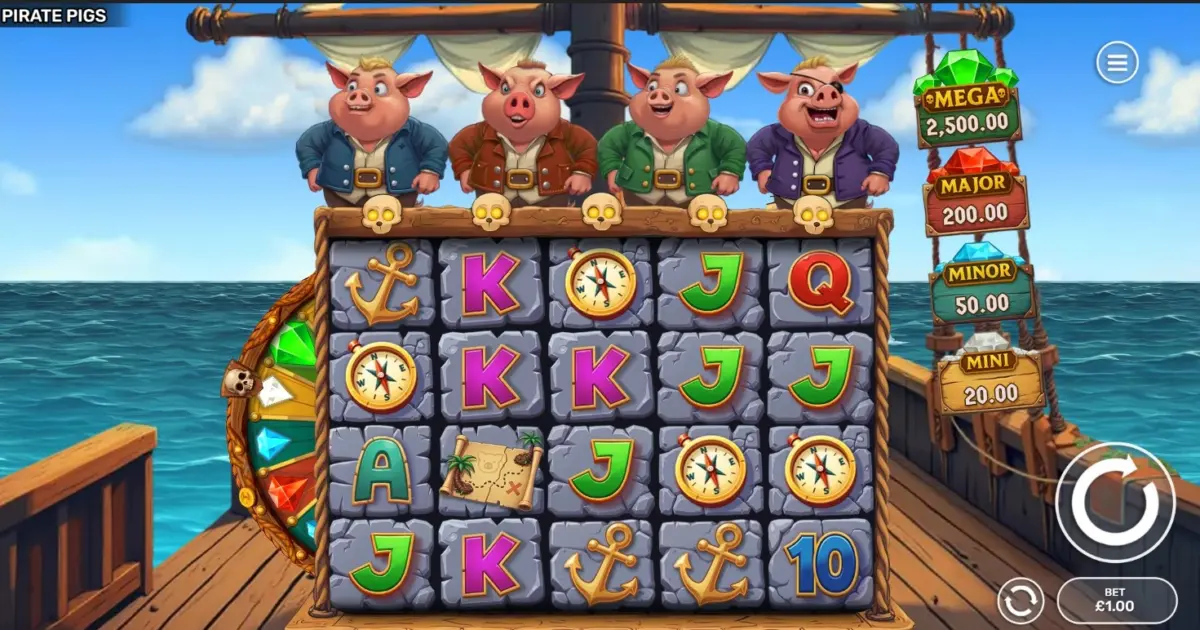
The pirate pigs slot by Dreamspin sits below the site’s corpus average RTP and leaves several key specifications unpublished. If you’re hunting for a game that outperforms 95.71% over time, this isn’t your pick — but a 94.5% return on a free demo is still worth a spin if the theme appeals to you.
Pirate Pigs Slot at a glance
Dreamspin is a small provider with only three games in our catalogue, which limits meaningful within-provider comparison. Pirate Pigs ranks 1386th overall with a popularity percentile of 93.1, meaning it attracts more attention than the bottom 93% of games on this site.
| Detail | Value |
|---|---|
| Provider | Dreamspin |
| RTP | 94.5% |
| Reels | 5 |
| Theme | Animals, 5-Reels |
| Volatility | Not published |
| Stake range | Not published |
| Free demo | Yes |
At 94.5%, Pirate Pigs trails the corpus average of 95.71% by 1.21 percentage points. It also falls 0.34 points below Dreamspin’s own provider average of 94.84%. Among the developer’s three titles, only one — Smash Street Wilds — exceeds 95% RTP at 95.5%. If you want the best return in this developer’s small catalogue, that game is your starting point.
What a 94.5% RTP actually returns
RTP is a long-run statistical average measured across millions of spins. It tells you nothing about a single session, but it does set the mathematical ceiling on what any bankroll strategy can achieve.
Work through a concrete example: suppose you place 1,000 spins at £0.20 each. Total staked is £200. At 94.5% RTP, the theoretical return is £200 × 0.945 = £189, meaning an expected loss of £11 across that sample. Over the same 1,000 spins at the corpus average of 95.71%, you’d expect £191.42 back — a difference of just £2.42. The gap is small in absolute terms at this scale, but it compounds across extended play.
Every spin is independent. No sequence of losses or wins shifts the expected value of the next one, regardless of what you’ve just experienced at the reels.
Volatility and what your session will feel like
Dreamspin has not published a volatility rating for Pirate Pigs. This is a genuine gap in the information available to you before committing real money, and it’s the single most important missing figure in this review.
Volatility (sometimes called variance) describes how a game distributes its RTP across time. A low-volatility slot returns most of its RTP through frequent small wins, producing short swings and a steadier bankroll curve. A high-volatility slot concentrates its return into rare large payouts separated by long losing stretches, requiring more patience and a larger bankroll buffer. Medium volatility sits between the two.
Without a published figure, you cannot determine which pattern to expect here. If Dreamspin’s other titles offer any guide, Wizards of Wild Wood shares a nearly identical RTP of 94.53% and is also a small-stakes casual title — but volatility ratings are assigned per game, not per provider, so even that comparison is limited. Check the game’s info screen before playing for real, or ask your casino’s support team directly.
The 5-reel layout and how wins are counted
Pirate Pigs uses a standard 5-reel grid, the most common configuration among Animals slots across this site’s catalogue of 1,788 titles in that category. Five reels give game designers room to build wider symbol sets and more frequent near-miss patterns than 3-reel formats allow.
The payline count is not listed in the available data. This matters because it determines how many ways a single spin can produce a win, and directly affects hit frequency — how often you see a payout at all. Some 5-reel games use fixed paylines (10, 20, or 25 being common), while others adopt “ways” systems that generate hundreds or thousands of potential combinations per spin.
Until the payline structure is confirmed, treat any claim about win frequency for this game as unverifiable. Many slots in the 5-reel category pair a fixed layout of 15–30 paylines with wild and scatter symbols, but asserting specifics here would be guessing.
Stake range and sizing a bankroll
No stake range has been published for Pirate Pigs. Without knowing the minimum bet, you cannot calculate a precise session length at a fixed budget — but you can plan in principle.
The rule for sizing a bankroll against a 94.5% RTP is straightforward: expect to lose 5.5% of everything you wager over the long run. To survive 200 spins with only a 25% chance of exhausting your balance, you’d need roughly £0.20 × 200 × 4 = £160 as a starting bankroll (a rough buffer factor accounting for variance without a known volatility figure). Lower minimum stakes improve this equation significantly by letting the same budget cover more spins.
The demo mode sidesteps bankroll concerns entirely, which is the next point.
Playing the Pirate Pigs demo before you commit
A Pirate Pigs free demo is available on this site with no download required. Demo play uses a simulated balance and produces outcomes drawn from the same RNG as real-money sessions, but those outcomes carry zero financial weight. The demo teaches you the mechanics — how wins land on the grid, how the interface responds — without exposing you to risk.
One note before you move to real stakes. You must be 18 or over to gamble where you live. Set a loss limit before your first paid spin and treat the entire session as a fixed entertainment cost — money you are paying for an experience, not money you expect to recover. No strategy changes the mathematical house edge built into the RTP figure.
The demo is your best tool for determining whether the pacing and presentation suit you. If five-reel gameplay with Animals theming isn’t engaging across 200 free spins, no amount of real-money play will change that verdict.
Verdict: who should play Pirate Pigs
Pirate Pigs is a below-average RTP title from a provider with too few games for reliable pattern-matching. At 94.5%, it gives up 1.21 points to the site average and 0.34 to its own developer’s mean. The unpublished volatility and stake range make informed bankroll planning difficult before real-money play.
That said, the gap between 94.5% and 95.71% represents roughly £1.20 per £100 wagered — noticeable over thousands of spins, negligible over dozens. If you find the concept appealing in demo and your session budget is modest, the mathematical penalty is small enough not to disqualify it outright.
If maximizing long-run return is your priority, Hercules Power Wild offers 96.2% RTP — a full 1.7 points better — on a 5-reel layout within the same broad category. The difference compounds meaningfully over extended sessions.
Frequently Asked Questions
Can I play Pirate Pigs for free without downloading anything?
Yes. A Pirate Pigs free demo is available on this site directly in your browser with no download or registration required. The demo uses the same random number generator as real-money play, so you get an accurate feel for the 5-reel layout and pacing before deciding whether to stake your own money.
What does the 94.5% RTP mean for my bankroll?
Over a very large number of spins, Pirate Pigs returns an average of £94.50 for every £100 wagered, keeping £5.50 as the mathematical house edge. On a sample of 1,000 spins at £0.20 each (£200 total staked), the theoretical expected return is £189 — a net loss of £11. Individual sessions vary widely.
What volatility level does Pirate Pigs use?
Dreamspin has not published a volatility or variance rating for this title. Without that figure, you cannot predict whether wins will arrive frequently in small amounts or rarely in larger clusters. Check the game's built-in information screen at a real-money casino, where providers sometimes list this detail.
Is Pirate Pigs a good choice compared to other Dreamspin games?
It depends on your priority. Smash Street Wilds delivers 95.5% RTP — a full 1.0 point better than Pirate Pigs — while Wizards of Wild Wood sits at 94.53%, virtually identical. With only three titles in Dreamspin's catalogue, Smash Street Wilds is the stronger mathematical pick if RTP is your main criterion.
Can the free demo version of Pirate Pigs pay real money?
No. The Pirate Pigs demo runs on simulated credits only. Wins and losses in demo mode have no cash value whatsoever. Converting to real-money play requires an account at a licensed casino, and the demo results tell you nothing about what your paid session will produce.