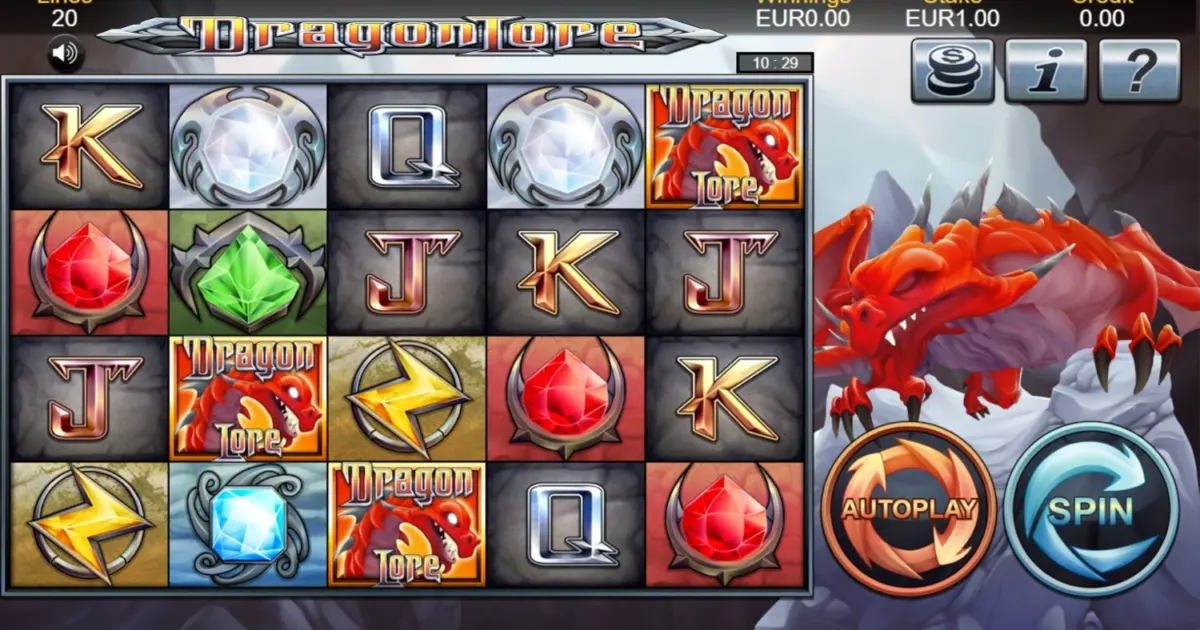
Dragon Lore is a 5-reel Slot Machine from Leander Games with a 95.96% RTP that sits a fraction above the wider average — a measured pick if you want familiar reel play without paying a big statistical price. The dragon lore slot does not publish volatility or feature details in the available data, so your decision comes down to the numbers we can verify and whether you prefer to test that maths in demo first.
Ranked 1,374 across the tracked corpus and sitting in the 93.1st percentile for popularity, it is not a chart-topper but it retains a steady audience within a 62-game provider catalogue. If you compare before you spin, the value here is transparency: you know the return figure, the reel count and the provider context, and you can weigh those against close alternatives.
| Item | Detail |
|---|---|
| Game | Dragon Lore (Leander Games) |
| RTP | 95.96% |
| Reels | 5 |
| Category | Slot Machine / 5-Reels |
| Provider average RTP | 95.73% |
| Corpus average RTP | 95.71% |
| Popularity rank | 1,374 (93.1st percentile) |
| Free demo | Available (no download) |
Dragon Lore at a glance
Dragon Lore is built around a 5-reel format and listed under the 5-Reels theme category, which signals a conventional grid rather than an experimental mechanic. The headline figure is 95.96% RTP, which is 0.25 percentage points above the corpus average of 95.71% and 0.23 points above Leander Games’ own average of 95.73% across 62 titles. That does not make it an outlier, but it means you are not taking a below-average theoretical return to play it.
With a rank of 1,374 and placement in the 93.1st percentile, it sits toward the more-played end of the database without being in the top few hundred. For you, that matters because highly ranked games tend to have more community discussion and more readily available help pages, while mid-ranked titles like this one often fly under the radar and benefit from a quick demo check before you commit time.
Who suits it best? If you like standard 5-reel play, want an RTP that at least matches the market, and prefer to evaluate a game on verifiable maths rather than feature promises, this fits. If you need detailed volatility guidance, published max-win data or a full feature sheet before you try anything, the gaps in the available data will matter — you will be testing feel in demo rather than reading it on paper.
A practical way to compare is to look sideways within the same provider. Diamond Blast Zone offers 96.08% RTP from the same studio, so it gives you a like-for-like reference point at a slightly higher theoretical return. Keeping that comparison in mind helps you frame what 95.96% means in context rather than in isolation.
What a 95.96% RTP actually returns
RTP is a long-run statistical average, not a promise for a single session. A 95.96% figure means that across a very large number of spins — millions, not hundreds — the game is designed to return £95.96 for every £100 wagered, with the remaining £4.04 representing the house edge. Every spin remains independent, and short-term results can swing far above or below that average.
To make that concrete, imagine 1,000 spins at £0.20 per spin. Your total amount wagered would be £200. If the game performed exactly at its theoretical RTP in that sample, the return would be £200 × 0.9596 = £191.92, for a net loss of £8.08. In the same 1,000-spin sample at the corpus average of 95.71%, the expected return would be £191.42, a net loss of £8.58. The 0.50 difference over £200 wagered is small in a single session, which is exactly the point: a 0.25-point edge only compounds into something meaningful over very high volume.
Scale it up and the pattern becomes clearer. Over 10,000 spins at £0.20 (£2,000 wagered), the expected return at 95.96% is £1,919.20 versus £1,914.20 at the corpus average — a £5.00 gap in theoretical loss (£80.80 vs £85.80). Over 100,000 spins, the gap widens to £50. None of this tells you what will happen tonight; variance dominates short samples. What RTP does tell you is the price of entertainment over time, and here that price is marginally lower than average.
Leander Games averages 95.73% across its portfolio, so Dragon Lore at 95.96% sits 0.23 points above its own stable. That consistency suggests the provider is not using this title to offset a low-return outlier; it is priced in line with their normal range. If you want a slightly higher option from the same provider, Alexandria: City of Fortune at 95.89% is close, while the higher comparison noted earlier gives you the upper bound.
Volatility and what your session will feel like
No volatility rating has been published for Dragon Lore in the data provided, and that absence is worth stating plainly. Volatility — sometimes called variance — describes how returns are distributed: low volatility tends to mean more frequent but smaller wins and longer, steadier sessions; high volatility tends to mean fewer hits, larger swings and a greater chance of both extended dry spells and sharp upswings. Without a rating, you cannot know in advance which profile this game follows.
That does not leave you blind. Many slots use volatility to tune the same RTP into very different experiences, so two games at 95.96% can feel nothing alike over 200 spins. Since the figure is not disclosed here, treat any volatility claim you see quoted elsewhere with caution and rely on what you can observe yourself in demo play.
In practical terms, plan for uncertainty. If you go in assuming a medium profile, you can still manage risk by choosing a stake that lets you absorb a run of non-winning spins without shortening your session below what you find enjoyable. Track how often you see any return, how far your balance moves from its starting point over 100–200 spins, and whether the game feels streaky or even. That lived sample will not predict the next spin, but it will tell you whether the rhythm suits your preferences.
Because the provider catalogue is sizable at 62 games, you can also contextualise by trying a known comparator from the same studio. Gem Zone at 95.80% is another Leander Games title with a verifiable RTP close to Dragon Lore, so comparing session feel across the two in demo can help you decide which pacing you prefer without relying on an undisclosed label.
The 5-reel layout and how wins are counted
Dragon Lore uses a 5-reel layout, the most common configuration in modern video slots. In general terms, five reels give designers more room for paylines or ways-to-win systems than three-reel classics, and they allow for a balance between hit frequency and paytable spread. The data supplied confirms the reel count but does not specify the exact number of paylines, whether it uses fixed lines or ways, or how symbols are evaluated.
That distinction matters for how you read the screen. Many 5-reel games evaluate wins from left to right on adjacent reels, sometimes requiring three or more matching symbols on a payline, while others credit any adjacent combination or cluster. Without a published line count for this title, the precise mechanics cannot be asserted here, and you should check the in-game help screen when you load the demo to see whether it uses paylines, ways, or another method.
Reel count also influences session maths in a subtle way. More reels typically allow for more possible symbol combinations, which lets a designer set a given RTP and then distribute returns across many small line wins, occasional medium wins and rarer larger events. How that distribution is tuned is volatility, which as noted is not disclosed. The reel count alone does not tell you whether the game pays little and often or saves most of its return for less frequent spikes.
For comparison, both of the related Leander Games titles mentioned earlier share the same provider approach to reel design, so their help screens can be useful reference points for how this studio typically presents line and win information. Load Dragon Lore and one comparator side by side in demo and you will quickly see whether the win evaluation feels familiar or distinct, without needing to trust a second-hand description.
Stake range and sizing a bankroll
No minimum or maximum stake has been published for Dragon Lore in the supplied data, so a specific £0.10–£100-style range cannot be quoted here. When a stake range is missing, the most useful step is to open the demo and note the lowest and highest options the interface actually allows, as that is the only source you can verify.
Even without a published range, the bankroll principle stays the same. Your stake determines how many spins a given budget buys, and therefore how much variance you can ride through. A £20 budget at £0.20 per spin buys 100 spins if every spin is a loss; at £0.40 it buys 50. Since every spin is independent, a smaller stake does not change the expected value, but it does extend the sample over which that expected value can play out, which many players find more entertaining.
A simple way to size a session is to decide how many spins you want to see — for example, 150 — and then divide your total entertainment budget by that number to set a per-spin figure. If your budget is £30 and you want about 150 spins, £0.20 per spin matches that plan (£30 ÷ 150 = £0.20). If the demo shows a higher minimum, adjust the spin count or the budget rather than stretching beyond what you intended to spend.
Because Dragon Lore’s RTP is 95.96%, the long-run cost per spin averages about 4.04% of your stake. At £0.20, that is £0.00808 per spin in theoretical cost; at £1, it is £0.0404. Those are averages over huge samples, not per-session guarantees, but they give you a consistent way to compare the same stake across games. A higher RTP lowers that average cost slightly, which is why the 0.25-point advantage over the corpus average was highlighted earlier.
Playing the Dragon Lore demo before you commit
Dragon Lore is available as a free demo with no download required, which is the cleanest way to answer the questions the missing data leaves open. Demo play uses the same 95.96% design as the real-money version in principle, but it does not predict what will happen with real funds and it cannot pay out real money. Treat it as a way to learn the interface, see how wins are displayed, and gauge whether the pacing suits you.
Use the demo to check what the data block does not state: the actual stake options, the paytable and line or ways information, and how the game feels over a couple of hundred spins at the stake you would realistically use. Note how often the balance moves, how the game presents wins, and whether the help screens explain the mechanics clearly. That hands-on look is more reliable than any summary that invents features not in the official facts.
Set a budget before you move from demo to any real-money play, and keep it separate from essential costs. Decide in advance how long you want to play and what a comfortable loss limit is, and stop at whichever comes first. All licensed games use random number generators, so no pattern of wins or losses makes a win more likely next spin, and increasing stakes after a losing run does not change the house edge. Play for entertainment, not to recover losses.
You must be 18+ to gamble in the UK. If you ever feel play is no longer just entertainment, use deposit limits, time-outs or self-exclusion tools offered by licensed operators, and seek support from independent services if you need it. Keeping these controls in place before you start is simpler than trying to apply them mid-session.
Verdict: who should play Dragon Lore
Dragon Lore suits players who want a standard 5-reel experience with a verifiable, slightly above-average RTP and who are comfortable evaluating the rest in demo rather than on a spec sheet. The 95.96% figure is 0.25 points above the corpus average and a touch above the provider mean, so on maths alone it does not ask you to accept a below-market return.
It is less suited to those who need a published volatility rating, a detailed feature breakdown or a max-win figure before they invest time. Those gaps do not make it a weak game, but they do shift the work onto you to confirm the feel and the interface yourself. The free demo without download makes that step straightforward.
If you like to compare within the same studio, keep Diamond Blast Zone at 96.08% in mind as the slightly higher-RTP alternative from Leander Games, with Alexandria: City of Fortune and Gem Zone as closer, mid-range reference points. Try Dragon Lore for 150–200 demo spins at a realistic stake, note the actual paytable and stake limits, and let that direct experience decide whether it earns a place in your regular rotation.
Frequently Asked Questions
Can I play Dragon Lore for free without downloading anything?
Yes, Dragon Lore is listed as free demo available with no download required, so you can load it in your browser to check the paytable and pacing. Demo uses virtual credits, does not pay real money and does not predict real-money results, but it is the best way to verify stake options and feel.
What is the RTP of Dragon Lore and what does 95.96% mean in practice?
Dragon Lore has a 95.96% RTP, which means it is designed to return £95.96 per £100 wagered across millions of spins. Over 1,000 spins at £0.20 (£200 wagered), the theoretical return would be £191.92, but short-term sessions can vary widely because each spin is independent.
What volatility does Dragon Lore have and how will that affect my session?
No volatility rating has been published for Dragon Lore in the verified data, so low, medium or high cannot be asserted. Volatility controls how often and how large wins tend to be around the same RTP, so without it you should test 100–200 demo spins at your planned stake to see whether the swing size suits you.
Who makes Dragon Lore and what else do they offer?
Dragon Lore is made by Leander Games, a provider with 62 tracked titles averaging 95.73% RTP. Close studio comparators with verifiable figures include Diamond Blast Zone at 96.08% and Alexandria: City of Fortune at 95.89%, which help you benchmark Dragon Lore's 95.96% in context.
Is there a stake range published for Dragon Lore and how should I set a bankroll?
No minimum or maximum stake is listed in the data for Dragon Lore, so check the in-game demo for the actual options. As a guide, divide your entertainment budget by the number of spins you want — for example, £30 for 150 spins is £0.20 per spin — and remember bet size does not change expected value.