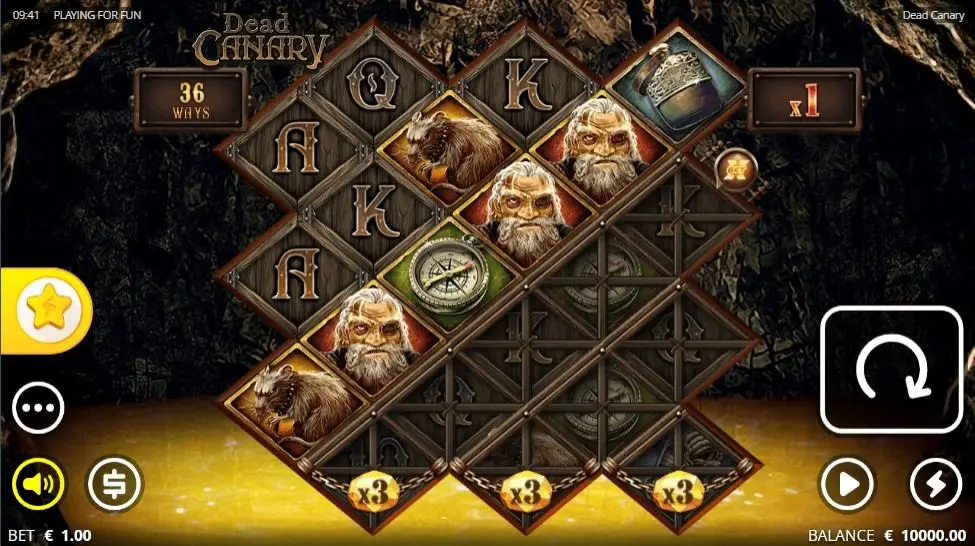
The dead canary slot runs at 94.12% RTP — 1.59 points below the site average and 1.91 below Nolimit City’s portfolio mean. That is the single most important number in this review. If RTP matters to you, it is a hard pass. If you are drawn to the 6-reel layout or want to try something from this provider outside the obvious picks, the free demo lets you form your own opinion without spending money.
Is Dead Canary slot worth playing?
It depends entirely on what you prioritise. Nolimit City publishes an average RTP of 96.03% across its 129 games in this corpus. Dead Canary’s 94.12% is the lowest figure you will find among this provider’s titles listed here. Over a long session, that gap compounds. A player wagering £1,000 on Dead Canary loses £58.80 more in expected terms than the same wager on a 96.03% game.
What Dead Canary does have going for it is availability of a free demo, meaning you can inspect the 6-reel structure and pacing without financial risk. The game holds a 93.2nd popularity percentile, so enough people play it to suggest the layout offers something engaging, even if the maths are unkind.
What 94.12% RTP means over 1,000 spins
RTP is a theoretical return-to-player percentage calculated over millions of simulated spins. It tells you nothing about any individual session. Still, it is the best long-run expectation available.
At 94.12%, every £100 you wager returns £94.12 on average. You surrender £5.88 per £100. Over 1,000 spins at £1 each — £1,000 total wagered — the expected loss is £58.80. At £2 per spin, that doubles to £117.60. Compare this with Nolimit City’s portfolio average: 96.03% costs £39.70 per £1,000 wagered. Dead Canary charges you roughly 48% more per pound spun than the provider norm.
Against the site-wide corpus average of 95.71%, the deficit is 1.59 percentage points, translating to £15.90 extra expected loss per £1,000 wagered. These are averages; your actual result on any given session will scatter wildly. But over thousands of spins across many sessions, the arithmetic holds.
| Specification | Value |
|---|---|
| Provider | Nolimit City |
| RTP | 94.12% |
| Reels | 6 |
| Theme classification | 6-Reels |
| Free demo available | Yes |
| Volatility | Not published |
| Hit frequency | Not published |
| Max win | Not published |
| Stake range | Not published |
How volatile is Dead Canary?
Nolimit City has not published a volatility rating for this title. That absence matters more than it seems. Volatility tells you the shape of your session — whether you will see frequent small wins that extend play or rare large hits followed by long dry spells. Without it, you are planning a bankroll in the dark.
As a general principle, providers sometimes suppress volatility figures on lower-RTP titles because the combination of thin expected return and high swings produces sessions that frustrate players. That is speculation, not fact. What is factual: if you cannot find a volatility figure in the game’s info screen or on the provider’s site, assume the worst-case swing profile and size your session budget accordingly. Try the free demo and time how often you see any return at all — that rough pattern is your only reliable volatility proxy here.
What the 6-Reels layout brings to the game
Dead Canary uses six reels. This is not a visual theme — it is a structural classification. Six-reel slots typically offer more symbol positions than the classic 5×3 format, which opens room for higher “ways” counts or expanded grid mechanics. Nolimit City builds several games on this structure, and it allows for cluster pays, cascading wins, and ways-based systems where winning combinations form through adjacent symbols rather than fixed paylines.
The practical implication for you: six reels create more combinatorial possibilities per spin, which can mean either more ways to hit something or a more complex bonus trigger condition. Without published feature documentation for this specific game, you cannot know which. The demo will show you the trigger logic, but remember that demo outcomes are randomised independently of real-money play — patterns you see are not predictive.
Stakes, session length and bankroll
No stake range is published in the data available here. You will need to check the game’s interface at whichever casino hosts it. What you can do, regardless of min and max stake, is plan session length from the RTP figure.
At 94.12% RTP, the house edge is 5.88%. If you budget £50 for a session and stake £0.50 per spin, you get 100 spins. The expected loss is £2.94 — a short session that could end either well or badly depending on variance. If you want 500 spins, you need a £250 bankroll at £0.50 per spin, with an expected loss of £14.70. The math does not change whether you are playing a $0.20 game or a $100 game — the percentage is the percentage.
Because volatility is unknown, err on the side of more bankroll per spin unit. If your session goes 40 spins without any return, that tells you something about the swing profile the game has not advertised.
Alternatives if Dead Canary is not for you
If the RTP gap is your dealbreaker, Nolimit City has three titles in this corpus that close it. Book of Shadows runs at 96.01%, nearly two points higher and within striking distance of the portfolio average. Fire in the Hole pushes further to 96.06% with its own 6-reel structure, making it the closest mechanical comparison available here. Tombstone RIP tops the provider group at 96.08%.
All three give you more expected return per pound wagered than Dead Canary’s 94.12%. Over 1,000 spins at £1 each, the difference between Dead Canary and Tombstone RIP is £19.60 in expected loss. If you play Nolimit City’s catalogue regularly, those fractions of a percentage point accumulate into meaningful bankroll preservation.
Final take
Dead Canary is a structurally familiar Nolimit City game attached to a below-average return figure. The 6-reel layout and the provider’s reputation for mechanics are reasons to try it. The 94.12% RTP, absent volatility rating, and missing stake data are reasons to walk away or at minimum spend your first session in the free demo rather than on real money.
If you do play it for real, treat it as paid entertainment. Set a hard loss limit before your first spin, stop when you hit it, and never chase. The maths guarantees the house wins over time; your only control is how much you are willing to pay for the experience. You must be 18 or older to play. Gambling can be addictive — if it stops being fun, stop.
More from Nolimit City
- Mental — 96.08% RTP
- Remember Gulag — 96.08% RTP
- San Quentin Xways — 96.03% RTP
- Tombstone Slaughter: El Gordo’s Revenge — 96.01% RTP
- The Rave — 96.09% RTP
- Deadwood — 96.03% RTP
- Misery Mining — 96.09% RTP
- Tombstone RIP — 96.08% RTP
Frequently Asked Questions
What is the RTP of Dead Canary?
Dead Canary has an RTP of 94.12%, which is 1.59 percentage points below the site-wide corpus average of 95.71% and 1.91 points below Nolimit City's portfolio average of 96.03%.
Can you play Dead Canary free with no download?
Yes, a free demo version of Dead Canary is available through Nolimit City's distribution network. You can play it in your browser without downloading software, though the demo uses randomised outcomes that do not predict real-money results.
Is Dead Canary a high or low volatility slot?
Nolimit City has not published a volatility rating for Dead Canary in available data. Without this figure, you cannot reliably predict whether the game delivers frequent small wins or rare large hits. Testing the demo and timing your return frequency is your best alternative.
How does Dead Canary compare to Fire in the Hole?
Fire in the Hole runs at 96.06% RTP versus Dead Canary's 94.12%, a difference of 1.94 percentage points. Both are Nolimit City slots using a 6-reel structure, but Fire in the Hole costs you roughly £19.40 less per £1,000 wagered in expected loss terms.
Is 94.12% RTP bad for a slot game?
It is below average. The corpus-wide mean is 95.71%, and Nolimit City's own portfolio sits at 96.03%. A 94.12% game surrenders £5.88 per £100 in expected value, versus £4.29 for the corpus average and £3.97 for the provider norm — a meaningful gap over extended play.