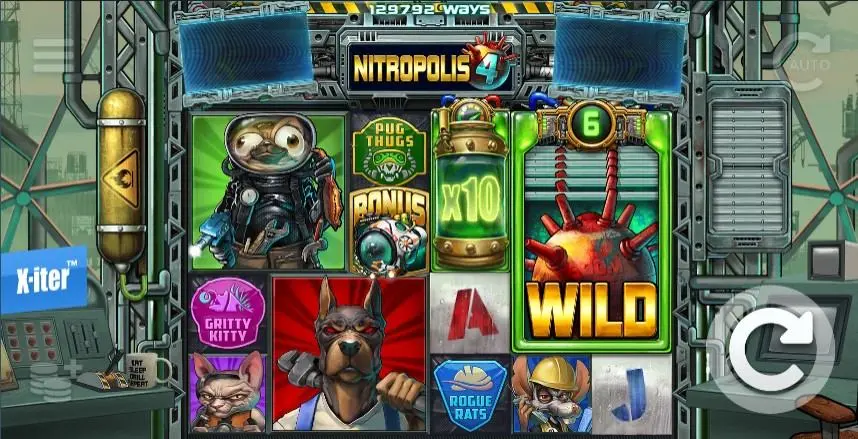
Nitropolis 4 is a high-volatility, 6-reel slot from ELK Studios with a 94% RTP and stakes from $/£/€0.20 to $/£/€50.00. That combination points to a choppy, swing-heavy session where bankroll and patience matter more than hit frequency. If you like longer, higher-risk spins rather than steady small returns, the nitropolis 4 slot deserves a look in demo first.
Nitropolis 4 slot versus the average slot
This game sits below the broader market on return. At 94%, it is 1.71 percentage points below the corpus average of 95.71%, which is a meaningful gap over a large sample. For every £100 wagered, the long-run statistical expectation is £94 returned, compared with £95.71 for the average slot in the dataset. That difference compounds the more you spin and does not even out in a single session.
Rank and breadth help put that in context. The title is ranked 1334 and sits at the 93.3rd percentile for popularity, so it is widely played despite the lower RTP. Its theme group, Technology, contains 163 titles, so you have plenty of direct comparisons if return is your first filter.
Provider context matters too. ELK Studios averages 94.92% across its 138 games, so this release is also below its own studio average by 0.92 points. ELK Studios titles tend to cluster around the mid-94% mark, while the wider corpus pushes closer to 95.7%. If you are choosing purely on maths, that makes Nitropolis 4 a below-average payer on paper, before volatility is even considered.
None of that makes the game unplayable, but it does set expectations. A lower RTP does not change the randomness of any single spin — every result is independent — it just means the house edge is larger over tens of thousands of spins. If you try it, do so knowing you are accepting a steeper long-run cost in exchange for the high-volatility profile that follows, and use the free demo to feel the pace without cost.
| Figure | Value |
|---|---|
| RTP | 94.0% |
| Corpus average RTP | 95.71% |
| Difference vs corpus | -1.71 percentage points |
| Provider average RTP (ELK Studios) | 94.92% |
| Volatility | High |
| Reels | 6 |
| Stake range | $/£/€0.20 – $/£/€50.00 |
| Themes | Technology, 6-Reels, Animals |
| Popularity rank / percentile | 1334 / 93.3rd |
RTP breakdown: 94.0% in context
RTP is a long-run statistical average, not a promise for your session. A 94.0% RTP means that for every $/£/€100 wagered across a very large number of spins — millions, not hundreds — the game is designed to return $/£/€94.00 in total wins, keeping $/£/€6.00 as the house edge. Your actual 100, 500 or even 2,000 spins can deviate wildly from that number in either direction.
To make it concrete, think in sample sizes. Wager $/£/€1 per spin for 1,000 spins, so $/£/€1,000 staked. At 94%, the theoretical expected return across an enormous sample of such 1,000-spin blocks is $/£/€940, an expected loss of $/£/€60. At the corpus average of 95.71%, the expected return would be $/£/€957.10, a loss of $/£/€42.90. The 1.71-point gap therefore represents about $/£/€17.10 more in expected cost per 1,000 $/£/€1 spins compared with the average slot.
That framing matters because RTP interacts with volatility. Two games can share 94% and feel completely different: one might pay many small hits that keep your balance ticking over, another might pay rarely but in larger bursts. The number alone does not tell you how bumpy the ride will be, how long a typical bankroll lasts, or how often you might see a feature trigger in general slot terms. It only tells you the long-run price.
No facts have been published about hit frequency, bonus frequency or max win for this title, so treat any such figures seen elsewhere with caution. Without them, focus on what is certain: the 94% return is below both the studio and corpus averages, and the high volatility label signals that short-term results will stray far from the average. Plan stakes and session length around that uncertainty, not around the headline percentage.
Volatility profile
High volatility describes the shape of returns, not the size of the long-run house edge. In general, high-volatility slots produce fewer winning spins overall, longer dry spells, and larger individual wins when they do pay, compared with low-volatility games at the same RTP. Your balance tends to move in steps rather than a slow drift.
For session planning, that means bankroll and bet size are more important than in a low-variance game. With stakes from $/£/€0.20 to $/£/€50.00, you have room to scale, but the maths does not change with stake: every spin is independent and the expected value remains 94%. Betting $/£/€0.20 extends spin count — $/£/€50 gives you 250 spins at that level — while $/£/€1 gives you 50 spins for the same outlay. Both approaches cost the same per pound wagered over time; the smaller stake simply buys more chances to ride out variance.
Many slots use mechanics such as wilds, scatters, free spins or ways-to-win to create volatility, but no specific features have been disclosed for this title in the available facts, so you should not assume any particular bonus structure is present here. What you can assume is that high volatility increases the chance of quickly losing a session budget as well as the chance of a sharp upswing, often within the same sitting.
If you prefer predictable playtime and steadier feedback, high volatility can feel punishing. If you accept that most sessions may end down and you are comfortable with longer gaps between wins, it can suit. In either case, keep bets consistent and avoid progression systems; raising stakes after losses does not recover expected value, it only increases total exposure on an already high-variance game.
ELK Studios as a studio
ELK Studios is the provider behind this title and has 138 games in the dataset, giving a useful baseline for its house style on maths. The studio averages 94.92% RTP across that catalogue, which is below the corpus average of 95.71% but above this particular release at 94.0%. In other words, Nitropolis 4 is on the lower side even within its own stable.
That average suggests ELK Studios tends to price its games with a slightly larger house edge than the market mean, often paired with distinctive volatility profiles rather than competing on headline RTP alone. Without published hit-frequency or max-win data for this title, the provider average is one of the few objective anchors you have for expectation setting.
For direct studio comparisons, the related ELK Studios titles Pirots 3 and Pirots both sit at 94.0% RTP as well, matching Nitropolis 4 exactly, so switching between them does not improve your long-run expectation. If you want the same studio feel but are looking for better maths, you would need to check individual titles rather than assume the brand average applies to every release, since ELK Studios games vary around that 94.92% mean.
A third related option from the same provider is Pirots 4, also at 94.0%. The fact that three close siblings share the same figure reinforces that 94% is a deliberate level for this line of games, not an outlier. Use that knowledge when comparing catalogues: a 0.9-point gap to the studio mean may seem small, but over thousands of spins it represents a measurable difference in expected cost.
Three Technology alternatives worth comparing
The Technology theme group has 163 games, so there are plenty of alternatives if you like the label but want different maths. Comparing RTP is the cleanest way to do that, because it is the only figure disclosed consistently across the group for this article.
Peak Power is a Technology-tagged alternative at 96.02% RTP, which is 2.02 points above Nitropolis 4 and 0.31 points above the corpus average. On a $/£/€1,000 staked sample, its theoretical expected return is $/£/€960.20 versus $/£/€940 for Nitropolis 4 — about $/£/€20.20 less in expected loss for the same turnover. That does not guarantee a better single session, but it does mean a lower long-run price if you play at volume.
My Slot offers a similar step up at 96.03% RTP, fractionally higher than Peak Power and also above both the studio and corpus averages. If your priority is maximising statistical return within the same theme, that makes it a straightforward comparison point, especially if you are sensitive to the 94% level here.
A third option is Retro Tokyo at 95.5% RTP. It sits below the two above but still 1.5 points above Nitropolis 4 and just below the corpus mean of 95.71%. It illustrates the middle ground: not the highest payer in the theme, yet materially cheaper on expected value than 94% over extended play. Since this title also carries 6 reels and an Animals secondary tag alongside Technology and 6-Reels, you may find the reel structure familiar while getting a different return profile.
Getting the most out of the free demo
Free demo is available for this game, and with high volatility it is the most useful tool you have. Use it to gauge pace — how often the balance moves, how long dry spells feel at your preferred stake — without assuming those demo results predict real-money outcomes. Demo and real play use the same stated RTP in principle where offered, but randomness means neither predicts the other in the short term.
Treat the demo as a structured test. Set a notional bankroll that matches what you would actually spend, pick a fixed bet within the $/£/€0.20 to $/£/€50.00 range, and run a defined block such as 200–300 spins without changing stake. Note how many spins your balance survives and how large the swings are. That gives a better sense of session length than any description can. Many slots in general include concepts like wilds, scatters or free spins, but since no specific features are confirmed for this title, focus the demo on rhythm and cost per spin rather than hunting for a particular bonus you may have read about elsewhere.
Keep responsible play front and centre. You must be 18+ to play, set a budget before you start and treat slots as paid entertainment, not a way to make money. Decide a loss limit and a time limit in advance, never chase losses, and step away if play stops being enjoyable. If you need support, use licensed responsible-gambling tools and services in your jurisdiction. The demo is there to help you decide if the game’s pace suits you, not to suggest that practice improves your odds.
Should you play Nitropolis 4?
Play it if you are comfortable trading return for variance. The maths is clear: 94.0% is below the corpus average and below the ELK Studios average of 94.92%, and high volatility means your short-term results will swing hard around that already below-average expectation. The six-reel format and $/£/€0.20 minimum keep it accessible for longer, low-stake tests, while the $/£/€50.00 ceiling gives headroom if you prefer larger bets without changing expected value per pound staked.
Think about why you would choose it over the Technology alternatives above. Peak Power at 96.02% and My Slot at 96.03% both offer materially better long-run value on paper, and Retro Tokyo at 95.5% sits in between. If theme alone drives your choice, Nitropolis 4 remains an option, but on RTP alone it is the most expensive of that set by a clear margin. Its popularity rank of 1334 shows it finds an audience despite that price, likely among players who specifically want its volatility profile.
The honest verdict is to demo first and let the numbers guide you. Use the Nitropolis 4 free demo with a realistic notional bankroll, keep stakes level, and see if the swing pattern suits your tolerance. If you notice the balance dropping quickly or sessions ending earlier than you like, that is high volatility doing what its label says, not the game being due or cold. With no published max win figure to anchor upside expectations, focus on what is known: the 94% return, the high variance, and the stake range, and decide whether that trade-off feels like entertainment worth paying for.
Frequently Asked Questions
Can I play Nitropolis 4 for free before wagering real money?
Free demo is available for Nitropolis 4, so you can try it without staking real funds. Use a fixed notional bet within the $/£/€0.20 to $/£/€50.00 range and a set spin block to gauge its high-volatility pace. Demo play uses the same stated 94% RTP in principle, but short-term results remain random and do not predict real-money outcomes.
What is the RTP of Nitropolis 4 and what does it mean for my session?
Nitropolis 4 has a 94.0% RTP, which is 1.71 points below the corpus average of 95.71%. Long-run, it theoretically returns £94 per £100 wagered across millions of spins, but any single session can vary widely. Over 1,000 spins at £1, expected return is £940 versus £957.10 for an average slot, though actual results are random.
How volatile is Nitropolis 4 and how should I plan my bankroll?
Volatility is listed as high, meaning fewer but larger wins and longer dry spells compared with low-volatility games at the same RTP. With stakes from $/£/€0.20 to $/£/€50.00, a £50 budget gives 250 spins at £0.20 but only 50 at £1. Keep bets level, because every spin is independent and raising stakes after losses does not change the 94% expected value.
Who makes Nitropolis 4 and what else do they offer?
ELK Studios developed Nitropolis 4 and has 138 games in the dataset, averaging 94.92% RTP. Related ELK Studios titles Pirots 3 and Pirots both have 94.0% RTP, matching Nitropolis 4 exactly, while Pirots 4 is also at 94.0%. The studio average sits below the corpus mean of 95.71%, so individual game RTPs vary around that level.
How does Nitropolis 4 compare to other Technology slots?
Within its Technology theme of 163 games, Nitropolis 4 at 94.0% sits below several peers. Peak Power offers 96.02% and My Slot offers 96.03%, both above the corpus average, while Retro Tokyo is at 95.5%. Those alternatives provide lower long-run expected cost for the same turnover, though short-term variance can still differ markedly on any given session.