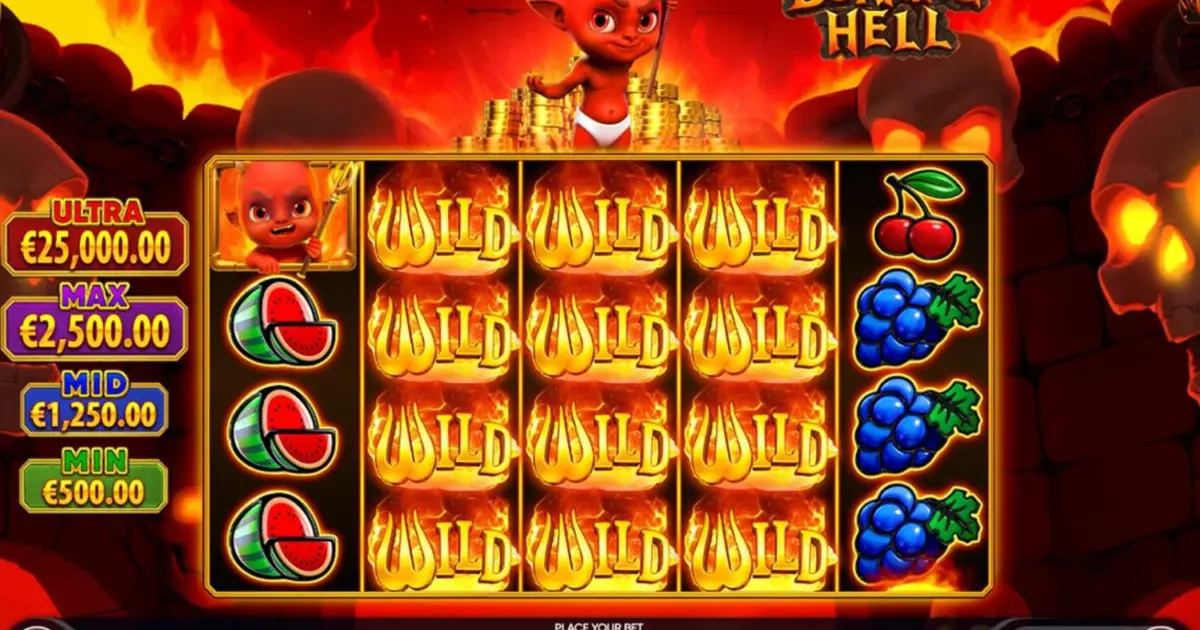
Endorphina’s Burning Hell slot offers a 96.01% RTP on a five-reel layout, placing it marginally above both the provider’s own average and the broader corpus. The immediate problem for comparison shoppers: volatility, payline structure, stake range, and max win are all absent from Endorphina’s published specification sheet, which makes long-term session planning difficult.
Burning Hell Slot at a glance
Before you decide whether this game fits your bankroll, here is everything Endorphina has confirmed:
| Specification | Value |
|---|---|
| Provider | Endorphina |
| RTP | 96.01% |
| Reels | 5 |
| Volatility | Not published |
| Paylines | Not published |
| Stake range | Not published |
| Max win | Not published |
| Free demo | Available |
| Popularity rank | 1326 (93.4th percentile) |
At rank 1326 out of the full corpus, Burning Hell sits in the 93.4th percentile for popularity — meaning it attracts more players than the vast majority of titles catalogued here. That ranking likely reflects Endorphina’s reputation rather than standout numbers, since the RTP is close to corpus average and no other headline figure is available.
What a 96.01% RTP actually returns
RTP is a long-run average calculated across millions of simulated spins. No single session will produce a 96.01% return; you will either beat it or lose to it. To make the figure concrete, suppose you spin 1,000 times at a theoretical 1.00 per spin (Endorphina has not confirmed a stake range, so treat this as illustrative). Across that sample you would wager 1,000 and the expected loss is 3.99 — roughly four units of your bankroll consumed by the house edge.
The corpus average RTP here is 95.71%, so Burning Hell gives you 0.30 percentage points more back over a large sample than the median game. In practical terms, that gap narrows your long-run house edge from 4.29% to 3.99%. Across Raging Wings, another Endorphina title at 96.06%, the gap shrinks by a further five basis points — a difference visible only across tens of thousands of spins.
If you play only 200 or 300 spins per session, volatility dominates outcome and the 0.3% RTP advantage is statistically meaningless.
Volatility and what your session will feel like
Endorphina has not published a volatility rating for Burning Hell, which is a genuine problem for bankroll planning. Volatility tells you how large and how frequent swings are — it determines whether you will grind through a 200-spin session with small wins and occasional dead stretches, or whether you will see long losing runs punctuated by one large payout.
Without that classification, you cannot responsibly size a bankroll. As a general rule, low-volatility slots suit players who want extended entertainment per unit staked, while high-volatility titles demand larger reserves to survive dry stretches before any meaningful payout lands. A medium-volatility game falls between those poles and is the most common classification among Endorphina’s output.
Since the theme field only lists “5-Reels” with no descriptor attached, there is no reliable signal about the game’s bonus structure that might hint at volatility. The 2025 Hit Slot from the same provider carries a comparable RTP of 96.05% but is at least classified as a slot machine with published volatility data, giving comparison shoppers more to work with.
The 5-reel layout and how wins are counted
Five reels is the standard modern configuration. Endorphina has not published whether Burning Hell uses fixed paylines, adjustable lines, or a ways mechanic. These three systems produce very different hit frequencies and pay structures even at identical RTP.
Fixed paylines mean you win only when matching symbols land along specific predetermined paths. Adjustable lines let you choose how many of those paths are active per spin — fewer lines mean fewer opportunities to win but lower cost per spin. Ways systems (243, 1024, etc.) count wins when matching symbols land on adjacent reels regardless of row position, typically producing more frequent but smaller payouts.
Without this information, you cannot predict how often a spin will return something. Demo play is the only way to form a rough sense of hit density before committing money. The Urartu demo from Endorphina sits at the same 96.00% RTP tier and may share a similar structural philosophy if you want a second reference point from the same provider.
Stake range and sizing a bankroll
Endorphina has not published a minimum or maximum stake for Burning Hell. This is the single most consequential omission because your entire bankroll strategy depends on it. A 0.10-per-spin minimum lets a 50-unit budget cover 500 spins; a 0.50-per-spin floor cuts that to 100 spins and dramatically changes your exposure to variance.
As a general framework, if you do discover the stake range through demo play, divide your planned entertainment budget by the minimum stake to find your available spin count, then divide again by ten to estimate how many full RTP cycles (in the statistical sense) you can observe. Below about 200 spins, your result is dominated by variance regardless of whether the game returns 96% or 99% in the long run.
If the maximum stake is unusually high, that signals the provider expects players to chase larger absolute payouts, which usually correlates with higher volatility — but this is inference, not confirmation.
Playing the Burning Hell free demo before you commit
Endorphina has made a no-download demo available for Burning Hell. This is not a trivial concession — the demo lets you observe the actual spin rhythm, approximate the hit frequency, and gauge the feel of wins without risking a single unit of real money.
Use it specifically for the data gaps: count how many spins pass between winning combinations, note whether bonuses appear frequently or rarely, and test whether the stake selection lets you extend a session to several hundred spins. Demo results do not predict real-money outcomes, and every spin is independent regardless of what you observed in the demo.
If you do move to real money, set a strict budget before you start, treat the session as paid entertainment rather than an investment, and stop when the budget is gone regardless of how the last few spins went. You must be 18 or over, and if gambling stops feeling like entertainment, that is the signal to stop entirely.
Verdict: who should play Burning Hell
Burning Hell is a mid-tier Endorphina title with a respectable RTP but an unusually incomplete specification sheet. If you are someone who plans sessions around published volatility and stake ranges, this game will frustrate you — the data simply is not there. If you already enjoy Endorphina slots and value their visual polish over statistical transparency, the 96.01% RTP is close to their Raging Wings at 96.06%, and the popularity ranking suggests the provider’s usual production quality is intact.
The 93.4th-percentile ranking is the strongest argument for giving it a spin in demo mode at minimum. You lose nothing by testing it, and you gain the only information Endorphina has not volunteered: what it actually feels like to play. Treat the 0.30-percentage-point RTP advantage over the corpus as negligible at realistic session lengths — it is a rounding error against the variance that volatility (or the lack of published volatility data) will impose.
Frequently Asked Questions
What is the Burning Hell RTP and is it good?
Burning Hell has a 96.01% RTP according to Endorphina's published data. This is slightly above the corpus average of 95.71% and marginally above Endorphina's own provider average of 95.95%. In practice, the 0.3-percentage-point advantage over the median game is invisible across sessions shorter than several thousand spins.
Can I play Burning Hell for free?
Yes, Endorphina has made a free demo version of Burning Hell available. The demo lets you observe spin frequency, approximate hit patterns, and test the stake range — all data points that Endorphina has not published in the game's official specification sheet.
Is Burning Hell high or low volatility?
Endorphina has not published a volatility rating for Burning Hell. This is unusual and means you cannot reliably plan a bankroll before playing. The demo is your best tool for forming a subjective impression of swing size and dead-spin frequency before risking money.
What other Endorphina slots have similar RTP to Burning Hell?
Raging Wings and 2025 Hit Slot both sit within 0.06 percentage points of Burning Hell's 96.01% RTP. Urartu matches it almost exactly at 96.00%. With 217 titles in Endorphina's catalogue, the provider averages 95.95% — so Burning Hell is a hair above its own house standard.
What are the minimum and maximum stakes for Burning Hell?
Endorphina has not published a stake range for Burning Hell. You will need to open the game — free demo or real money — to see what minimum and maximum bets the interface allows. This information is essential before sizing any bankroll.