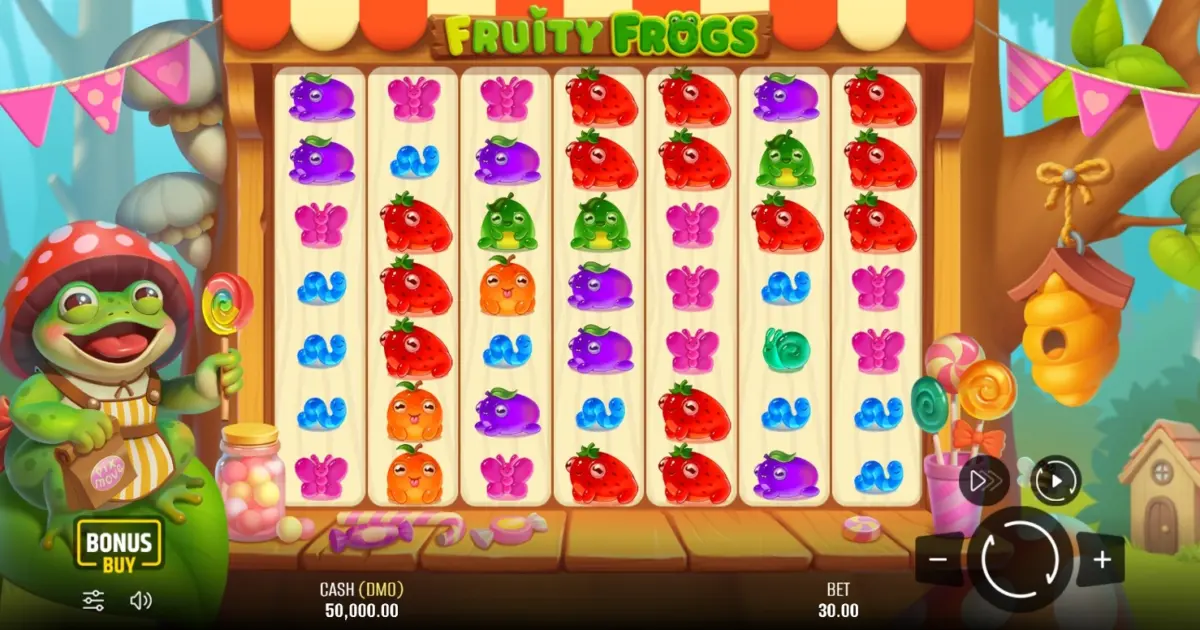
Should you bother with the Fruity Frogs slot? The short answer is that it offers a below-average theoretical return and no published data on volatility, hit frequency or maximum win to offset that deficit. If you play Sweets-themed games, stronger options exist.
Fruity Frogs slot versus the average slot
Our database places this game 0.71 percentage points behind the corpus average of 95.71% RTP. Concretely: for every £100 wagered across a very large sample of spins, Fruity Frogs returns £95.00 in theoretical terms versus £95.71 for an average title in our index. That 71-pence difference per £100 sounds trivial on a single spin, but it compounds across a session. At £1 per spin over 1,000 spins (£1,000 total staked), the expected structural loss versus the corpus average is roughly £7.10. No single game tells you whether a session will be profitable — variance and luck dominate short runs — but when you compare two slots side by side, this gap is the number that separates them over thousands of spins. A free demo run cannot resolve that question, because demo outcomes and real-money outcomes share the same underlying random-number logic, not a shared session history.
RTP breakdown: 95.0% in context
Return-to-player is a long-run statistical average, not a per-session guarantee. At 95.0%, the house edge is 5.0%. Over 10,000 spins at £1 each (£10,000 staked), the expected loss is £500. The distribution around that mean depends on volatility, which remains unpublished for this title.
What matters more is the comparative gap. Pixmove’s own catalogue averages 96.36% RTP, making Fruity Frogs 1.36 points below its developer’s baseline. That’s unusual. A provider typically clusters its games within one point of its own mean; a gap this wide from the studio average suggests either a deliberate trade-off for animation budget or a title released under a different licensing model. Cave Mystery, another Pixmove game, also sits at 95.0%, so the below-average mathematics appears to be a feature of part of the catalogue rather than this game alone. But Rotten Bottom and La Mafia from the same provider both return 97.0%, confirming that Pixmove publishes higher figures when it chooses to.
Volatility profile
No volatility rating is published in our data for Fruity Frogs. This absence is itself informative: without a confirmed tier, any “medium” or “high” label you encounter on a third-party site is an editorial guess, not a studio figure. In real play, that means you cannot plan your bankroll to a known rhythm — you won’t know whether the game delivers frequent small clusters or rare, larger payouts.
The seven-reel format is common in cluster-pay and scatter-pay structures, which statistically tend toward medium-to-high volatility because winning combinations require multiple symbols landing in adjacent positions rather than lining up on one of perhaps 20 paylines. This is inference from reel count, not confirmed data. The table below summarises everything we can state with certainty.
| Detail | Value |
|---|---|
| Provider | Pixmove |
| RTP | 95.0% |
| Reels | 7 |
| Theme | Sweets |
| Volatility | Not published |
| Max win | Not published |
| Stake range | Not published |
| Hit frequency | Not published |
| Free demo | Available |
Four out of nine key fields are absent. For a reader trying to decide whether to commit real money, that’s a significant blind spot.
Pixmove as a studio
Pixmove holds 23 games in our database, placing it in the smaller-catalogue tier. Studios this size typically build around a narrow mechanic set rather than the sprawling feature libraries of larger providers. The 23-title average RTP of 6.36% sits comfortably above the 95.71% corpus average, which means Pixmove as a brand is respectable — Fruity Frogs simply isn’t representative of that brand. If you want the same provider at higher maths, Rotten Bottom returns 97.0% RTP, a full 2.0 points above Fruity Frogs. That’s a meaningful gap: across 500 spins at £1, the difference in expected return is roughly £10. On the other hand, Cave Mystery matches Fruity Frogs at 95.0%, so the lower-RTP approach is consistent across a subset of the catalogue rather than an isolated decision.
Three Sweets alternatives worth comparing
The Sweets theme covers 313 games in our index, so choosing between them is straightforward when you have numbers. Sweet Bonanza returns 96.51% RTP — 1.51 points above Fruity Frogs. At £1 per spin over 1,000 spins, that translates to £15.10 in additional expected return. It is the clearest upgrade path in this category. Lollipop Drop MultiMax sits at 94.0%, which is 1.0 point below Fruity Frogs, so within the Sweets genre this title is actually stronger than the weakest comparison you might assume. Sugar Land has no RTP figure in our database, meaning you cannot make a mathematically informed choice without checking the in-game info screen yourself. A missing RTP in a review database is not a neutral fact — it means nobody has confirmed the number, and you should treat the game as unproven until you verify it.
Getting the most out of the Fruity Frogs free demo
The Fruity Frogs free demo lets you spin all seven reels without staking real money. Its purpose is mechanical: learn how clusters form, read the paytable, decide whether the game’s visual pace holds your attention. It cannot tell you whether you will enjoy the real-money experience, because demo and real-money sessions share identical random-number generation but produce entirely different emotional and financial contexts. A lucky demo run does not predict anything about future real-money outcomes — every spin is independent.
Use the demo to set expectations, then treat the transition to real play as a budgeting exercise. Decide your loss limit before your first real spin. There is no stake progression, timing pattern or reel-count strategy that alters expected value below the stated RTP. Only play if you are 18 or over, and only with money you can afford to lose without affecting anything else in your life.
Should you play Fruity Frogs?
Fruity Frogs delivers a below-average RTP with four out of nine key data points unpublished. If you enjoy the Sweets aesthetic and the seven-reel format specifically, the game is a reasonable entertainment choice — you’re paying 71 pence per £100 in structural value compared to the corpus average, and 1.36 points compared to its own provider’s baseline. That’s a fair price for a preference. But if you’re choosing between games on mathematical grounds, this title offers no reason to prefer it. The strongest Sweets comparison in our data is Sweet Bonanza, and the strongest same-provider comparison is Rotten Bottom. Fruity Frogs is a game you might enjoy for its theme; it is not a game you should choose for its numbers.
Frequently Asked Questions
Can I play Fruity Frogs for free without downloading anything?
Yes, Fruity Frogs is available as a free demo with no download required. The demo uses the same game logic as real play, so you can learn the seven-reel format and paytable structure before committing money. Demo results do not predict real-money outcomes, since every spin on both versions is independently random.
What is the RTP of Fruity Frogs and how does it compare?
Fruity Frogs has an RTP of 95.0%, which places it 0.71 points below the 95.71% corpus average and 1.36 points below Pixmove's own studio average of 96.36%. Over 10,000 spins at £1, the expected structural loss is £500. The gap matters most across long sessions rather than individual spins.
Is Fruity Frogs high or low volatility?
Pixmove has not published a volatility rating for Fruity Frogs in our data. The seven-reel format is commonly associated with cluster-pay mechanics that tend toward medium-to-high volatility, but that is inference, not confirmed information. Treat any specific label on third-party sites as unverified without a provider-published figure.
How does Fruity Frogs compare to other Pixmove games?
Pixmove has 23 titles in our database with an average RTP of 96.36%. Fruity Frogs at 95.0% underperforms that mean. Rotten Bottom and La Mafia both offer 97.0%, while Cave Mystery matches 95.0%. If you prefer Pixmove mechanics, Rotten Bottom provides 2.0 more RTP points from the same studio.
Does Fruity Frogs have better maths than Sweet Bonanza?
No. Sweet Bonanza returns 96.51% RTP compared to Fruity Frogs at 95.0%, a difference of 1.51 percentage points in favour of Sweet Bonanza. Both sit in the Sweets theme category. Over 1,000 spins at £1, the expected-return gap between them is roughly £15.10 in favour of Sweet Bonanza.