Flash Gordon (Cristaltec) slot sits at 93.41% RTP — 2.3 points below the tracked corpus average of 95.71%. That gap compounds over a session. Whether you bother with it depends on how much you value theme over maths, and how comfortable you are playing a game with so much missing data.
The 6-reel grid explained
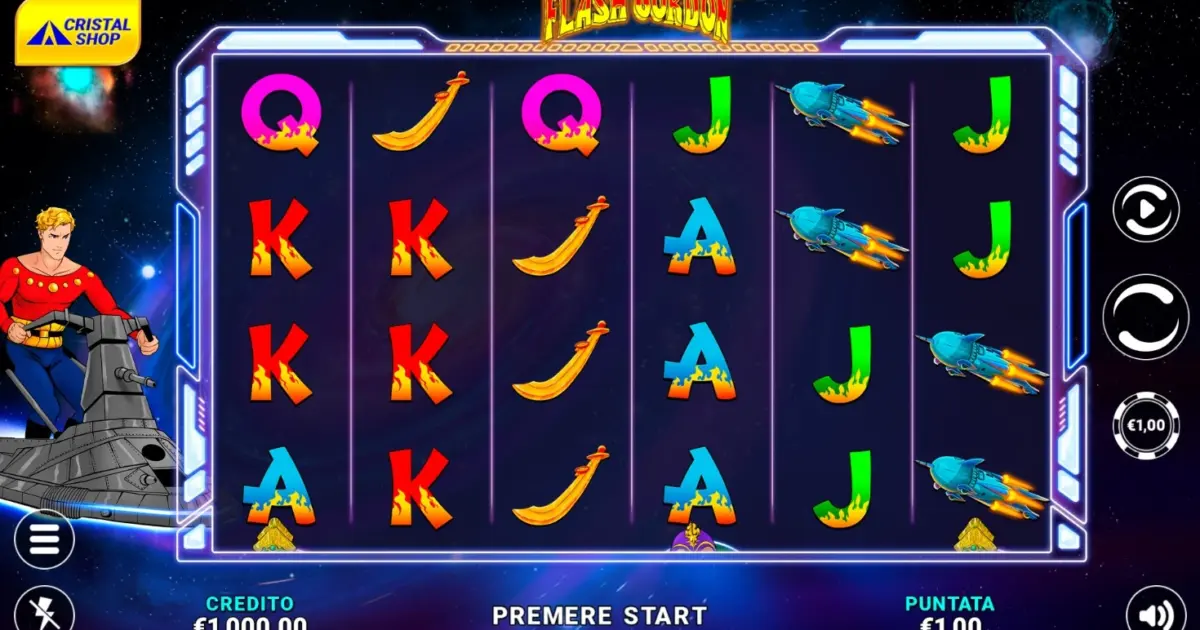
The game runs six reels. A 6-reel layout is less common than the traditional 5×3 grid, and it changes the math in a specific way: with an extra column, there are simply more positions where matching symbols can land, which typically creates more opportunities to form winning combinations on any given spin.
Cristaltec has not published the exact row count for this grid, so you’re working with a reel-count label only. Many 6-reel slots use either a fixed-height layout (every reel showing the same number of rows) or a variable-height layout where reels expand during triggered features. You can identify which by spinning the demo and watching whether row counts change between base game and any bonus sequence.
The theme labels — Comics, Super heroes, Space and galaxy — tell you this sits in a crowded niche. There are 92 games tagged Comics in the tracked corpus. The visual style draws on comic-book aesthetics; the space and galaxy label suggests the setting extends beyond a single panel’s frame. Beyond that, no further visual or audio detail is available.
If you’re already familiar with 6-reel games, this grid puts it in a category where mechanics matter more than art direction. Comic Craze shares the Comics theme and offers a point of comparison on format.
| Provider | Cristaltec |
|---|---|
| RTP | 93.41% |
| Reels | 6 |
| Theme | Comics |
| Free demo | Yes |
Paylines, ways and how Flash Gordon (Cristaltec) pays
No payline count or “ways” figure appears in available data for this title. That’s a real gap: without knowing whether the game uses fixed paylines, Megaways-style expanding reels, or cluster pays, you cannot calculate the exact number of winning combinations available on any spin.
What you can reason from: 6 reels with no published payline figure suggests either a ways-based system (commonly 1,000, 5,000 or more ways) or a cluster-pays format where adjacent matching symbols pay regardless of line position. Both formats tend to produce more frequent small wins than a traditional 20-line game, because many more symbol arrangements qualify as wins.
To determine the actual mechanic, spin the demo and watch how wins are highlighted. If connected symbols light up in blocks rather than horizontal or diagonal lines, you’re looking at a cluster game. If only symbols on specific reels count within a defined pattern, you have a ways or fixed-payline layout.
This ambiguity matters because it affects session planning. Cluster games and high-ways games behave differently from 25-line slots over a session — not necessarily in expected value, but in the rhythm of wins and the distribution of bet between base game and features.
93.41% RTP put in context
The published RTP is 93.41%. Across the broader corpus, the average sits at 95.71%. That places this title 2.3 percentage points below the field — a meaningful distance, not a rounding error.
RTP is a long-run statistical average. Over a very large sample, 93.41% means £93.41 returned per £100 wagered. The theoretical house edge is 6.59%. At the corpus average, the edge drops to 4.29%. Each £100 you stake here carries a 53% higher expected loss per unit wagered compared to an average slot — the difference between 6.59% and 4.29%.
Cristaltec’s own provider average is 93.6%, meaning this title sits at the provider norm rather than above it. The house edge across Cristaltec slots is consistently high compared to major providers. Their other games tell the same story: Cauldron of Secrets sits at 93.57%, The Clown at 93.12%, and the best performer in the tracked sample, 7 on Fire JP, only reaches 94.38% — still below the corpus average.
If RTP is your primary filter and you want a comic-themed alternative with stronger math, Billyonaire returns 96.0%, over 2.5 points higher.
Volatility and hit patterns
Cristaltec has not published a volatility rating for this game. No low, medium or high label appears in available data. Hit frequency is also absent. You cannot pre-plan a session with confidence.
In general terms: high volatility means long dry stretches punctuated by larger payouts, requiring a deeper bankroll to survive the lean periods; low volatility means frequent small wins that sustain a session but rarely produce dramatic swings. Medium sits between, offering a balance of hit frequency and payout size.
The 6-reel format leans toward higher variance in most implementations, because more reels create more opportunities for both near-misses and large combinations. This is a general observation about reel counts, not a confirmed property of this specific game.
If you switch to real money, treat the first 50–100 spins as information-gathering. Count how many produce a return above your stake. That rough ratio, combined with how large wins feel relative to dry spells, will give you a personal volatility read that the provider hasn’t supplied through official channels.
Choosing a stake — the missing data
No minimum or maximum stake range is listed for this title. That absence has direct consequences: you cannot calculate how many spins your bankroll covers, and you can’t assess whether the game suits your preferred bet size.
Cristaltec games distributed through smaller networks sometimes cap stakes lower than mainstream providers. A £0.10 minimum gives a £20 bankroll 200 spins; a £0.50 minimum drops that to 40. The difference in session length is enormous, and it determines whether you experience the game as entertainment or as a five-minute coin flip.
Until you see the actual bet range in the game interface, plan conservatively. Start at the lowest available stake, confirm your bankroll supports at least 200 spins at that level, and only increase once you’ve observed the win frequency firsthand. Given the unpublished volatility, that caution applies doubly.
Demo play versus real money
A free demo is available for this game. The Flash Gordon (Cristaltec) free demo uses a simulated balance — it tracks wins and losses identically to the real-money version mathematically, but no funds move. You cannot convert demo credits to cash, and the result of any demo spin has no bearing on what the real-money version will produce. Every spin is independent of all previous spins.
The demo’s value is mechanical: you can confirm the reel layout, observe how wins are announced, estimate the rough rhythm of the game, and test whether you find the pacing enjoyable before risking money. It does not predict your future session outcome.
If you do switch to real money, treat it as paid entertainment. Set a budget before you open the game — an amount you’re comfortable losing entirely — and stop when it’s gone. This game’s 93.41% RTP means the house edge is fixed; no amount of timing, pattern or stake adjustment changes the expected value on any individual spin. 18+ only.
Verdict on Flash Gordon (Cristaltec)
This is a niche title with a clear weakness: 93.41% RTP puts it well behind the market average, and Cristaltec hasn’t published volatility, hit frequency, stake range, payline structure or win mechanics. You’re making decisions with almost no planning information.
The popularity percentile of 94.1 tells you that among tracked games, this one attracts more attention than 94% of the catalogue — but attention and expected value are unrelated. Comic-themed and superhero games have a dedicated audience, and overall rank 1180 means a large crowd sits ahead of it.
The free demo lets you test the mechanics at zero cost. For a mathematically stronger comic-themed option, King Kong Cash returns 95.79% — 2.38 points higher, with published data on volatility and features.
Good if you’re paying for theme; poor if you’re paying for value. The maths here is not in your favour relative to the rest of the market, and the missing data means you’re accepting extra uncertainty on top of an already high house edge.
Frequently Asked Questions
Can you play Flash Gordon (Cristaltec) for free?
Yes, a free demo is available. It uses a simulated balance that mirrors the real-money version's maths without any funds moving. You can test reel behaviour, win frequency and pacing before deciding whether to play with real money.
What is the RTP of Flash Gordon (Cristaltec)?
The published RTP is 93.41%, meaning the theoretical house edge is 6.59%. That sits 2.3 percentage points below the corpus average of 95.71% and roughly matches Cristaltec's provider average of 93.6%.
What volatility does Flash Gordon (Cristaltec) have?
Cristaltec has not published a volatility rating or hit frequency for this game. You cannot determine the risk profile from official data alone. The 6-reel format suggests higher variance in general, but that remains unconfirmed for this specific title.
What other games does Cristaltec make?
Cristaltec has 8 tracked games. Their RTPs cluster around 93–94%: The Clown at 93.12%, Cauldron of Secrets at 93.57%, and 7 on Fire JP at 94.38%. All sit below the corpus average, making the provider a consistent low-RTP group.
How does Flash Gordon (Cristaltec) compare to King Kong Cash?
King Kong Cash returns 95.79% RTP versus Flash Gordon's 93.41% — a 2.38-point difference. Both share the Comics theme. King Kong Cash also has published volatility data, giving you more information to plan a session before you play.