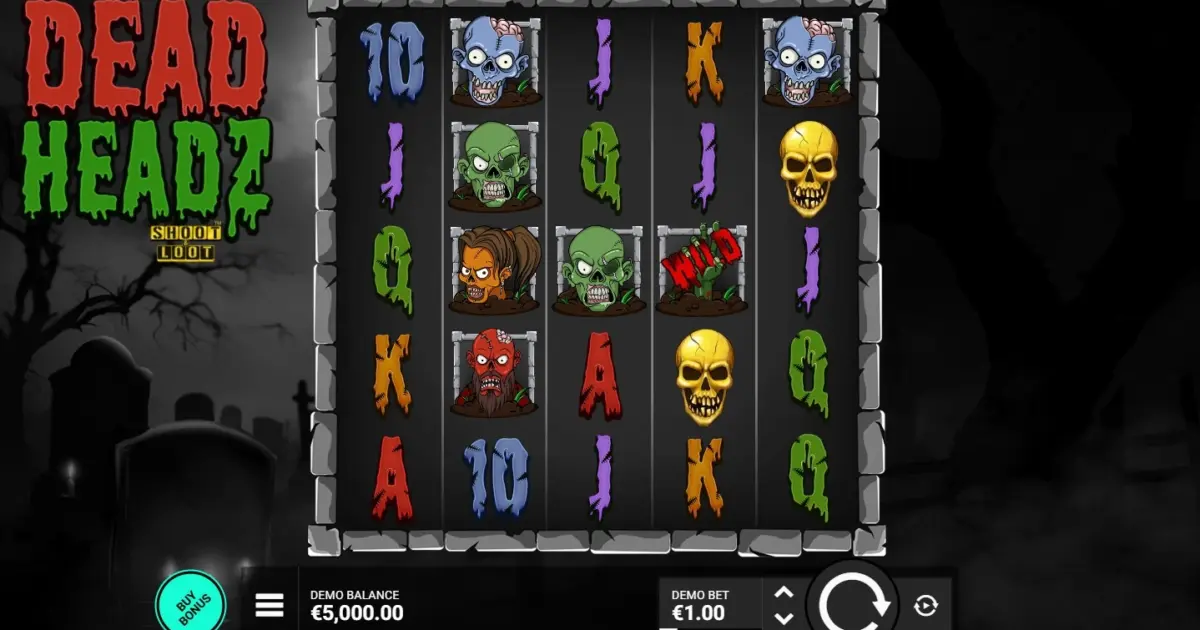
Dead Headz is a five-reel horror slot from JINX Gaming, a studio whose entire catalogue consists of this single title. Its 96.31% RTP places it above the site-wide average of 95.71%, but the provider publishes no feature breakdown, volatility label, or stake range—so your first decision is whether those gaps are dealbreakers before you load the demo.
First look at the Dead Headz slot
JINX Gaming released Dead Headz as its debut and only entry, which tells you something important: this is a brand-new studio testing a single concept rather than an established provider iterating on a proven formula. The game runs on five reels and carries the Horror and scary theme tag, placing it among 479 similarly themed titles in the corpus.
At popularity rank 1177 with a 94.1 percentile, Dead Headz outperforms the majority of available games in player interest—likely boosted by curiosity around a one-game provider rather than sustained engagement. If you are comparing it against established horror slots, you will notice that JINX Gaming has no portfolio to evaluate for consistency. There is no track record, no house style, no second example to confirm whether the math behind Dead Headz reflects deliberate design or a one-off implementation.
The five-reel format is standard. What the reels contain—wilds, scatters, multipliers, any special symbols—remains undocumented by the provider.
How a round plays out
The FACTS sheet gives you five reels and a slot machine classification. That is the full mechanical picture available. You cannot determine from published data whether Dead Headz uses fixed paylines, a ways mechanic, cluster pays, or any other win structure.
In general, five-reel slots occupy the middle ground between three-reel classics and complex six-or-seven-reel cascading titles. A standard five-reel layout with a fixed payline count typically offers moderate hit frequency—enough action to maintain engagement without the rapid micro-wins of high-frequency cluster games. But without JINX Gaming confirming payline count or win method, you are guessing at session rhythm.
No bonus features, free spin triggers, or pick-em rounds are listed in the available data. Whether these exist and simply are not documented, or whether Dead Headz is a base-game-only title, remains an open question. The free demo is your only way to answer it.
Reading the 96.31% return figure
RTP is a long-run statistical average calculated across millions of spins by the provider during certification. At 96.31%, the theoretical return means that for every £100 wagered across an extremely large sample, £96.31 is returned to players collectively. The house retains £3.69 per £100 over that same horizon.
Dead Headz sits 0.60 percentage points above the corpus average of 95.71%. That is not a dramatic edge, but it is meaningful: over 1,000 spins at £1 each, the theoretical difference between 95.71% and 96.31% return is £6. In practice, variance will swamp that gap within any realistic session length, but the figure confirms the game is not intentionally stingy.
JINX Gaming’s provider average RTP is also 96.31%—not because they have diversified and balanced their portfolio, but because Dead Headz is their only product. There is no way to confirm whether this figure reflects a deliberate mathematical philosophy or a single implementation choice that happened to land in a conventional range.
One caution: RTP is measured by the provider under controlled conditions. Individual casino configurations cannot alter a certified RTP, but the number only becomes reliable across millions of spins. Your session will almost certainly deviate substantially from the expected value.
Why the missing volatility rating changes your bankroll maths
JINX Gaming has not published a volatility classification for Dead Headz. This is a genuine problem for bankroll planning. Without knowing whether the game is low, medium, or high volatility, you cannot accurately estimate session length, expected swing sizes, or minimum bankroll needed to survive dry spells.
General guidance: low-volatility games return smaller wins more frequently, so a modest bankroll sustains a longer session with less dramatic fluctuation. High-volatility games concentrate payouts into fewer, larger events—requiring a bigger cushion to endure losing streaks without depletion. A medium-volatility game sits between both extremes.
Given the horror theme and single-provider status, it is tempting to assume the game targets casual players with medium volatility. But assumptions based on aesthetics are not math. Treat the missing rating as a risk factor: the session experience could range from steady trickle wins to long dry spells punctuated by single large returns, and you will only discover which by playing.
Bet sizing with no published stake range
No minimum or maximum stake data exists for Dead Headz in the available information. This limits your ability to plan bankroll allocation before playing.
In general, most five-reel video slots from newer studios target a £0.10–£100 range per spin, but JINX Gaming has not confirmed theirs. When you load the demo, note the minimum and maximum bet controls immediately—they reveal how the provider intended the game to be played and what stakes they expect from their target audience.
Without volatility data layered on top of unknown stakes, prudent bankroll advice defaults to the conservative assumption: plan as if the game is high volatility until you observe otherwise. Allocate enough balance for at least 200–300 spins at your chosen stake, so that a string of dead spins does not exhaust your session before you understand the game’s rhythm.
Where Dead Headz sits among horror and scary slots
With 479 horror and scary themed titles in the corpus, Dead Headz competes in a crowded niche. Here is how its known RTP compares to three neighbours:
| Game | RTP | Difference vs Dead Headz |
|---|---|---|
| Dead Headz | 96.31% | — |
| Hand of Anubis | 96.24% | −0.07 |
| Trickstar Spins | 94.00% | −2.31 |
| Halloween Crystals | Not published | — |
Hand of Anubis edges within a rounding error of Dead Headz on return percentage, and it comes from an established studio with multiple titles and published feature documentation. If you want the same numerical profile with greater transparency, Hand of Anubis is the safer exploratory choice.
Trickstar Spins falls well below the average at 94.00%—a meaningful gap that would require a strong reason (perhaps unique mechanics) to justify the higher house edge. Trickstar Spins demonstrates that horror-themed games span a wide range of return math, and theme alone tells you nothing about value.
Halloween Crystals has no published RTP at all, which mirrors the opacity problem that makes Dead Headz difficult to evaluate against peers.
The honest verdict
Dead Headz offers a respectable 96.31% RTP—mathematically above average and competitive within its theme category. The five-reel horror format is familiar enough to feel accessible. But the information gaps are substantial: no volatility rating, no feature list, no stake range, no bonus documentation, and a provider with zero track record.
That combination means you cannot evaluate this game on paper. The free demo is not just recommended—it is essential. Play it at the lowest available stake, observe hit frequency over at least 100 spins, and note whether bonus features exist and how they trigger. Only then can you judge whether the session experience matches the theoretical numbers.
This is a slot for the curious rather than the methodical. If you prefer games you can assess before committing time, the published data on Dead Headz will frustrate you. If you enjoy discovering a game’s character through direct play, the above-average RTP means the maths will not penalise you for that curiosity.
Remember that all outcomes remain subject to chance regardless of RTP. Set a budget before playing, treat any time spent as entertainment cost, and stop when that budget is exhausted—whether you are in the demo or playing with real money. Only players aged 18 and over should access this game.
Frequently Asked Questions
Can I play Dead Headz for free without downloading anything?
Yes, the free demo of Dead Headz is available without any download or registration. You can play it directly in your browser to explore the game's mechanics and observe its hit frequency before deciding whether to stake real money. The demo gives you access to the same five-reel layout that paying players will encounter.
What does Dead Headz's 96.31% RTP mean for a session?
A 96.31% RTP means that over millions of spins, the game returns 96.31% of all wagered money to players collectively. For any individual session, however, results will vary dramatically from that average. The figure sits 0.60 points above the site-wide corpus average of 95.71%, confirming the game is not unusually stingy.
Is Dead Headz a high or low volatility slot?
JINX Gaming has not published a volatility rating for Dead Headz, making it impossible to confirm from available data. This absence is notable because volatility determines session experience as much as RTP does. Without it, plan conservatively—as if the game could swing widely in either direction—until you observe patterns during demo play.
Who makes Dead Headz and what else do they offer?
Dead Headz is developed by JINX Gaming, and it is currently the studio's only published game. That means there is no portfolio to assess for design consistency or mathematical philosophy. The 96.31% RTP figure is also JINX Gaming's provider average, simply because a single game constitutes the entire catalogue.
Can playing the Dead Headz demo help me win real money?
No. Demo play uses simulated credits and cannot produce real-money outcomes or be converted into cash. It exists purely as a learning tool so you can observe the game's rhythm, check whether bonus features trigger, and form expectations before deciding whether to wager your own money at a licensed operator.




