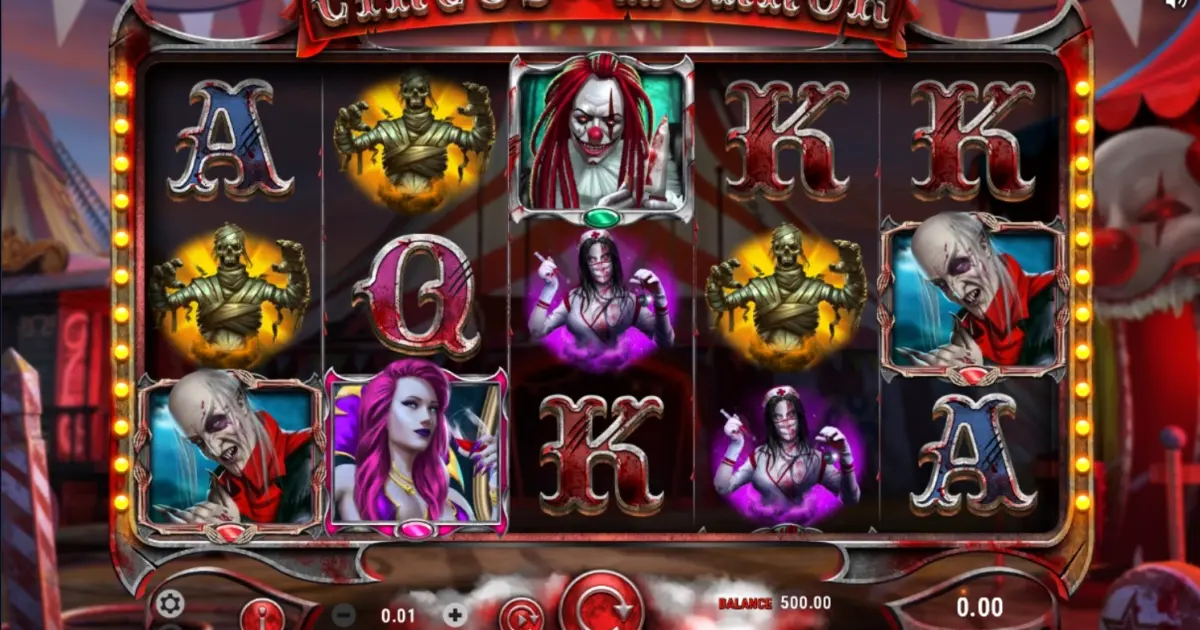
Circus of Horror is a 5-reel slot from GameArt that sits at 96.68% RTP, nearly a full percentage point above the corpus average. If you are searching for a circus of horror slot that draws on the horror and scary theme with above-average return maths, this one qualifies on paper. Whether it suits your session depends on the details below.
The 5-reel grid explained
The game runs on five reels, which is the standard layout for modern video slots. Five reels give designers enough horizontal space to fit multiple symbols per reel position while keeping the screen readable on phones and desktops alike. GameArt has used this format across most of its catalogue, so Circus of Horror follows the studio’s established template rather than experimenting with an unusual grid shape.
A 5-reel layout in general supports a wide range of symbol combinations compared to older 3-reel fruit machines, but the exact number of visible rows per reel determines how many combinations are actually possible at once. GameArt has not published the row count for this title in its available metadata, so treat any specific “ways” or “lines” figure you encounter from third-party sources as unverified.
The theme label “Horror and scary” confirms the game draws on horror-genre imagery and atmosphere. Circus of Horror belongs to a pool of 479 titles tagged under the same theme in our corpus, so you have a substantial catalogue to browse for alternatives. One horror-themed title with published RTP data is Hand of Anubis at 96.24%, a modest 0.44 points below this game.
| Provider | GameArt |
|---|---|
| RTP | 96.68% |
| Reels | 5 |
| Theme | Horror and scary |
| Free demo | Yes |
Paylines, ways and how Circus of Horror pays
GameArt has not published payline counts or a “ways” mechanic specification for Circus of Horror in the data available to us. This gap matters for readers who want to calculate exact per-spin probability or compare hit frequency across titles.
In general terms, a slot can pay through fixed left-to-right lines, through scatter pays that hit anywhere on the grid, or through a ways system where matching symbols on consecutive reels multiply their combination count. Each structure changes how often small wins land and how much of your total return concentrates into fewer, larger payouts. Without knowing which system Circus of Horror uses, you cannot model its behaviour beyond the headline RTP figure.
The practical consequence: you should treat the RTP number as the only reliable quantitative guide to this game’s expected return. Everything else—bonus frequency, top-line payouts, the contribution of wild substitutions—requires either a published game rules document or a statistically meaningful sample of demo spins to estimate. For a GameArt title with fuller published mechanics, compare Sweet FTN at 96.55% RTP.
96.68% RTP put in context
RTP is a long-run theoretical average calculated across millions of simulated spins. At 96.68%, Circus of Horror returns 96.68 units of currency per 100 wagered across that entire statistical horizon. On a practical session of a few hundred spins, actual returns scatter widely in both directions around that mean.
The comparison points are useful. GameArt’s provider average across 178 published titles is 96.08%, so Circus of Horror sits 0.60 percentage points above its own developer’s typical output. Against the full corpus average of 95.71%, the game is 0.97 points ahead. That places it in the upper band of GameArt’s library and comfortably above the industry median.
One percentage point of RTP is not trivial over long sessions. If you wager 10,000 units across a month of play, the difference between 95.71% and 96.68% is roughly 97 units retained versus lost to the house edge. The 0.97-point margin means the game is not a standout outlier—it is simply a well-calibrated title above the market floor. If you prefer a GameArt game with slightly different maths, Kukulkan’s Queen returns 96.06%, closer to the provider average.
Volatility and hit patterns
No volatility rating has been published for Circus of Horror in the available data, and hit frequency is likewise absent. This is the single largest information gap in this review.
As a general principle, low-volatility slots return frequent small wins that keep a session moving but rarely produce payouts far above your stake. High-volatility slots deliver fewer wins overall but concentrate returns into larger events that can cover long stretches of small losses. Medium volatility sits between those extremes. Without a published rating, you cannot assign Circus of Horror to any of these bands with confidence.
The practical implication: approach the game with no assumption about win cadence. If you spin it in demo mode, your sample size will be too small to estimate volatility reliably from personal experience—dozens of spins tell you almost nothing. Treat the 96.68% RTP as the only quantitative anchor and plan your bankroll for the worst-case swing you can tolerate.
Choosing a stake range without published limits
GameArt has not published minimum or maximum stake figures for Circus of Horror in our dataset. Without those bounds, you cannot pre-plan a stake tier that maps to a specific bankroll size before you open the game.
General guidance still applies. A bankroll of 200 units supports a stake of 1 unit per spin for roughly 200 spins at medium-to-low volatility, or perhaps 60–80 spins if the game concentrates returns into fewer, larger events. Since you cannot verify which pattern Circus of Horror follows, the prudent move is to start at the lowest available stake in the interface and observe whether wins arrive in clusters or trickle evenly.
Once you know the real range from the game itself, revisit these calculations. Your stake choice interacts directly with session length and swing exposure—the tighter your per-spin risk relative to your total budget, the more spins you get before variance threatens to end the session.
Demo play versus real money
A Circus of Horror free demo is available through GameArt’s integration with review sites. Demo play uses simulated credits; it produces the same reel outcomes and paytable maths as the real-money version but cannot convert any balance to cash. No demo session, however long, tells you whether the game will pay you real money—it only shows you the interface and helps you learn where features trigger.
If you do transition to real play, the maths stay identical. The house edge is the same 3.32% implied by the RTP regardless of whether you wager credits from your wallet or a demo counter. Every spin is independent; past results have no bearing on the next outcome.
Slots are paid entertainment. Set a budget before you start, treat the amount as the cost of a leisure session rather than an investment, and stop when it is spent. If gambling stops feeling like entertainment, help is available at 1-800-GAMBLER or equivalent services in your region. You must be 18 or older to play for real money.
Verdict on the Circus of Horror Slot
Circus of Horror clears a meaningful benchmark: its 96.68% RTP is 0.97 points above the corpus average and 0.60 above GameArt’s own library mean. The 5-reel horror presentation aligns with a theme pool of 479 comparable titles, giving you ample alternatives if you want to shop around.
The honest caveat is the data gap. No volatility rating, no payline count, no stake range, no max win figure, no hit frequency—these absences mean you cannot fully model what a Circus of Horror session will feel like before you try it. The return maths say the game is above average over very long horizons. The experience between spins remains unknown until you load it yourself.
If above-average RTP is your priority and you are willing to accept a few hours of demo time to learn the game’s rhythm, Circus of Horror is a reasonable candidate. The 96.68% figure is verified and places it ahead of most of what GameArt produces. Everything else is still a blank page.
Frequently Asked Questions
Can I play Circus of Horror for free without downloading anything?
Yes, a free demo version is available through browser-based review sites without any download or registration. The demo uses the same 96.68% RTP maths as the real-money game but does not pay out actual currency. It is useful for learning the interface and observing how the 5-reel grid behaves across a sample of spins.
What does 96.68% RTP mean in practice for Circus of Horror?
Across millions of simulated spins, the game returns approximately 96.68 units per 100 wagered. In a short session of a few hundred spins, actual returns will scatter widely above or below that average. The figure is 0.97 percentage points above the corpus average and 0.60 above GameArt's provider mean of 96.08%.
Is Circus of Horror high or low volatility?
GameArt has not published a volatility rating for this title, so it is not possible to classify it as low, medium, or high. Without that data, you cannot predict whether wins will arrive frequently in small amounts or rarely in larger clusters. Plan your bankroll conservatively until you observe the pattern yourself.
Who makes Circus of Horror and what else do they offer?
GameArt develops the game, a studio with 178 published slot titles in our corpus and an average RTP of 96.08%. Circus of Horror exceeds that provider average by 0.60 points. Other GameArt titles in our catalogue include Sweet FTN at 96.55% and Kukulkan's Queen at 96.06% RTP.
Can the demo version of Circus of Horror pay real money?
No, the free demo uses simulated credits that have no cash value and cannot be withdrawn or converted. The underlying maths—96.68% RTP across 5 reels—remain identical between demo and real-money play. Demo sessions are for familiarisation with the interface and do not predict or influence real results.