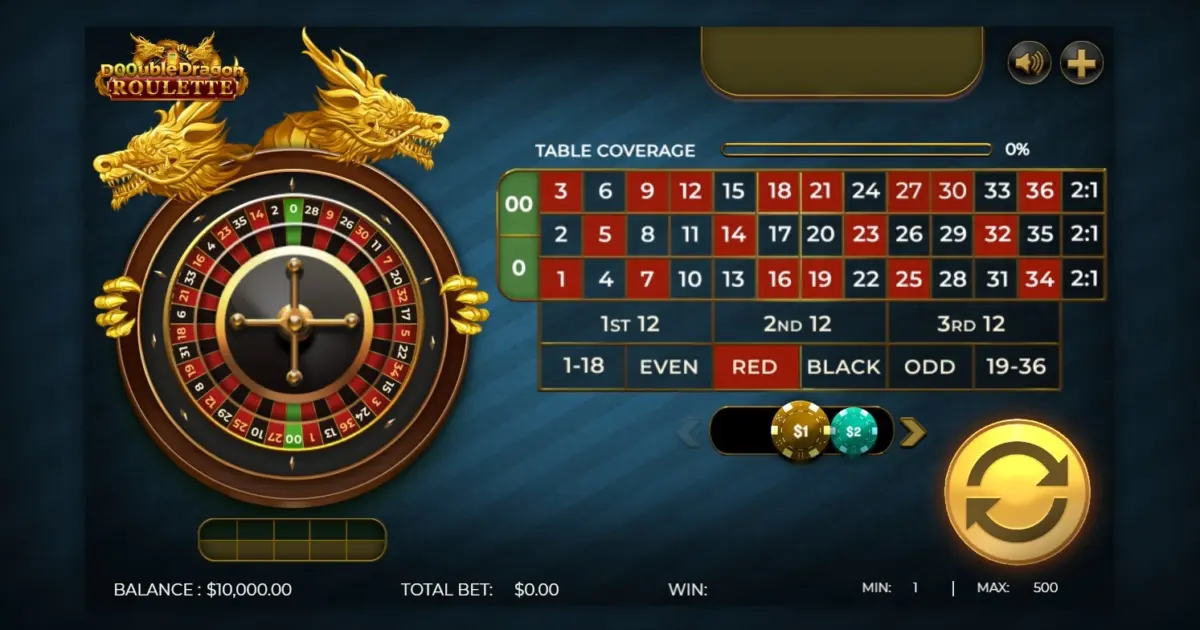
Double Dragon Roulette is a table where the maths tells you more than the artwork does. The published RTP of 94.74% works out to a 5.26% house edge, which is the exact figure you get on an American-style double-zero wheel. Before you commit any time here, decide whether you are comfortable surrendering roughly 5.3% of your total stake on average over a long session. If the answer is no, the same provider offers a European version at 97.3% RTP, and that gap compounds faster than most players expect.
Is Double Dragon Roulette worth your spins?
The honest starting point is the number itself. A 94.74% RTP means that for every $100 you wager across a session, the expected return is $94.74, and the casino keeps $5.26 as its margin. Compare that to a standard single-zero European wheel at 97.30% RTP, and the difference is substantial over hundreds of spins. The question is not whether the game is well-built or visually appealing. The question is whether the specific ruleset behind this table justifies the edge it takes.
If you play for short sessions and entertainment, the 5.26% edge means variance can still produce wins on any given evening. But no session-length trick, no bet selection, and no “hot number” theory changes the underlying expectation. The house edge is built into the pocket count, and until the rules screen tells you otherwise, you should read this table’s figure as a fixed cost of playing.
Dragon Gaming and this wheel
Dragon Gaming is a small studio with four roulette titles in the catalogue reviewed here. That low count is useful context: when a provider has fewer games, each one tends to receive more individual attention, but it also means fewer alternatives if you decide a particular ruleset does not suit your style. The provider’s average RTP across its roulette tables sits at 96.02%, which is below the corpus average of 96.97%. You are already looking at one of the studio’s lower-return options.
If the Double Dragon theme appeals but the maths does not, Dragon Gaming also publishes European Roulette Deluxe at 97.3% RTP and American Roulette at 94.74% RTP. The American title sharing the identical RTP figure is worth noting: it reinforces that 94.74% is the expected return on a double-zero layout, and this table likely operates on the same fundamental pocket structure.
House edge: 2.70%, 5.26% or 1.35%?
These three numbers represent the three tiers of roulette house edge, and where a table lands depends entirely on its wheel type and rules.
A single-zero European wheel has 37 pockets. The house edge on all standard bets is 2.70%, because one extra pocket beyond the 36 payouts creates that gap. A double-zero American wheel has 38 pockets, pushing the edge to 5.26% on nearly every bet. The five-number basket bet (0, 00, 1, 2, 3) is the worst wager in the game at 7.89% and should never be placed. French rules with La Partage or En Prison return half your stake on even-money bets when zero lands, cutting that specific edge to approximately 1.35%. That is the best standard bet in all of roulette.
The published 94.74% RTP on Double Dragon Roulette corresponds mathematically to a 5.26% house edge, the same figure as a double-zero wheel. The FACTS block for this table does not include a variant_hints field or confirmed pocket count, so I cannot state with certainty that this is an American wheel. What I can say is that the RTP figure is consistent with one, and if you want confirmation, the game’s own rules or paytable screen should display the wheel layout and applicable edge directly.
Bet types, payouts and true odds
The table below shows how payouts compare against actual probabilities on a double-zero layout. The gap between the two columns is where the house edge lives.
| Bet type | Pays | True odds | House edge |
|---|---|---|---|
| Straight-up (single number) | 35:1 | 37:1 | 5.26% |
| Split (two numbers) | 17:1 | 18:1 | 5.26% |
| Street (three numbers) | 11:1 | 11.67:1 | 5.26% |
| Cornor (four numbers) | 8:1 | 8.5:1 | 5.26% |
| Even-money (red/black, odd/even, low/high) | 1:1 | 1.11:1 | 5.26% |
| Five-number basket (0, 00, 1, 2, 3) | 6:1 | 6.6:1 | 7.89% |
Every standard bet carries the same 5.26% edge. Inside bets swing wildly, outside bets grind steadily, but neither changes expected value. The only bet that deviates is the five-number basket, which is strictly worse. If this table does include a single-zero option somewhere in its rules screen, the edge would drop to 2.70% and the true odds column would shift accordingly.
What experienced players actually do
Seasoned roulette players do not chase patterns. They make three decisions and stick with them. First, they check the rules screen for the wheel type and whether any special rule applies. On this table, the 94.74% figure already signals a high-edge layout, and if a lower-edge variant exists, it should appear there.
Second, they flat-stake. One unit per spin, chosen as a size that lets them survive a losing run without emotional escalation. Progressions like Martingale or Fibonacci do not alter expected value because each spin is independent, but they compress the same losses into fewer, larger bets and hit table limits faster. Flat staking stretches your session for the same budget.
Third, they pick the bet type that matches their goal. If you want maximum time per unit staked, even-money bets minimize variance without touching the edge. If you want the possibility of a large single hit and accept rapid bankroll swings, straight-up numbers deliver that shape. Neither choice changes what you give back on average.
Free play before real money
A free demo of Double Dragon Roulette is available, which is exactly what you should use before depositing anywhere. The demo lets you open the rules screen, confirm the wheel layout, read the actual payout table, and see how the interface handles call bets or racetrack wagers if any are present. What the demo cannot do is predict real-money results or tell you whether your session will be profitable. RNG outcomes are independent, and demo play carries no information about future spins.
Play for entertainment, not income. Set a budget before you start, treat it as the cost of an evening, and stop when it is gone. This is an 18-plus activity, and if gambling stops feeling like entertainment, that is the signal to stop entirely.
Final take
Double Dragon Roulette delivers a confirmed 94.74% RTP, which translates to a 5.26% house edge. That is the cost of playing here, and no strategy reduces it. The theme and provider may appeal, but the numbers are what determine long-term outcomes. If you want the same provider’s mechanics with a lower edge, the European variant at 97.3% RTP is the more rational choice. Use the demo to confirm the wheel layout for yourself, set a session limit, and treat every spin as a fixed-price entertainment unit rather than an investment. The wheel has no memory, and neither should your strategy be built on the assumption that it does.
Frequently Asked Questions
Can I play Double Dragon Roulette for free?
Yes, a free demo is available through the review page. The demo uses the same RNG and payout structure as real money play, so you can inspect the wheel layout, confirm the applicable house edge, and evaluate the interface without any financial risk. Demo results carry no predictive value for real-money sessions.
What is the RTP on Double Dragon Roulette?
The published RTP is 94.74%, which means the house edge is 5.26%. This is well below the 97.30% RTP you would find on a standard single-zero European wheel and below the 96.97% corpus average across all roulette tables reviewed here.
Is Double Dragon Roulette a European or American wheel?
The 94.74% RTP figure corresponds mathematically to a 5.26% house edge, which matches a double-zero American wheel with 38 pockets. The FACTS data does not include a confirmed variant hint, so check the game's own rules screen to verify the pocket count before playing real money.
Does any betting system work on Double Dragon Roulette?
No system changes the expected value of any bet on this table. Martingale, Fibonacci, D'Alembert, and colour-tracking approaches all operate under the same 5.26% house edge per spin. Progressions redistribute variance and increase the speed at which you hit table limits, but the mathematical outcome remains unchanged.
How does Double Dragon Roulette compare to American Roulette by Dragon Gaming?
Both tables share an identical 94.74% RTP, indicating the same underlying house edge and likely the same double-zero pocket structure. If the visual theme or interface of Double Dragon appeals more, you are not sacrificing or gaining any mathematical ground by choosing it over the standard American title.




