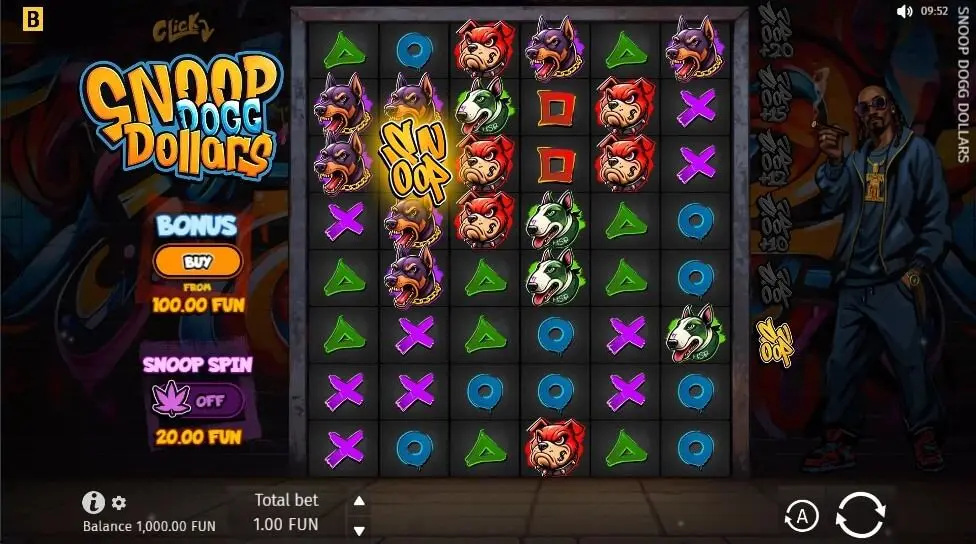
The Snoop Dogg Dollars slot from BGaming delivers a 96.0% RTP on a 6-reel grid with high volatility. That RTP sits 0.29 percentage points above the site-wide corpus average of 95.71%, but 0.47 below BGaming’s own portfolio mean of 96.47%. It suits players who accept extended dry spells in exchange for the possibility of larger single payouts, without requiring extreme feature complexity.
The Snoop Dogg Dollars slot at a glance
| Detail | Value |
|---|---|
| Provider | BGaming |
| RTP | 96.0% |
| Volatility | High |
| Reels | 6 |
| Min stake | $/£/€0.25 |
| Max stake | $/£/€25.00 |
| Themes | Music, Money and wealth |
| Max win | Not published |
| Hit frequency | Not published |
The absent max-win figure is worth noting: BGaming has not disclosed the top payout multiplier for this title. If you see a number quoted on other review sites, treat it with caution. The missing hit-frequency data means you cannot know precisely what share of spins will return a win before you start playing.
What a 96% RTP actually returns
A 96.0% RTP means that across a very large sample of spins — millions, not dozens — the game is programmed to return $96.00 for every $100.00 wagered. The remaining $4.00 is the theoretical house edge. That long-run expectation holds regardless of your individual session outcome.
Work through a concrete example. At the minimum stake of $0.25, one thousand spins total $250.00 in wagers. Expected return over that span: $240.00, leaving $10.00 as the theoretical cost of playing. The corpus average across all reviewed games is 95.71%, so this title is slightly above that baseline. However, among BGaming slots the average RTP is 96.47%, meaning you are giving up 0.47 percentage points relative to the provider’s typical output. Over 10,000 spins at $0.25, that gap equals roughly $11.75 in additional expected loss compared to the provider average.
High volatility and what your session will feel like
High volatility describes the shape of a game’s win distribution. Wins arrive less frequently but tend to be larger when they land. The practical consequence: you will experience stretches of ten, twenty, or more spins returning nothing or nearly nothing, punctuated by occasional hits that recover several spins’ worth of stake at once. Your bankroll will spend more time below your starting point than it would in a medium-volatility game.
Because BGaming has not published a hit frequency for this title, you cannot quantify exactly how long those droughts might run. What you can predict from the volatility label alone is the asymmetry: the median session outcome will be a loss, while the mean (which includes rare large wins) is what the RTP figure describes. Your actual experience will cluster around the median, not the mean. This is why high-volatility games feel harsher than their RTP percentage suggests.
The 6-reel layout and how wins are counted
Six reels is one column more than the industry-standard 5, providing 6 × N symbol positions per spin where N is the number of rows. More positions generally mean more opportunities for matching combinations, though the specific pay mechanism — fixed lines, ways, or cluster pays — is not confirmed in the available data for this title.
Many 6-reel slots use a “ways” system where any matching symbol on adjacent reels from the left forms a winning combination without requiring a fixed payline. Others use cluster pays where a group of touching identical symbols counts. Without BGaming publishing the mechanic for this particular game, the reel count alone tells you the grid is wider and visually denser than a standard 5-reel slot. That affects how often you scan for patterns, which matters more at high stake per spin than at low.
Stake range and sizing a bankroll
The $/£/€0.25 minimum and $/£/€25.00 maximum span a 100× range. At the low end, 200 spins cost $50.00 total wagered. At the high end, 200 spins cost $5,000.00. The RTP remains identical at every stake — your bet size does not change the house edge, only the absolute dollar swing per spin.
For high-volatility games, the standard bankroll guidance is to fund enough spins to survive the drought phase before a meaningful win arrives. Many players budget for 250–400 spins as a minimum viable session. At $0.25 per spin, that requires $62.50 to $100.00. At $1.00, it requires $250 to $400. If your starting budget does not cover 250 spins at your chosen stake, the probability of ending the session mid-drought — before the volatility has room to deliver its characteristic spikes — rises substantially. Consider lowering your stake rather than extending your budget.
Playing the Snoop Dogg Dollars demo before you commit
The Snoop Dogg Dollars free demo is available here with no download required. Demo play lets you observe the pace of wins and losses at your preferred stake, which is genuinely useful for gauging whether the high-volatility rhythm suits your tolerance before funding an account.
What demo play cannot do: predict your real-money results. Every spin is an independent random event. The RNG carries no memory from demo mode to paid mode, and outcomes in one do not influence the other. A session full of wins in demo is not a signal.
Before depositing real money, set a fixed loss limit and treat the entire amount as the price of entertainment rather than an investment with an expected return. Confirm the casino holding your account is licensed for your jurisdiction. If you are 18+ and gambling is legal where you live, proceed only with money you can afford to lose entirely. If you find yourself chasing losses or betting beyond your pre-set limit, contact a support service such as GamCare.
Verdict: who should play Snoop Dogg Dollars
This is a mid-range BGaming release whose 96.0% RTP is honest but unremarkable. It clears the corpus average of 95.71% but trails the provider’s own mean. The 6-reel music-and-wealth theme gives it identity in a crowded space, and the 0.25–25.00 stake range makes it accessible from tight budgets upward.
If pure RTP is your filter, Merge Up 2 from the same provider delivers 98.0%, a substantial mathematical improvement over 96.0%. If you want to stay within the music theme, Disco Beats offers 96.62% — half a point above this title. For a higher RTP without theme constraints, Lucky Turkey provides 97.17%. But if this specific game is what appeals to you and you can absorb the variance that high volatility demands, the maths is defensible: you wager with a 4% theoretical house edge, and your actual experience will be governed entirely by how the swings land on the day.
Frequently Asked Questions
Can I play Snoop Dogg Dollars for free without downloading anything?
Yes. BGaming provides a no-download browser demo of this 6-reel slot, letting you spin the same grid and observe the high-volatility pace before deciding whether to play with real money. The demo is accessible directly from this review page.
What does the 96.0% RTP mean for a Snoop Dogg Dollars session?
Over a very large sample of spins, the game is programmed to return $96.00 for every $100.00 wagered, leaving a theoretical 4% house edge. At the minimum stake of $0.25 across 1,000 spins, expected losses are roughly $10.00 — but your individual session can diverge sharply due to high volatility.
Is Snoop Dogg Dollars a high-risk game because of its volatility?
The high volatility label means wins arrive less frequently but tend to be larger when they hit. Your bankroll will experience deeper and longer dips between winning spins compared to a low-volatility slot, so risk here refers to variance and swing size rather than the house edge, which remains fixed at 4%.
How does this BGaming slot compare to other games from the same provider?
At 96.0% RTP, Snoop Dogg Dollars sits below BGaming's portfolio average of 96.47%. Other titles from the provider include Merge Up 2 at 98.0% and Lucky Turkey at 97.17%, both offering stronger theoretical returns to the player.
Can I win real money playing the Snoop Dogg Dollars demo?
No. The demo uses virtual credits and cannot pay out real prizes. It exists solely so you can experience the game's layout, pace, and volatility without financial risk. Real-money play requires a funded account at a licensed operator in your jurisdiction.