If you are weighing whether the rotten slot deserves a session, the short answer is yes on numbers and “unknown” on feel. Hacksaw Gaming has given you a 6-reel grid with a 96.27% RTP and a horror theme, but has withheld the volatility and stake-range data that would tell you how the game actually behaves minute to minute. That gap matters, and this review explains exactly what you know and what you do not.
The 6-reel grid explained
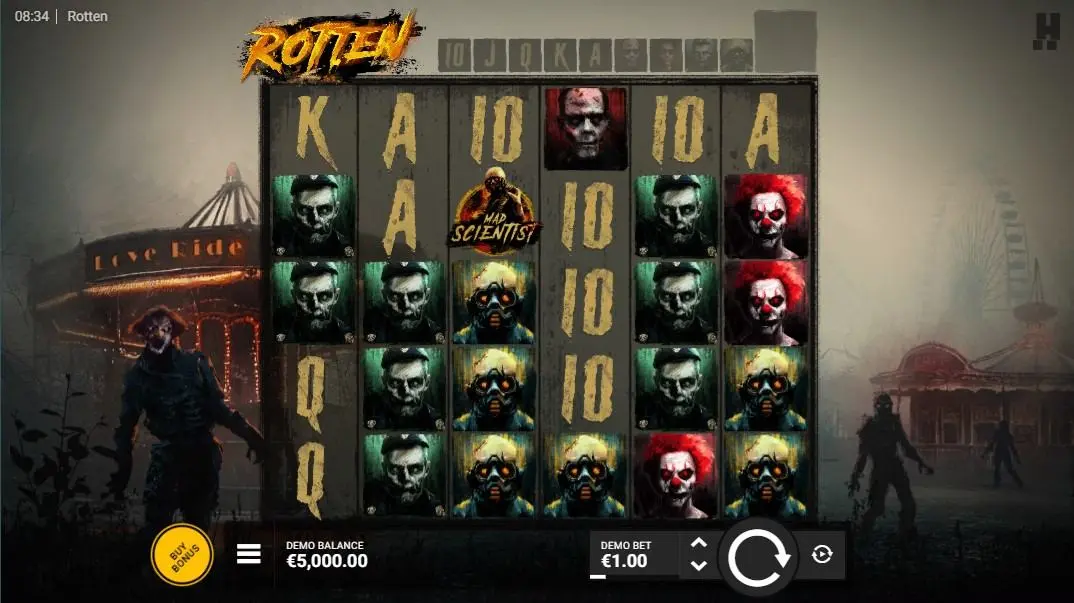
Most online slots use five vertical reels, so Hacksaw Gaming’s choice of six immediately changes the math. With one extra column, the number of possible symbol combinations on any single spin grows roughly by a factor of four to six compared to a standard layout, depending on the number of rows per reel.
Wider grids tend to support cluster pays or “ways” mechanics rather than traditional fixed paylines, because the extra width gives more positions for matching symbols to line up. Six-reel games from major providers frequently use a 6×5 or 6×7 structure. Without a published row count, you should expect a grid that feels dense on screen — more symbols per spin means more visual information to track, and typically a slightly longer animation cycle before the next spin begins.
For context, you can compare this layout with Wanted Dead or a Wild, another Hacksaw title that uses a non-standard grid to create a distinctly different pacing profile.
| Provider | Hacksaw Gaming |
|---|---|
| RTP | 96.27% |
| Reels | 6 |
| Theme | Horror and scary |
| Free demo | Yes |
Paylines, ways and how Rotten pays
Hacksaw Gaming has not published a payline count or ways figure for Rotten. On a 6-reel game, two architectures are most common: a fixed-payline layout where winning combinations must land on pre-drawn lines across the grid, or a ways mechanic where any adjacent matching symbols on consecutive reels from left to right form a win regardless of vertical position.
A third option is cluster pays, where groups of five or more touching symbols of the same kind trigger a payout and often initiate a cascade that removes the winning cluster and drops new symbols into the empty positions. Many 6-reel games use cascades because the extra width gives clusters more room to grow.
Because you cannot confirm which system Rotten uses from the provider’s public data sheet, the practical advice is to check the paytable inside the game itself before wagering real money. The paytable will state clearly whether you are playing lines, ways or clusters, and it will list every symbol value. If you prefer titles with published mechanics, Hand of Anubis documents its cluster-pay structure openly.
96.27% RTP put in context
RTP, or return to player, is a long-run theoretical average. A 96.27% RTP means that across millions of spins the game is expected to return 96.27 units for every 100 units wagered. On a practical session of a few hundred spins, your actual return can swing anywhere from zero to several times your total stake, because variance dominates over small samples.
The number matters most as a comparison point. The corpus-wide average across all tracked games is 95.71%, so Rotten sits 0.56 percentage points above that benchmark. Among the 156 titles in Hacksaw Gaming’s catalogue, the provider average is 96.1%, placing Rotten slightly above its own family mean. In the broader horror genre — 479 tracked games under the “Horror and scary” label — Rotten’s RTP is competitive, though Trickstar Spins at 94.0% shows that genre membership alone tells you nothing about return.
The 0.56-point gap between Rotten and the corpus average translates to roughly £5.60 extra per £1,000 wagered over an extremely large sample. No single session will reveal that difference.
Volatility and hit patterns
Hacksaw Gaming has not published a volatility rating or hit-frequency percentage for Rotten. This is a genuine gap. Volatility tells you whether wins land frequently in small amounts or rarely in larger amounts, and without it you cannot plan a bankroll with any confidence.
What you can observe indirectly: the provider’s other 6-reel titles in this dataset — Strength of Hercules, Le Bandit and Wanted Dead or a Wild — all carry RTPs between 96.31% and 96.38%, a narrow band that often correlates with medium-to-high volatility settings in Hacksaw’s design language. This is inference, not fact, and you should treat it as a rough guide only.
For horror and scary slots specifically, the genre tends toward higher volatility because thematic payoff events — large multipliers, expanding symbols, bonus rounds — suit infrequent-but-dramatic mathematics. But you should confirm the game’s actual rating inside the lobby before depositing. If the information is absent there too, assume medium-to-high variance and budget accordingly.
Choosing a stake range without published limits
FACTS do not include a minimum or maximum bet for Rotten. Without those figures you cannot calculate how many spins your bankroll funds at a given stake. A useful planning heuristic: if you set a session budget of, say, 200 units, divide it by the per-spin cost the game actually offers and aim for at least 100 spins to feel a volatility profile. Below that threshold, the session outcome is almost entirely luck rather than a reflection of the game’s mathematical character.
Once you open the game, the stake selector will show the real range. Note it, then decide whether it fits your budget before committing funds. A minimum stake that is too high for your bankroll turns the game into a coin flip rather than a planned session.
Demo play versus real money
Rotten is available as a Rotten free demo with no download required, so you can load the game and spin at zero cost before wagering anything. Demo play uses a simulated balance, which means it cannot generate real-money payouts, but it does let you see the grid, read the paytable, and observe the cadence of wins and dead spins without financial risk.
One important caveat: demo results do not predict real-money results. The random number generator produces independent outcomes on every spin regardless of whether you are playing for fun or for cash. No sequence of demo spins — lucky or unlucky — changes what happens next when money is on the line. Every spin is independent.
Set a spending limit before you switch to real-money mode. Treat the session as paid entertainment, not an income source. If you are 18 or over and have decided to play for money, decide your loss ceiling in advance and stop when you reach it, irrespective of whether you are ahead or behind.
Verdict on Rotten
The numbers justify a look: 96.27% RTP, a 6-reel grid that supports more combinations than a standard layout, and a popularity percentile of 95.5% that places it among the most-watched titles in its genre category. If you enjoy Hacksaw Gaming slots for their production quality, Rotten sits in a portfolio that includes some of the studio’s best-regarded releases.
What holds it back is the data gap. No published volatility rating, no hit frequency, no stake range, no bonus-round description. You are walking in with less information than the provider gives you for its flagship titles. That does not make the game bad, but it means you must verify the missing details in the game lobby or paytable before forming a full opinion.
Bottom line: spin the demo first, read the paytable, and only move to real money once you understand the volatility behaviour you are actually getting.
Frequently Asked Questions
Can I play Rotten slot for free without downloading anything?
Yes, the Rotten no download demo is available directly in the browser with no registration or software installation required. You receive a simulated balance and can explore the 6-reel grid, paytable and feature cadence at no cost before deciding whether to play with real money.
What is the RTP of Rotten by Hacksaw Gaming?
The published RTP for Rotten is 96.27%, which sits 0.56 percentage points above the overall corpus average of 95.71% and slightly above Hacksaw Gaming's own catalogue mean of 96.1%. Over a very large number of spins this implies a theoretical return of about £96.27 per £100 wagered, though individual sessions will vary far more than that figure suggests.
Is Rotten a high or low volatility slot?
Hacksaw Gaming has not published a volatility rating or hit-frequency percentage for Rotten, so no definitive answer exists from official sources. Based on the provider's typical design language across similar 6-reel titles with RTPs near 96.3%, a medium-to-high variance setting is a reasonable assumption, but you should confirm inside the game lobby before playing for real money.
How does Rotten compare to Wanted Dead or a Wild?
Both are Hacksaw Gaming titles using non-standard grids, but Wanted Dead or a Wild has a slightly higher RTP at 96.38% compared to Rotten's 96.27%. More importantly, Wanted Dead or a Wild has published volatility data and a documented bonus-round structure, giving players significantly more information before they commit a bankroll.
Can demo play on Rotten lead to real-money winnings?
No. The free demo mode uses a simulated balance and produces outcomes that have no financial value whatsoever. Real-money play requires a funded account with a licensed operator, and the game's random number generator treats demo and real-money spins identically in terms of independent probability. Demo play is for evaluation only.