If you are comparing Pragmatic Play slots and one called Vampy Party catches your eye, the headline number to check first is its 96.0% RTP. That sits slightly under the provider average, but above the broader corpus mean, so it is not a bad title to sit with. Here is what the numbers actually mean for your session.
The 6-reel grid explained
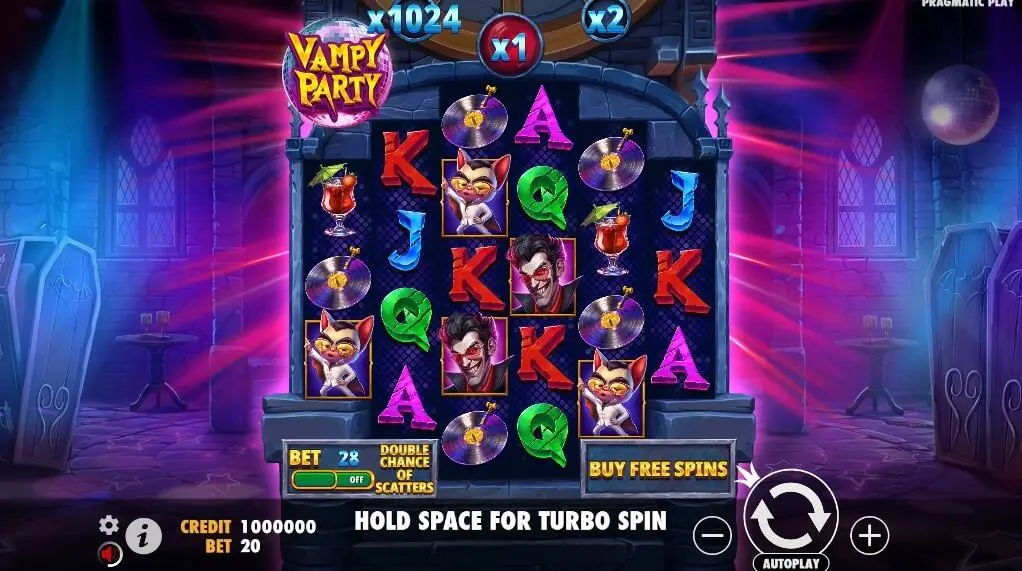
Vampy Party runs on six reels, which immediately separates it from the more common five-reel layout you will see across most of Pragmatic Play’s 739-game catalogue. Six reels expand the visible symbol area, giving the game room to build clusters or cascade sequences that a narrower grid cannot match. In a cascading-tumble game — and the music-and-Halloween theming plus a 6-reel count is consistent with that design pattern — each reel is one more column for symbols to land, one more chance for a winning arrangement to trigger on the very first drop, and one more layer of removals before the next batch falls into place. The practical consequence for you as a player is wider variance per spin: more cells means more possible combinations, which can push either big swings or long dry patches, depending on how the maths is tuned behind the scenes.
Paylines, ways and how Vampy Party pays
Pragmatic Play has not published a fixed payline count or “ways” figure for this game, so any number you see quoted on other review pages is likely guesswork. What the 6-reel grid does tell you is that the game almost certainly does not use a traditional left-to-right line structure with ten or twenty five paylines, because that layout would be an unusual pairing with six reels. Many slots on six reels use either cluster pays — where adjacent groups of matching symbols trigger a win regardless of lines — or tumble mechanics that keep replacing winning symbols until no new match appears. Without a confirmed mechanic from the provider, treat the win structure as unknown and check the game’s own paytable screen in demo mode before deciding how you want to stake your money. The theme labels Music and Horror point to the presentation layer, not the maths.
96.0% RTP put in context
Return to player is a long-run statistical average calculated across millions of simulated spins. A 96.0% RTP means that across a sufficiently large sample, the game returns £96 for every £100 wagered — and the house keeps £4. Your individual session will land somewhere above or below that line, often by a wide margin.
Where does Vampy Party sit relative to its peers? Pragmatic Play’s own portfolio averages 96.32%, so this game trails its provider by 0.32 percentage points. Compare it to Gates of Olympus at 96.5% or Sweet Bonanza at 96.51% and the gap widens further — half a percentage point over a thousand spins at £1 is £5 of extra theoretical return you are giving up. Against the broader corpus average of 95.71%, however, Vampy Party is 0.29 points ahead, so it is not a poor choice in absolute terms. It is a middling choice inside a provider that tends to publish above-average RTPs.
| Field | Value |
|---|---|
| Game | Vampy Party |
| Provider | Pragmatic Play |
| RTP | 96.0% |
| Reels | 6 |
| Primary theme | Music |
| Popularity rank | #838 (95.8th percentile) |
| Volatility | Not published |
| Bet range | Not published |
Volatility and hit patterns
Neither Pragmatic Play nor the data available here includes a volatility rating for Vampy Party. That absence matters because volatility governs how the 96.0% RTP is actually delivered to your screen. A high-volatility game at 96.0% will produce long stretches of small or zero returns punctuated by rare large payouts, while a low-volatility game at the same RTP spreads wins more evenly across hundreds of spins. The practical difference is bankroll: high volatility demands a larger starting balance to survive the dry stretches, while low volatility lets you play a shorter session at a higher stake per spin without risking bust. Without a confirmed rating, you cannot plan your session around either extreme. Many reviewers infer volatility from the provider’s other 6-reel titles, but that is speculation. Your best route is to play the Vampy Party free demo and observe the win distribution over a few hundred spins yourself.
Choosing a stake with unknown bet limits
FACTS contains no minimum or maximum stake for this title, so the table above lists it as unpublished. Pragmatic Play’s games typically open at £0.20–£0.30 and cap at £100–£250, but I cannot confirm those bounds apply to Vampy Party specifically. What you can do is decide your bankroll first, then choose a stake that lets you place at least 200 spins before you hit zero. A £20 bankroll supports £0.10–£0.20 per spin; a £100 bankroll supports £0.50. That calculation is independent of what the game’s limits happen to be, and it protects you from an unplanned bust. If you are playing on a real-money site and cannot find the stake limits in the game’s settings panel, contact the operator’s support rather than guessing.
Demo play versus real money
A free demo version of this slot is available, which means you can spin the reels with no deposit and no withdrawal. Demo play uses a virtual balance; outcomes on a demo server follow the same RNG as the real-money version, but there is no mathematical reason to expect your demo session to mirror your first paid session — each spin is independent, regardless of what came before. No download is needed for the demo, so you can check the feel of the 6-reel layout and observe win frequency without committing a pound.
If you do move to real money, treat the session as paid entertainment with a fixed budget you are willing to lose entirely. You must be 18 or over in your jurisdiction. Setting a deposit limit before you play is far more effective than trying to stop mid-session. No game, including this one, can be “due” for a win, and no stake pattern changes the underlying house edge.
Verdict on Vampy Party Slot
Vampy Party is a music-and-horror themed Pragmatic Play release on a 6-reel grid that sits in the upper tail of the provider’s catalogue by popularity rank (#838 of 739) while falling 0.32 points short of Pragmatic Play’s average RTP. The missing volatility and bet-range data mean you cannot fully size a session from numbers alone, so the demo is genuinely necessary rather than a convenience. If you enjoy the presentation — the Brazilian Carnival shares its Music theme at an identical 96.0% RTP, so you could compare the two back to back — and you find the win cadence comfortable over a few hundred free spins, there is no mathematical reason to avoid it. If RTP is your single priority, Disco Beats at 96.62% on the same theme delivers 0.62 more points per £100 wagered. Vampy Party works best as a theme-first choice with your eyes open on the maths.
Frequently Asked Questions
Can you play Vampy Party Slot for free without signing up?
A free demo of this Pragmatic Play title is available with no download required, so you can spin the reels using a virtual balance before deciding whether to play for money. The demo carries the same 96.0% RTP figure as the real-money version, meaning the underlying maths are identical even though nothing is at stake in either direction.
What does the 96.0% RTP mean for a Vampy Party session?
Over a very large number of spins, the game returns approximately £96 for every £100 wagered, retaining £4 as the theoretical house edge. Your actual session will diverge significantly from that average, potentially by hundreds of pounds in either direction on a short run. Pragmatic Play's portfolio average is 96.32%, so this title trails its own provider slightly.
Is Vampy Party high or low volatility?
Pragmatic Play has not published a volatility rating for this game in the available data, so you cannot plan your bankroll around a confirmed swing profile. The practical alternative is to observe win frequency and streak length over several hundred demo spins, which gives you a rough empirical sense of the risk without risking money.
How does Vampy Party compare to other Pragmatic Play slots?
At 96.0% RTP, it trails Gates of Olympus (96.5%) and Sweet Bonanza (96.51%) by roughly half a percentage point, meaning a measurably lower theoretical return per hundred pounds wagered. However, it still exceeds the broader corpus average of 95.71%, placing it slightly above the industry-wide midpoint despite sitting below its own provider's mean.
Can you win real money playing the Vampy Party demo?
No. Demo play uses a virtual balance that cannot be converted into withdrawable funds under any circumstances. The demo exists so you can evaluate the 6-reel layout, observe how wins cluster, and decide whether the pace suits your bankroll before funding an account. Real-money play requires a separate deposit at a licensed operator.