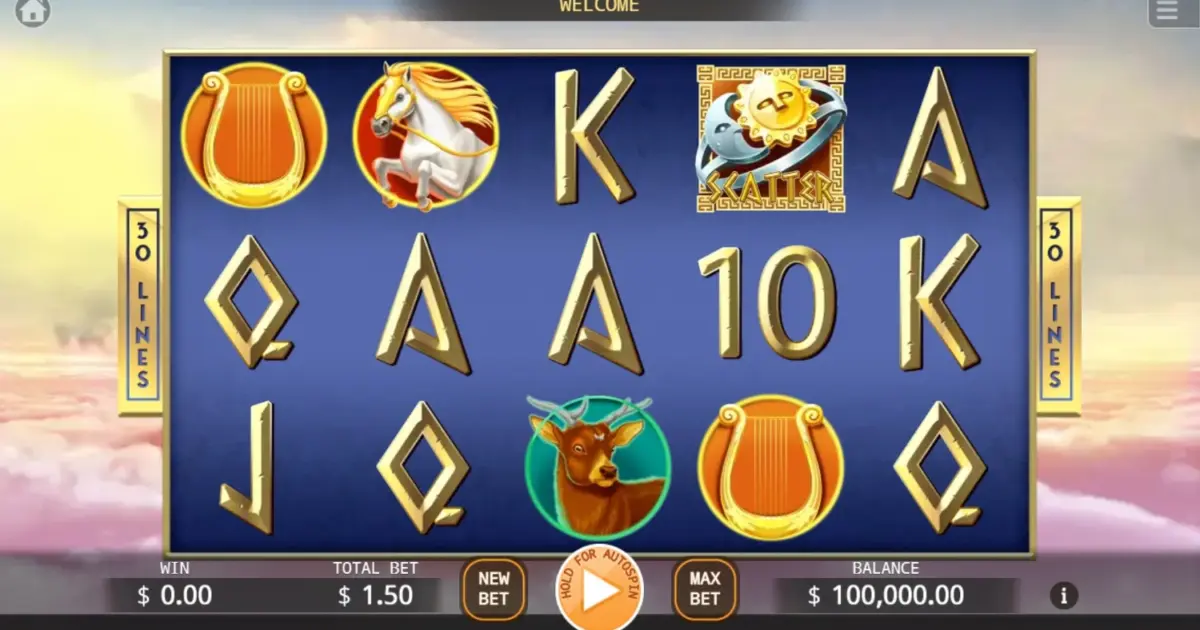
Apollo and Artemis is a mythology-themed slot from Ka Gaming running on a 5-reel layout with a published RTP of 94.0%. That return sits below both the provider average and the broader corpus, so manage expectations accordingly. If you already know what a below-average RTP implies for your balance over thousands of spins, this review will confirm whether the game offers anything to offset the mathematical drag.
The 5-Reel Grid Explained
Apollo and Artemis uses a standard 5-reel configuration—the format that dominates modern online slots because it balances visual complexity with manageable symbol density. Five reels mean each spin evaluates five vertical strips of symbols, and the total number of possible stop combinations scales exponentially with reel height. Most 5-reel slots run three or four rows, though Ka Gaming does not publish the exact row count for this title, so you will need to confirm it at the game’s first load.
What a 5-reel grid gives you in practice is more room for thematic symbols than a 3-reel classic. Mythology slots tend to populate their higher-paying tiers with character icons and their lower tiers with card values or rune variants. The extra columns let designers layer more symbol types without the pay table becoming a single crowded row.
The grid also matters for ways-based mechanics. Many 5-reel slots use fixed paylines (10, 20, or 25 are common), while others deploy 243 or 1,024 ways. Without a published line count, you should check the in-game pay table before committing a real-money bankroll. The grid alone tells you the shape of the game; the line structure determines your per-spin cost.
For context, Ka Gaming holds 602 titles in its catalogue, so this is one slot among many sharing the same provider infrastructure, math engine, and regulatory testing pipeline. You can sample other entries from the same provider—Miss Tiger is one example—to see whether the underlying build quality holds consistent across the range.
| Provider | Ka Gaming |
|---|---|
| RTP | 94.0% |
| Reels | 5 |
| Theme | Mythology |
| Free demo | Yes |
Paylines, Ways and How Apollo and Artemis Slot Pays
Ka Gaming has not published a payline count or ways figure for this title, so any number you see quoted on third-party sites is unverified. Treat such claims with caution, particularly if they present a specific line count without citing the provider’s own documentation.
In general terms, the two dominant payment structures in 5-reel video slots are fixed paylines and ways systems. Fixed-line games require matching symbols on designated horizontal or diagonal paths; you choose how many lines to activate, and each active line adds its stake to the total per-spin cost. Ways games pay for adjacent matching symbols on consecutive reels from left to right regardless of vertical position, which typically produces a higher hit frequency but smaller average individual wins.
Mythology-themed slots lean toward fixed paylines more often than, say, fruit machines or Megaways conversions. A 20-line structure at $0.01 per line would cost $0.20 per spin; at $1.00 per line it would cost $20.00. Without the published line count, you cannot calculate your actual per-spin stake from the coin-value slider alone.
Compare this to 9 Arrows of Odysseus, which shares the same 94.0% RTP and mythology branding. If both titles use similar line structures, your cost-per-spin will behave identically; if one uses ways and the other fixed lines, the variance profile of each session changes dramatically despite the identical theoretical return. Checking the pay table before playing is the only way to confirm which structure applies.
94.0% RTP Put in Context
RTP stands for return to player: the percentage of wagered money a game is programmed to pay back over an infinite number of spins. Apollo and Artemis returns 94.0%, which means that for every $100 wagered across a sufficiently large sample, the game’s mathematics are designed to retain $6.00 as house edge.
That figure requires context. Ka Gaming’s provider-wide average RTP sits at 94.47%, so Apollo and Artemis falls 0.47 percentage points below its own developer’s mean. Against the full corpus of indexed slots—averaging 95.71%—the game trails by 1.71 percentage points. A $6.00 house edge versus a $4.29 edge does not change whether you win in the short term, but it measurably accelerates bankroll depletion over extended sessions.
Over 1,000 spins at $1.00 each, the expected loss at 94.0% RTP is $60.00. At the corpus average of 95.71%, the same 1,000 spins would statistically cost $42.90. That difference of $17.10 per thousand spins compounds linearly: double the spins, double the gap. This is not a prediction for any individual session—variance can produce wins that dwarf these averages—but it is the mathematical floor beneath every long play.
If you want a mythology slot that exceeds the corpus average, Gates of Olympus sits at 96.5% RTP on the same theme label. That is 2.5 percentage points better on paper, which translates to a noticeably lower expected drain per hundred dollars wagered.
Volatility and Hit Patterns
Neither Ka Gaming nor any regulatory test report indexed in our dataset publishes a volatility rating or hit-frequency figure for Apollo and Artemis. This absence is not unusual for a mid-catalogue title from a provider with 602 games, but it leaves you without a critical planning input.
Volatility describes the shape of the return distribution. Low-volatility slots award frequent small wins that keep balance steady; high-volatility slots produce long dry stretches punctuated by larger payouts that arrive unpredictably. Hit frequency—the percentage of spins returning any win—interacts with volatility: a 25% hit rate means three out of four spins produce nothing, regardless of whether the wins that do land are large or small.
Without published figures, you can only observe volatility yourself during demo play. Track how many consecutive non-paying spins occur, the ratio of your largest single win to your total wagered, and whether wins cluster or spread evenly. Demo play at the same stake you intend to use real money is the closest proxy, though remember that outcomes in demo mode carry no causal relationship to real-money results—each spin is an independent random event.
If volatility information matters to your strategy, a game with no published rating is a risk you cannot price. That is worth weighing before funding an account.
Choosing a Stake When No Range Is Published
Ka Gaming does not list minimum or maximum bet figures for Apollo and Artemis in the data available to us. Stake ranges also vary by casino operator, since each licensee can configure the coin-value slider within the game’s permitted bounds. This means your practical stake options depend on where you play, not solely on the game’s design.
As a general framework, divide your session bankroll by your intended spin count to derive a safe per-spin stake. A $100 bankroll spread across 500 spins suggests a $0.20 maximum per spin. At 94.0% RTP, you expect to retain $94.00 of that $100 across 500 spins—leaving $6.00 as the statistical cost of entertainment. Shorter sessions at higher stakes produce wider swings around that same expectation.
Before funding play, load the game and read the coin-value selector and any multiplier options on-screen. If the minimum total stake is $0.20 and your planned budget is $50, you have 250 spins at the floor rate. That determines how many opportunities the maths has to work toward its published average before your balance expires.
Demo Play Versus Real Money
The free demo is available for Apollo and Artemis without registration or download. Demo mode uses the same random number generator and pays the same symbol combinations as the funded version, so it is the correct environment to assess layout, line structure, and your subjective impression of variance before risking a deposit.
Demo outcomes do not predict real-money results. The RNG does not track your balance, your bet size, or your previous session; every spin is independent. A demo run that shows 30 consecutive dead spins tells you the reel-stop map includes dead-stop configurations—it does not tell you whether your next funded session will reproduce that pattern.
Play responsibly: this game costs money over time because its mathematics retain $6.00 per $100 wagered. Treat any session as paid entertainment, set a budget before you fund, and stop when it is spent regardless of what the screen shows. If gambling stops feeling like entertainment, contact a helpline in your jurisdiction. Players must be 18 or older.
Verdict on Apollo and Artemis
Apollo and Artemis earns its place in the mythology genre through the provider’s infrastructure and a recognisable theme, but its numbers do not compete. A 94.0% RTP against a 95.71% corpus average, with no published volatility rating and no disclosed line count, means you are walking in without a map. The free demo at least lets you scout the terrain before committing funds.
If you play Ka Gaming slots for the provider’s visual style or have a specific operator that hosts this title with attractive terms, that is a valid reason to spin. But if you are selecting purely on mathematical merit from the mythology theme—where 1 Reel – Demi Gods 7 offers 95.42% RTP with a simpler format—there are better-quantified options in the same category. Apollo and Artemis is not a bad game; it is an incomplete data sheet that asks you to accept the unknown.
Frequently Asked Questions
Is Apollo and Artemis available to play for free?
Yes. The free demo is available without registration or download, and it uses the same symbol payouts and reel structure as the funded version. You can load the game and confirm the payline count and stake range before depositing anywhere. Demo play is the fastest way to verify what Ka Gaming has not published in its documentation.
What does 94.0% RTP mean for my bankroll?
Over a very large number of spins, the game returns 94 cents for every dollar wagered, keeping 6 cents as house edge. Ka Gaming's own catalogue averages 94.47%, and the broader slot corpus averages 95.71%, so Apollo and Artemis sits below both. The practical effect is a slightly faster expected drain than average during long sessions.
What is the volatility of Apollo and Artemis?
Ka Gaming has not published a volatility rating for this title. Without that figure you cannot plan a bankroll using standard low-medium-high assumptions. The practical workaround is demo play at your intended real-money stake, tracking dead-spin frequency and win-to-wager ratios before funding.
What else does Ka Gaming make besides Apollo and Artemis?
The provider holds 602 games in its catalogue, spanning varied themes and mechanics. Related titles include Monkey Heist, Miss Tiger, and The Primeval Rainforest, none of which have a published RTP in our dataset either. Apollo and Artemis ranks at the 96.6th popularity percentile across the full corpus of indexed slots.
Can I win real money playing Apollo and Artemis in demo mode?
No. Demo play uses virtual credits and cannot produce cash payouts, regardless of how favourable the on-screen result looks. Real-money play requires a funded account at a licensed operator. The two environments share the same maths model, but demo outcomes carry zero financial value and predict nothing about future funded results.




