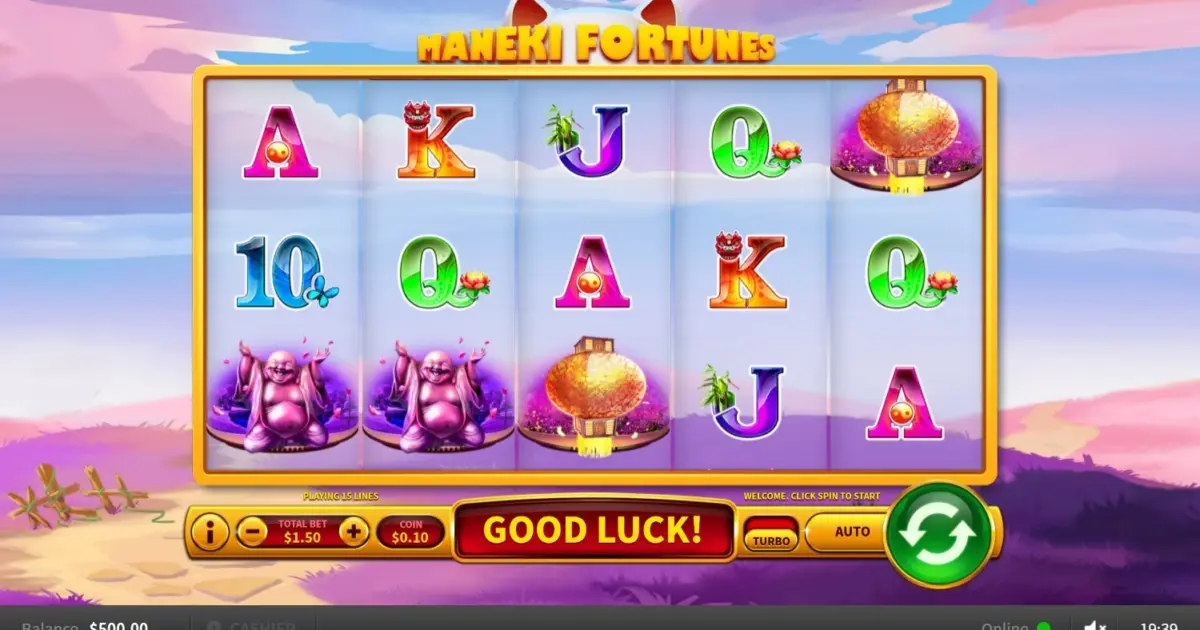
Skywind Group has not published an RTP figure for Maneki Fortunes, which puts you at an immediate informational disadvantage. Without return-to-player data, you cannot calculate expected session cost or compare this slot’s long-run value against the 542 other Fortune-themed games in the catalogue. That alone makes it a harder game to recommend.
| Attribute | Value |
|---|---|
| Provider | Skywind Group |
| Reels | 5 |
| RTP | Not published |
| Volatility | Not published |
| Theme | Fortune |
| Popularity rank | 45 (99.8th percentile) |
| Free demo | Yes |
Is Maneki Fortunes worth playing?
The popularity rank tells you this game has found an audience: Maneki Fortunes sits at position 45 across the entire catalogue, placing it in the 99.8th percentile. That means fewer than one game in five hundred performs better in player engagement, which is a strong signal that something about this title connects with its audience.
But popularity is not the same as value. The missing RTP figure means you cannot calculate how much of your stake the game is designed to return over the long run. RTP is the single most important number for session planning. Without it, you are flying blind.
Skywind Group’s portfolio averages 95.55% RTP across its 257 games, which sits below the corpus-wide average of 95.71%. If Maneki Fortunes follows the provider’s pattern, you would be looking at below-average long-run return. But that is speculation, not fact. The provider could just as easily have configured this title at 96.5% or 94%. You do not know, and that uncertainty costs you money in expectation.
The game carries a Fortune theme and offers free demo play, so you can test the mechanics and hit frequency without risking real money. That demo session will tell you whether the pacing and feature frequency suit your taste, but it will not tell you anything about the game’s configured return or volatility. Every spin is independent, and demo outcomes do not predict real-money results.
What [RTP]% RTP means over 1,000 spins
This section would normally walk you through the mathematics of return-to-player over a stated sample size. RTP is a long-run statistical average: a game set to 96% RTP will return £96 for every £100 wagered across hundreds of thousands or millions of spins. Over 1,000 spins, variance dominates, and your actual return can sit anywhere in a wide range around that expectation.
But Skywind Group has not published an RTP figure for Maneki Fortunes, so there is no number to work with. That absence is itself decision-relevant information. When a provider chooses not to disclose RTP, you lose the ability to compare value across titles or calculate expected session cost. Treat that lack of transparency as a red flag.
If you want to make an informed choice, prioritise games where the RTP is stated clearly in the paytable or the provider’s spec sheet. A published RTP does not guarantee a winning session—variance will dominate over any realistic play period—but it does let you understand what you are paying for the entertainment.
How volatile is Maneki Fortunes?
Volatility describes how a slot distributes its return. Low volatility means frequent small wins that extend your session and drain your balance slowly. High volatility means long dry spells punctuated by occasional large hits; these games demand a deeper bankroll and tolerance for losing streaks, but they offer the possibility of session-defining payouts.
Skywind Group has not published a volatility rating for this game. Without it, you cannot plan bankroll requirements or set realistic expectations for session length. A low-volatility game at £1 per spin might give you two hours of play on a £100 budget. A high-volatility game with the same stake could evaporate that bankroll in twenty minutes, or triple it in fifteen.
The only way to gauge volatility without the published figure is to play the demo and track your balance over a few hundred spins. If your balance declines steadily with small recoveries, the game is probably low to medium volatility. If you see long losing runs followed by sudden balance jumps, it is likely medium-high or high. But this is observation, not measurement, and it will not tell you how deep a bankroll you need for real-money play.
For comparison, many slots in the Fortune theme category publish their volatility alongside RTP. Mystic Fortune Deluxe offers 96.71% RTP with disclosed volatility, and Fortune Tiger sits at 96.81% RTP, both giving you the data you need to plan a session. If transparency matters to you, those alternatives are worth considering.
What the Fortune theme brings to the game
Fortune is one of the most crowded themes in the slot catalogue, with 542 titles competing for attention. The theme typically draws on symbols and motifs associated with luck, prosperity, and chance—coins, lucky cats, gold, red envelopes, and other imagery tied to wealth and good fortune across various cultures.
Maneki in the title likely refers to the maneki-neko, the Japanese beckoning cat figurine traditionally believed to bring good luck to its owner. That thematic anchor suggests the visual design will centre on East Asian iconography, though without detailed paytable information or feature descriptions in the FACTS, it is impossible to say what specific symbols or bonus mechanics the game uses.
Theme does not affect RTP, volatility, or expected value. It is presentation, not mathematics. A Fortune-themed slot and a fruit machine with identical RTP and volatility will cost you the same amount per hour of play over the long run. Theme matters only to the extent that you enjoy looking at it while the reels spin.
If you are drawn to the Fortune category because you believe it influences outcomes, understand that it does not. The random number generator does not care about thematic dressing. Every spin is independent, and no symbol, theme, or visual motif makes a game “luckier” than any other.
Stakes, session length and bankroll
Skywind Group has not published minimum or maximum stake figures for Maneki Fortunes, which leaves another gap in your session planning. Stake range matters because it determines whether the game fits your budget and how long your bankroll will last.
A general rule: your bankroll should cover at least 100 times your chosen stake if the game is low volatility, and 200 to 300 times your stake if it is medium to high volatility. Without knowing the volatility or the stake range, you cannot apply this rule accurately. You are left guessing.
If you plan to play Maneki Fortunes with real money, start by testing the demo to identify the minimum and maximum bet options the game offers. Then calculate your session budget based on your tolerance for loss. Decide in advance how many spins you want, multiply by your stake, and add a cushion for volatility. If the game evaporates that budget faster than you expected, accept it and walk away. Chasing losses by increasing stake or session length only accelerates the drain.
Session length is a function of bankroll, stake, volatility, and RTP. A player with £100, betting 50p per spin on a 96% RTP slot with low volatility, might expect 150 to 250 spins before the bankroll is exhausted, assuming average luck. Double the volatility or halve the RTP, and that estimate drops sharply. Because Maneki Fortunes does not publish these figures, you are left managing your session by feel rather than by calculation, which is a disadvantage.
Alternatives if Maneki Fortunes is not for you
If the absence of published RTP and volatility data makes Maneki Fortunes a hard sell, the Fortune theme offers better-documented alternatives. Mystic Fortune Deluxe runs at 96.71% RTP, which sits a full percentage point above the Skywind Group portfolio average and gives you a clear baseline for session cost. Fortune Tiger goes higher still at 96.81% RTP, which translates to an extra £1.26 returned per £100 wagered compared to a 95.55% game over a very large sample.
Within the Skywind Group catalogue, Flaming Jaguar publishes its RTP at 94.1%, which is low by any standard but at least gives you the number. That transparency lets you decide whether the trade-off between theme, features, and long-run cost is worth it. Two other Skywind titles—Gorilla Moon and Symphony of Diamonds—also lack published RTP figures, which suggests this may be a portfolio-wide issue rather than a one-off omission.
When you compare slots, prioritise the ones that give you the data. RTP and volatility are not nice-to-have details; they are the foundation of informed choice. A game that hides those numbers is asking you to trust it without evidence, and that is not a bet worth taking.
Final take
Maneki Fortunes ranks in the 99.8th percentile for popularity, which tells you it has connected with a large player base. But popularity does not equal value, and the lack of published RTP or volatility data is a serious transparency problem. You cannot calculate expected session cost, compare long-run return, or plan a bankroll without those numbers. That puts you at a disadvantage before you place your first spin.
The game offers free demo play, so you can test the mechanics and decide whether the pacing suits you. But demo outcomes do not predict real-money results, and they will not tell you whether the game is configured to return 94%, 96%, or something in between. Every spin is independent. No betting pattern, timing, or progression system changes the expected value.
If you choose to play Maneki Fortunes, set a budget in advance, treat it as the cost of entertainment, and stop when it is gone. Never chase losses, never bet money you cannot afford to lose, and remember that the house edge is always in operation. You must be 18 or over to play. If gambling is affecting your life negatively, contact the National Gambling Helpline on 0808 8020 133 or visit BeGambleAware.
For most players, better-documented alternatives in the Fortune theme will offer more value and less guesswork. Transparency is a feature, and Maneki Fortunes does not provide it.
Frequently Asked Questions
Can I play Maneki Fortunes slot for free before wagering real money?
Yes, a free demo version is available. Demo play lets you test the game mechanics, reel layout, and feature frequency without risking your own money, but it will not tell you the game's RTP or volatility because those figures have not been published. Every spin in demo mode is independent, and demo outcomes do not predict real-money results.
Why hasn't Skywind Group published the RTP for Maneki Fortunes?
The provider has not disclosed the reason, but the absence of RTP data means you cannot calculate expected session cost or compare this game's long-run return against alternatives. Skywind Group's portfolio averages 95.55% RTP across 257 games, which sits below the corpus-wide average of 95.71%, but without a published figure for Maneki Fortunes you are left guessing where this title sits within that range.
How does Maneki Fortunes compare to Fortune Tiger in terms of return to player?
Fortune Tiger publishes its RTP at 96.81%, which is transparent and above the corpus average. Maneki Fortunes does not publish an RTP figure at all, so no direct comparison is possible. Over a very large sample, a game at 96.81% RTP will return £1.26 more per £100 wagered than a game at 95.55%, but without knowing where Maneki Fortunes sits, you cannot calculate the difference.
What does the Fortune theme tell me about how this game plays?
Nothing about RTP, volatility, or expected value. Theme is presentation, not mathematics. Fortune-themed slots typically use iconography associated with luck and prosperity, and the "Maneki" in the title suggests Japanese lucky-cat motifs, but the theme does not influence the random number generator or change the house edge. Two games with identical RTP and volatility will cost you the same per hour of play regardless of theme.
How much bankroll do I need to play Maneki Fortunes for an hour?
That depends on the game's stake range, volatility, and your chosen bet size, none of which Skywind Group has published. A low-volatility game might let you play 150 to 250 spins on a modest bankroll; a high-volatility game could drain the same budget in a fraction of that time. Without the published figures, you cannot plan accurately. Test the demo to identify the minimum stake, then budget at least 100 to 300 times that amount depending on your risk tolerance.




