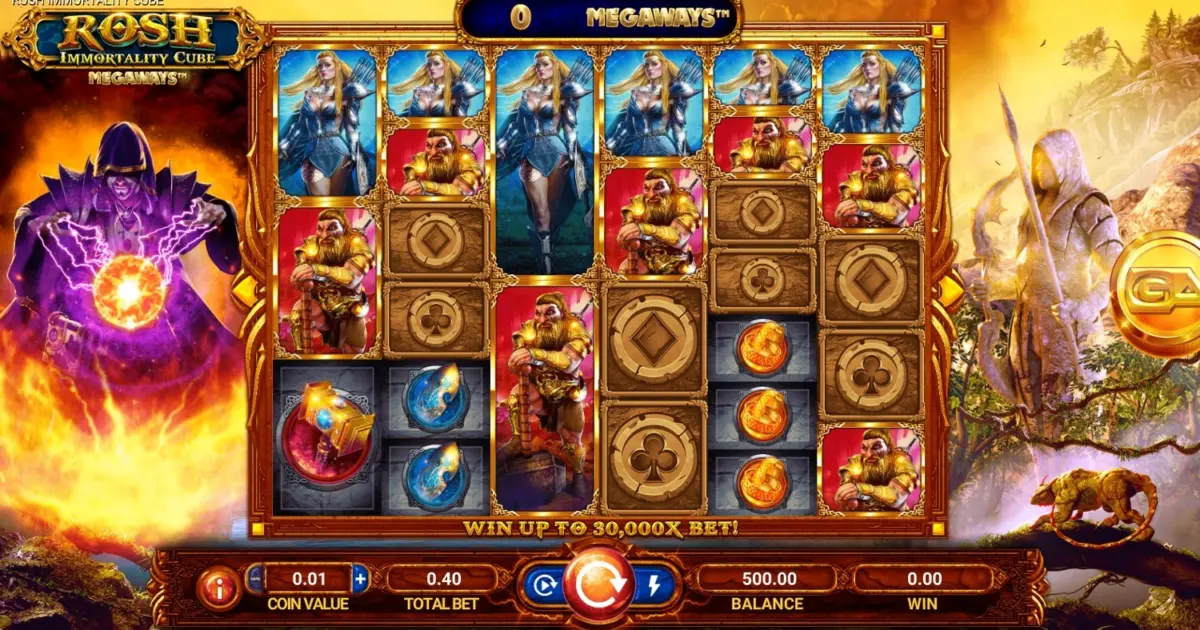
The rosh immortality cube megaways slot puts you in front of six reels and a Megaways mechanic from GameArt, a provider with 178 titles in our index. It is high volatility, so expect dry stretches punctuated by large swings. If you want a mythological Megaways game with a transparent return figure, this is not it — GameArt has not published an RTP for this title.
Rosh Immortality Cube Megaways at a glance
Here is everything the data confirms about this game:
| Field | Detail |
|---|---|
| Provider | GameArt |
| Volatility | High |
| Reels | 6 |
| Mechanic | Megaways |
| Theme | Mythology |
| Minimum stake | $0.40 / £0.40 / €0.40 |
| Maximum stake | $40.00 / £40.00 / €40.00 |
| RTP | Not published |
| Popularity rank | #540 (97.3rd percentile) |
| Free demo | Available |
The popularity rank tells you this is one of the more-watched titles in the corpus, sitting above 97% of the games we track. That alone does not make it a better game, but it means other players have scrutinised it enough to drive traffic.
What a 96.08% provider-average RTP implies
Because GameArt has not released an RTP for this specific title, the closest reference point is their portfolio average of 96.08% across all 178 slots. If Rosh sits near that figure, you would expect roughly $96.08 back per $100 wagered over a very large number of spins. The corpus-wide average across all providers in our index is 95.71%, so GameArt’s typical return edges slightly above the field.
Treat this as an estimate, not a guarantee. Individual titles within a provider’s catalogue can diverge significantly from the average. Until GameArt publishes a specific RTP, you cannot confirm whether this slot returns more or less than 96%. Some providers release the figure in the game’s information panel; others bury it or omit it entirely. Where you can, always check the in-game help screen before wagering real money.
High volatility and what your session will feel like
High volatility means the game concentrates its theoretical return into fewer, larger payouts rather than spreading it across frequent small wins. In practice, you can expect sessions where a substantial portion of spins return nothing or barely cover the stake, followed by a single hit that resets your balance sharply upward. The swings are wider than they would be in a low-volatility game with the same theoretical return.
This matters for bankroll sizing. A $50 session at high volatility can feel like a coin-flip on whether you reach the next feature or run dry first. Players who prefer steady, small wins — filling a lunch break with constant feedback — will find this style frustrating. Players who accept long dry spells in exchange for the possibility of a large payout will find it more engaging. Neither approach is objectively better; the maths does not change based on your temperament.
If you want a high-volatility game with a confirmed RTP you can plan against, compare this title with Gates of Olympus, which also draws on mythology, runs at 96.5% RTP, and is similarly volatile.
The 6-reel layout and how Megaways wins work
Six reels running a Megaways mechanic means the number of symbols on each reel changes every spin, creating a different number of winning ways each time. This is a structural choice, not a theme element — it affects how often matching combinations can form and how the maths engine distributes hits. Many Megaways slots pair this with cascading or tumbling reels, where winning symbols disappear and new ones drop in, potentially chaining multiple wins from a single spin. Whether Rosh uses cascades cannot be confirmed from the available data.
The practical implication of six reels with a Megaways grid is that hit frequency — the percentage of spins producing any payout — is likely lower than on a three-reel classic. You will see more blank or near-miss spins before a combination lands. That is the structural trade-off the volatility setting already warned you about.
Stake range and sizing a bankroll
At $0.40 minimum you can cover 125 spins with a $50 session budget. At $40 maximum, the same $50 lasts barely one spin. The range is wide, which is useful — it lets you match your stake to your tolerance for variance.
For a high-volatility game with no confirmed RTP, the sensible planning rule is to divide your session budget by at least 200 to find a stake where you can survive a losing streak. At $0.40, a $80 budget gives you 200 spins of runway. At $1.00, you need $200. The more volatile the game, the more spins you need in reserve to give the maths time to behave as its theoretical return describes.
If you are comparing stake flexibility across GameArt slots, Kukulkan’s Queen sits at a confirmed 96.06% RTP from the same provider, giving you a clearer expected-value calculation before you commit a bankroll.
Playing the Rosh Immortality Cube Megaways free demo before you commit
The demo is available on this site with no download and no registration. You can spin the reels using a virtual balance to learn the interface, see how often wins land, and get a feel for the volatility without spending money. It will not, however, tell you anything the data above does not. A 200-spin demo session will produce results that scatter randomly around any theoretical figure; the variance you observe is noise, not signal.
Use the demo to confirm you are comfortable with the pace and visual style before moving to real money. If the game’s presentation annoys you in demo mode, no amount of theoretical RTP will make a real session enjoyable. For other free-play GameArt slots, browse our Sweet FTN review, which sits at a confirmed 96.55% RTP.
When you do switch to real-money play, treat it as paid entertainment with a fixed budget. You must be 18 or older. Decide your loss limit before your first spin and stop when you reach it. No slot — including this one — becomes more likely to pay out because you have played longer or lost more recently.
Verdict: who should play Rosh Immortality Cube Megaways
This is a reasonable pick if you specifically want a mythological Megaways title with high volatility and you are comfortable playing without a confirmed RTP. The popularity rank suggests it resonates with players, and GameArt’s portfolio average is competitive. It is a poor choice if a published return figure matters to your bankroll planning, or if you prefer frequent small wins over occasional large ones.
The missing RTP is the single most important gap. Before wagering real money, check the game’s own information panel at the casino you are using. If the figure is absent there too, you are making a decision with incomplete information — and that is the one risk no volatility label can quantify.
Frequently Asked Questions
What is the RTP for Rosh Immortality Cube Megaways?
GameArt has not published a specific RTP for this title. The closest reference is GameArt's portfolio average of 96.08% across 178 slots, and the corpus-wide average is 95.71%. Check the in-game information panel at your chosen casino for any confirmed figure before wagering real money.
Can I play Rosh Immortality Cube Megaways for free?
Yes. The free demo is available on this site without download or registration. You spin with a virtual balance to learn the interface and gauge the pacing. The demo does not predict real-money outcomes, so treat it as a familiarisation tool rather than a performance indicator.
Is Rosh Immortality Cube Megaways a high-volatility slot?
It is classified as high volatility. This means the game concentrates returns into fewer, larger payouts rather than spreading them across frequent small wins. Expect long dry stretches between meaningful hits and size your bankroll to survive those gaps — a common guideline is 200 times your stake per session.
How does Rosh Immortality Cube Megaways compare to other GameArt slots?
With a popularity percentile of 97.3, this title attracts more attention than most of GameArt's 178 slots. However, titles like Sweet FTN (96.55% RTP) and Kukulkan's Queen (96.06% RTP) offer confirmed return figures, making bankroll planning more straightforward than with Rosh.
What are the minimum and maximum bets on this slot?
The stake range runs from $0.40 (or £0.40, €0.40) per spin up to $40.00 (or £40.00, €40.00). At minimum stake, a $50 session covers roughly 125 spins. At maximum, the same budget covers barely one spin, so match your stake to your total session budget carefully.