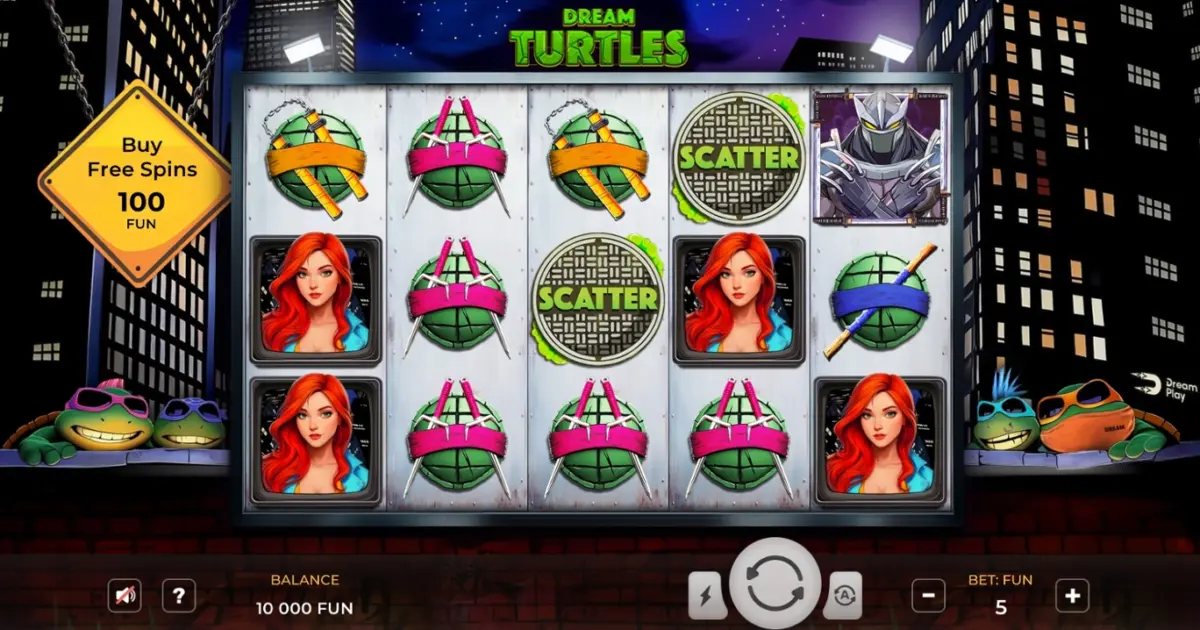
Dream Turtles is an anime-themed 5-reel slot from Dream Play that sits 0.36 percentage points below the corpus average RTP. If you want a quick read: the maths are slightly weaker than what most providers publish, and Dream Play has not disclosed volatility, stake range, or payline structure for this title. That combination of a below-average return and sparse published data means the demo is not optional — it is your primary source of information before committing real money.
The Dream Turtles Slot at a glance
Dream Play is a small provider with 44 titles in the corpus and an average RTP of 95.18% across its portfolio. Dream Turtles runs at 95.35%, which is marginally above the provider’s own average but clearly below the 95.71% corpus benchmark. At rank 498 with a 97.5th-percentile popularity score, the game draws more attention than its math suggests it deserves — likely because the anime theme and the 5-reel format appeal to players who gravitate toward visually distinct titles rather than the highest theoretical returns.
Here are the only figures Dream Play has published for this game:
| Statistic | Value |
|---|---|
| Provider | Dream Play |
| RTP | 95.35% |
| Reels | 5 |
| Theme | Anime |
| Volatility | Not published |
| Paylines / Ways | Not published |
| Stake range | Not published |
| Max win | Not published |
| Free demo | Yes |
Four key numbers are absent. That matters more than it might seem: without volatility or max-win data, you cannot estimate how long a session will last or how large a single swing could be. If you compare this against other Dream Play slots like Future Sevens at 95.0% or Kingdom Coin Chase at 94.9%, you will notice the provider’s portfolio clusters in the 94.9–95.4% band — all below corpus average.
What a 95.35% RTP actually returns
RTP is a long-run statistical average. It does not predict any individual session. But working the figure through a concrete example helps you see the gap between this game and a higher-paying alternative.
Suppose you play 1,000 spins at £1 per spin. Your total wagered is £1,000. At 95.35% RTP, the expected return across that sample is £953.50 — a theoretical loss of £46.50. Now compare that to the corpus average of 95.71%: over the same 1,000 spins, a 95.71% game returns £957.10, meaning £3.60 more back in your pocket. The difference looks small per session, but across 10,000 spins at £1 it widens to £36. Across 100,000 spins it reaches £360.
The gap to the corpus is modest. Where it becomes noticeable is in comparison to higher-RTP anime titles. Starlight Princess, for instance, pays 96.5% — 1.15 percentage points above Dream Turtles. Over 10,000 spins at £1 that difference is £115. If raw return percentage is your priority, Starlight Princess is a straightforward upgrade within the same theme category.
One caveat: RTP assumes the theoretical model and an infinite sample. Short sessions will scatter far from the average in both directions. Treat these figures as a guide to long-term house edge, not a session forecast.
Volatility and what your session will feel like
Dream Play has not published a volatility rating for Dream Turtles. This is the single most consequential missing data point in the review, because volatility — not RTP — determines whether a session feels smooth or jagged.
As a concept, volatility describes the size and frequency of wins. A low-volatility slot pays smaller amounts more often, stretching your bankroll across more spins with less drama. A high-volatility slot pays rarely but with larger hits, meaning long dry spells punctuated by brief spikes. The RTP figure stays the same regardless of volatility; only the distribution of wins changes.
Without a published rating, you cannot plan your session around Dream Turtles the way you would around a game rated low or high. The practical solution is the demo: play 200–300 spins in free mode, track how long your starting balance lasts, note the ratio between your smallest and largest wins, and judge the swing pattern yourself. If wins cluster tightly and your balance barely moves, you are likely looking at low-to-medium volatility. If you see long silences followed by occasional large hits, the game behaves like a high-volatility title regardless of what Dream Play has not told you.
The 5-reel layout and how wins are counted
Dream Turtles uses a 5-reel configuration, which is the industry standard for video slots. Five reels give the game enough width to support multiple symbols per row while keeping the visual complexity manageable. Most modern 5-reel games pair with 20, 25, or 50 paylines, or with a “ways” mechanic where adjacent matching symbols across reels count as wins regardless of horizontal alignment.
Dream Play has not published the payline count or win mechanic for this title. You will see the layout when you open the demo: count the visible rows and look for any paytable reference that says either “paylines” or “ways.” This distinction matters for two reasons. First, a fixed-payline game typically requires you to bet on each line, so a £1 total stake at 20 paylines means 5p per line. A ways game may take a single stake regardless of matching patterns. Second, the number of ways directly affects hit frequency — 243 ways produces far more frequent small wins than 20 fixed lines at the same symbol set.
Until you see the paytable, treat all claims about how this game “pays” as unverified.
Stake range and sizing a bankroll
Dream Play has not published the minimum or maximum stake for Dream Turtles. This means you cannot pre-plan a bankroll using stated figures; you will discover the range only when you load the game at a casino.
What you can do in the meantime is size a bankroll around the RTP figure and the unknown volatility. At 95.35% RTP, the house edge is 4.65%. If you budget £100 for a session and play at an unknown stake, a reasonable heuristic is to set your per-spin cost so that you get at least 200 spins from that budget. At £100 and 200 spins, that caps you at £0.50 per spin. If you get fewer than 200 spins before your balance halves, the game is likely high-volatility and you should reduce your stake next time.
Never treat 95.35% as a guarantee that £100 becomes £95.35. Over a few hundred spins the variance dwarfs the RTP edge. You could finish the session with £150 or £20, and both outcomes are statistically normal. The RTP figure only tells you which direction the long-run math points.
Playing the Dream Turtles free demo before you commit
The Dream Turtles free demo is available and is the single best tool you have for evaluating this game, given how many key specifications are missing. Use it to measure three things: the payline or ways count (visible in the paytable), the rough volatility (how long your balance lasts over 200 spins), and the stake range (the minimum and maximum bet buttons).
Demo play replicates the game’s mechanics but not the psychological pressure of real money. Wins in a demo cost you nothing, so you may find yourself spinning far more freely than you would with your own cash. When you eventually play for real, expect your perception of the same session to differ — dry spells that felt bearable in the demo will sting when they cost actual money.
One note on responsible play: this is a 4.65% house-edge game with undisclosed volatility. Set a budget before you start, treat any money wagered as the cost of entertainment rather than an investment, and stop when that budget is spent. The demo is free, which makes it the right place to build your understanding first.
Verdict: who should play Dream Turtles
Dream Turtles is a below-average-RTP anime slot with significant information gaps. At 95.35%, it returns less per wagered pound than the 95.71% corpus average, and the gap to the best anime titles in this category — Disco Beats at 96.62%, Starlight Princess at 96.5% — is meaningful over thousands of spins. If you compare it side-by-side with Disco Beats in the demo, the difference in hit density alone will show you what a 1.27-percentage-point RTP gap feels like in practice.
That said, if the anime visual style is what draws you and you plan to play fewer than 500 spins per session, the 0.36% penalty against corpus average is mathematically trivial. Dream Turtles also sits above its own provider’s 95.18% average, and Future Sevens from the same studio pays even less at 95.0%.
The real blocker is not the RTP. It is the missing volatility, payline, and stake data. Until those are confirmed — by loading the game or by a Dream Play spec sheet — you are gambling blind on session management, not just on outcomes. Play the demo, extract the numbers yourself, and decide whether the experience justifies the slightly weaker math.
Frequently Asked Questions
Can I play Dream Turtles for free without downloading anything?
Yes. The Dream Turtles free demo is available to play in your browser with no download, no registration, and no deposit required. The demo replicates the game's mechanics so you can measure the reel layout, paytable structure, and rough volatility before deciding whether to play with real money.
What does the 95.35% RTP on Dream Turtles mean for my money?
Across a very large sample of spins, Dream Turtles returns approximately £95.35 for every £100 wagered. The corpus average is 95.71%, so Dream Turtles trails by 0.36 percentage points. Over 10,000 spins at £1, that gap costs you roughly £36 compared to an average game, though individual sessions will vary far more than this figure suggests.
What volatility is Dream Turtles rated at?
Dream Play has not published a volatility rating for Dream Turtles. This means you cannot predict whether your session will be smooth with frequent small wins or jagged with long dry spells and occasional spikes. You can estimate the volatility yourself by tracking 200–300 demo spins and observing how quickly your balance fluctuates.
Who makes Dream Turtles and what else does the studio produce?
Dream Turtles is developed by Dream Play, a provider with 44 games in the reviewed corpus. Their portfolio averages 95.18% RTP, slightly below the 95.71% industry benchmark. Other Dream Play titles include Future Sevens at 95.0% RTP and Kingdom Coin Chase at 94.9%, placing the studio consistently in the sub-average RTP range across its catalog.
How does Dream Turtles compare to Starlight Princess in the anime theme?
Starlight Princess pays 96.5% RTP compared to Dream Turtles at 95.35%, a gap of 1.15 percentage points in Starlight's favor. Over 10,000 spins at £1, that difference is £115 returned. Both are 5-reel anime-themed games, but Starlight Princess offers a stronger long-run return figure according to published data.




