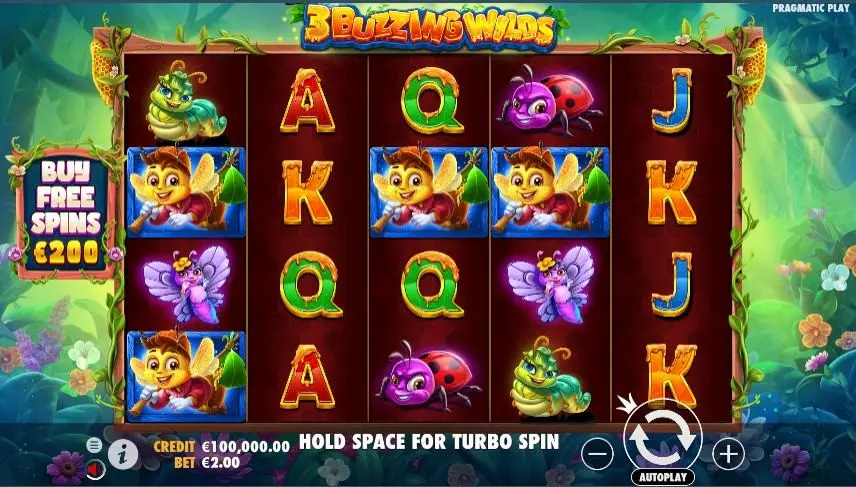
If you want a high-volatility Pragmatic Play slot that pays above the industry average and caps out at 5,000x your stake, this 3 buzzing wilds slot from the Relax-themed corner of their catalogue is a legitimate option. Below are every number Pragmatic Play has published, what those figures actually mean for a session, and whether the maths supports a real-money play.
3 Buzzing Wilds versus the average slot
Across the full corpus of games tracked here, the average return-to-player figure sits at 95.71%. 3 Buzzing Wilds posts 96.03%, which is +0.32 percentage points above that baseline. On a practical level, for every £100 you wager over a very large sample, you would expect a theoretical return of £96.03 rather than £95.71. That difference of 32 pence per £100 sounds trivial on a single spin, and it is — the volatility profile dominates your actual experience far more than the RTP gap.
The game also sits at popularity percentile 97.7 within the tracked catalogue, meaning more than 97% of slots reviewed here attract less attention from players. Its rank of 452 places it in the top half of Pragmatic Play’s 739-game portfolio by engagement, so it is neither obscure nor a headline release. The table below summarises every published figure so you can scan the key data before reading the analysis.
| Specification | Value |
|---|---|
| Provider | Pragmatic Play |
| RTP | 96.03% |
| Volatility | High |
| Reels | 5 |
| Bet range | $0.20 – $100 |
| Max win | 5,000x stake |
| Popularity percentile | 97.7 |
| Free demo available | Yes |
RTP breakdown: 96.03% in context
At 96.03%, 3 Buzzing Wilds falls 0.29 points below Pragmatic Play’s own portfolio average of 96.32%. That does not make it a poor performer — the studio has produced several titles at 96.5% and above, including Gates of Olympus and Sweet Bonanza, both of which return slightly more per wager on average. The gap between 96.03% and 96.5% translates to roughly 47 pence per £100 wagered, again only meaningful over thousands of spins.
RTP is a long-run theoretical ceiling calculated across millions of simulated spins by the game’s mathematicians. It tells you nothing about where your next ten spins will land, whether a session will be profitable, or how a single evening maps onto the published figure. What it does tell you is the house edge: at 96.03%, the operator retains approximately 3.97% of all money wagered over the game’s full statistical life. Compared to a slot at 95% RTP, you are retaining an extra 1.03 percentage points of your theoretical loss rate. Over 10,000 spins at £1 per spin, that is the difference between a theoretical £500 loss and a £447 loss — both large numbers in absolute terms, and both dwarfed by session-level variance.
Volatility profile
3 Buzzing Wilds is classified as high volatility. In practical terms, that means three things you should plan around: your hits will be widely spaced, the swings between wins will be large, and your bankroll needs to be deeper relative to your stake to survive the dry stretches.
High-volatility slots concentrate their return into fewer, larger payouts. You will experience sequences where dozens of spins pass without a return that meaningfully offsets your stake, followed by occasional spins that land a significant multiple. The 5,000x max win figure is the theoretical ceiling on a single spin — reaching it requires an unlikely combination of symbols and multipliers, and most sessions will not come close. That said, the potential for large payouts is what keeps the overall RTP competitive despite the infrequent hit pattern.
Your bankroll requirement is directly tied to how much variance you can absorb. At a minimum stake of $0.20, you need 50 spins of balance just to cover one unit of stake per spin if you hit nothing at all — and with high volatility, that is entirely plausible. If you normally play at medium-volatility titles, expect to feel the difference within 20 or 30 spins on this slot. The $100 maximum stake also gives room to scale up, but the same variance that produces large wins will produce large losses at that rate too.
Pragmatic Play as a studio
Pragmatic Play has published 739 games across the tracked catalogue, making it one of the largest slot providers in the review set. Their average RTP across that library is 96.32%, which places 3 Buzzing Wilds slightly below their own portfolio standard but comfortably above the industry-wide average of 95.71%.
The studio’s most recognisable titles tend to skew toward high volatility and above-average RTP. Gates of Olympus returns 96.5% and Joker’s Jewels matches that figure, while Sweet Bonanza sits at 96.51%. If you prefer a slightly better mathematical return from the same provider, those three are worth comparing. 3 Buzzing Wilds offers a lower ceiling on RTP than their flagships but brings a Relax- and Nature-themed presentation that the provider’s mythology and candy titles do not.
The breadth of the catalogue also means the studio iterates frequently on maths frameworks — you will find overlapping volatility and RTP bands across many of their titles, so comparing within the provider before committing is a sensible research step.
Three Relax alternatives worth comparing
The “Relax” theme tag covers 380 games in the tracked corpus, so you have plenty of options if the high-volatility profile of 3 Buzzing Wilds does not suit your play style. Three alternatives worth a look:
Big Bass Splash carries a 96.71% RTP — nearly seven-tenths of a percentage point above 3 Buzzing Wilds — and draws on an outdoor, Nature-adjacent theme. That RTP edge over thousands of spins is small but consistent. Frutinions and Cleopatra (Arrow’s Edge) round out the themed set, though neither has a published RTP figure in the tracked data, which means you cannot make a reliable mathematical comparison to those two from public information alone. If RTP matters to you, stick with titles where the figure is openly stated.
When browsing Relax slots, check whether the provider publishes volatility alongside RTP. Some studios disclose both, which lets you model session length and swing size together. 3 Buzzing Wilds gives you both figures; several competitors in the same theme group do not.
Getting the most out of the free demo
A free demo of 3 Buzzing Wilds is available, which means you can play the 5-reel layout with simulated credits before committing money. The value of that demo is not in predicting your real-money results — it cannot do that, because every spin is independent and the demo uses the same random logic without financial consequence. What the demo genuinely offers is a feel for the cadence of hits and misses, so you can decide whether the gap between meaningful payouts sits within your tolerance before you risk a penny.
Use the demo to test the stake range from both ends. Spin at $0.20 for a while and notice how many cycles pass before a return that exceeds your total outlay. Then try $5 or $10 per spin and observe whether the same underlying volatility produces a session experience you can stomach. The maths does not change, but your psychological response to variance does scale with stake size.
Play responsibly. This is an 18+ product designed for adults treating slot sessions as paid entertainment with a known house edge. Set a budget before you open the real-money version, stop when you reach it, and never chase losses. No pattern of spinning, no timing strategy, and no stake progression changes the expected value of any future spin.
Should you play the 3 Buzzing Wilds slot?
If you are drawn to the Relax-and-Nature theme, want a Pragmatic Play title with a published 96.03% RTP that clears the industry average, and your bankroll can handle the extended dry spells that high volatility guarantees, this slot is a mathematically honest option. The 5,000x max win gives you a genuine ceiling to aim at, though reaching it is not a realistic planning assumption for any single session.
The case to look elsewhere: if you prefer frequent small hits, if your budget does not give you at least 100 minimum-stake spins of headroom, or if a 96.03% RTP feels underwhelming when several related titles return 96.5% or better. The demo lets you make that call with zero financial risk — use it before you decide.
Frequently Asked Questions
Can I play 3 Buzzing Wilds for free without downloading anything?
Yes, a free demo is available directly in your browser with no download required. You can spin the 5-reel layout with simulated credits at any stake from the demo range, which lets you experience the high volatility pattern without risking money. Demo results are not predictive of real-money outcomes.
What is the RTP on 3 Buzzing Wilds and is it good?
The RTP is 96.03%, which is 0.32 percentage points above the industry-wide average of 95.71% tracked across this corpus. That means over a very large sample you retain about 96 cents of every dollar wagered. It sits slightly below Pragmatic Play's own portfolio average of 96.32%, so it is competitive but not the provider's strongest mathematical offering.
How risky is 3 Buzzing Wilds in practice?
The game carries high volatility, which means long sequences of minimal or zero returns punctuated by occasional larger payouts. Your session will swing significantly, and your bankroll needs to be deep enough relative to your stake to survive the dry periods. The 5,000x max win is the theoretical single-spin ceiling, but reaching it is an outlier event.
What else does Pragmatic Play make that is similar?
Pragmatic Play has published 739 slots across the tracked catalogue with an average RTP of 96.32%. Titles like Gates of Olympus (96.5%), Sweet Bonanza (96.51%), and Joker's Jewels (96.5%) all return more than 3 Buzzing Wilds. If you prefer higher RTP from the same studio, those three are worth demoing first.
What is the bet range on 3 Buzzing Wilds and how does it affect bankroll?
Stakes run from $0.20 to $100 per spin. At the minimum stake, you need a substantial balance to absorb the high-volatility dry spells — expect 50 to 100 spins of budget before a meaningful return is even likely. Scaling up stake size does not change the volatility pattern, only the absolute swing size in monetary terms.




