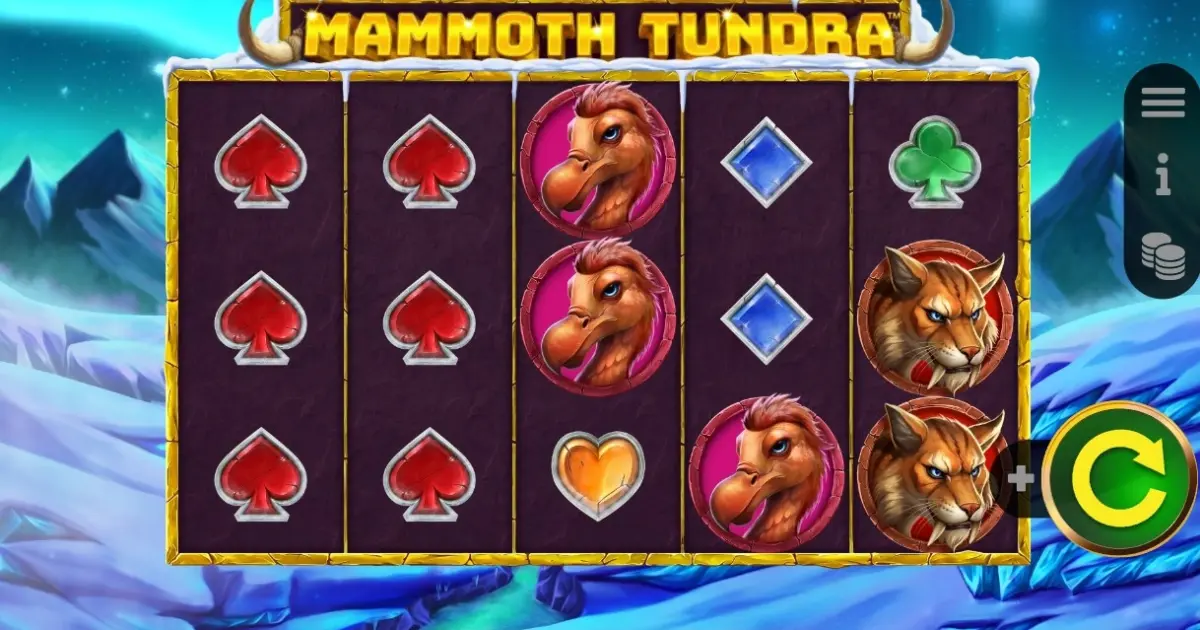
Mammoth Tundra slot from Booming Games sits below both its provider’s average RTP and the broader corpus benchmark, which makes it a harder recommendation than several similar titles. If long-run returns matter more to you than theme, the numbers below give you a clear reason to compare options before committing stake.
Mammoth Tundra at a glance
| Detail | Value |
|---|---|
| Provider | Booming Games |
| RTP | 95.4% |
| Reels | 5 |
| Themes | Animals, Winter, 5-Reels |
| Popularity rank | 432 (97.8th percentile) |
| Free demo | Available |
Booming Games publishes 128 slots with a portfolio average RTP of 95.79%. Mammoth Tundra lands 0.39 percentage points below that. Against the full corpus average of 95.71%, the gap widens to 0.31 percentage points. The 97.8th-percentile popularity rank tells you this title attracts a large audience relative to the total slot database — but high play counts often reflect theme appeal and marketing placement rather than superior maths.
If you want a winter or animals theme with a measurably higher RTP, Apex Strike Megaways returns 96.13%, putting it 0.73 points above Mammoth Tundra while staying in the same animals category.
What a 95.4% RTP actually returns
RTP is a theoretical long-run average calculated across millions of simulated spins. It is not a prediction for any single session. To make the figure concrete: across 10,000 spins at a hypothetical £1 stake, the statistical expectation is a return of £9,540 against £10,000 wagered, a net theoretical loss of £460.
Compare that to the corpus average of 95.71%. Over the same 10,000 spins, a game at corpus-average RTP would expect to return £9,571 — £31 more than Mammoth Tundra. Against Booming Games’ own portfolio mean of 95.79%, the gap is £39 per 10,000 spins at £1. These are small per-spin differences, but they compound across long sessions.
Boogie Boom from the same provider returns 95.7%, a half-point above Mammoth Tundra. Thunder Eagle Hold and Win Extreme 10,000 reaches 95.9%, closing the gap to the portfolio average. If you prefer Booming Games mechanics, either of those gives you a better theoretical return.
Volatility data missing — what that means for your session
Booming Games has not published a volatility rating for Mammoth Tundra in the data available to this review, so you cannot plan your bankroll against a known risk profile before playing.
As a concept, volatility describes how unevenly returns are distributed across spins. A low-volatility slot pays small wins frequently, stretching your bankroll across many spins with modest swings. A high-volatility slot pays less often but with larger amounts when it does, producing long dry stretches followed by sharp spikes. Medium sits between both.
Without a confirmed rating, you can only assess risk empirically: play the free demo version and track how many spins pass between wins and how large those wins are relative to your stake. That observation gives you a working sense of the distribution before you risk real money.
The 5-reel layout and how wins are counted
Mammoth Tundra uses a 5-reel grid. Five reels are the most common slot layout in the market — it balances the number of symbol positions with manageable spin frequency. A 5-reel slot has more cell combinations than 3-reel titles, which allows for denser paytable structures and typically more ways to trigger winning lines.
The data available here does not specify whether this game uses fixed paylines, a ways mechanic, or a cluster-pay system. Those three approaches count wins in fundamentally different ways. Fixed paylines reward matches along specific horizontal or diagonal paths. Ways systems pay for left-to-right (or any-direction) matches on adjacent reels regardless of vertical position. Cluster pays require groups of touching identical symbols. The same set of reel results produces very different outcomes depending on which system applies.
Check the game information screen or paytable before playing for real money to confirm the winning method.
Stake range and sizing a bankroll
No minimum or maximum stake figures are published in the available data for Mammoth Tundra. Without those boundaries, you cannot calculate a precise session length or a risk-per-spin percentage.
General bankroll planning works like this: at 95.4% RTP, the theoretical house edge is 4.6% per spin. If you know your stake per spin, multiply it by 0.046 to get the expected loss per spin. A £0.50 stake yields £0.023 in expected loss per spin; a £2 stake yields £0.092. Divide your total session budget by the expected loss per spin to estimate a rough spin count before depletion — keeping in mind this ignores variance entirely.
Most experienced players treat the expected loss as a minimum guide and budget for 1.5 to 2 times that number of spins to survive normal variance without exhausting funds during a cold stretch.
Playing the Mammoth Tundra demo before you commit
A free demo is available for Mammoth Tundra, which lets you test the game’s pacing, win distribution, and feature triggers without risking money. Demo outcomes use the same random number generator as real-money play, so you get an honest feel for how often the reels produce wins — but the RTP you observe in a demo session of a few hundred spins will not match the published 95.4% because that figure only stabilises across tens or hundreds of thousands of iterations.
Use the demo to learn the paytable and confirm the winning method. Do not treat a short demo streak as evidence that the real-money version will behave similarly in a single session.
Slots are paid entertainment. Set a firm budget before you open the real-money version, stick to it regardless of how the session unfolds, and treat it as the cost of an experience you chose — not an investment with a return you are owed. You must be 18 or older to play for real money in your jurisdiction.
Verdict: who should play Mammoth Tundra
Mammoth Tundra appeals if you specifically want an animals-and-winter theme from Booming Games and are willing to accept a 0.31-point RTP discount against the corpus average in exchange. The popularity rank confirms many players share that preference. But if your priority is maximising theoretical return within a category, Hercules Power Wild at 96.2% delivers 0.8 percentage points more per wager with a similarly mythic-creature flavour.
The missing volatility data is the more practical concern. Without it, you cannot match the game to your risk tolerance before playing. That gap alone is a reason to try the free demo first and build your own read on the distribution.
Frequently Asked Questions
Can you play Mammoth Tundra for free?
Yes. A Mammoth Tundra free demo is available, letting you spin without depositing money. The demo uses the same underlying maths as the real-money version, so you can observe win frequency and feature pacing. It cannot pay out cash, but it is the right way to decide whether this Booming Games title suits your preferences before you stake anything.
What does 95.4% RTP mean for Mammoth Tundra?
Over a very large sample of spins, Mammoth Tundra is expected to return £95.40 for every £100 wagered, keeping a 4.6% theoretical house edge. That sits 0.31 percentage points below the corpus average of 95.71% and 0.39 points below Booming Games' portfolio mean of 95.79%. A short session will deviate widely from this figure due to variance.
Is Mammoth Tundra a high or low volatility slot?
No volatility rating is published in the available data for this game. You can assess risk empirically by playing the demo and counting spins between wins and their relative size. Until Booming Games or a casino platform discloses the rating, plan your bankroll conservatively and treat the game as potentially medium-to-high until you confirm otherwise.
Who made Mammoth Tundra and what else do they offer?
Booming Games developed Mammoth Tundra. Their catalogue spans 128 titles with an average RTP of 95.79%. Boogie Boom from the same studio returns 95.7%, and Thunder Eagle Hold and Win Extreme 10,000 reaches 95.9%. If you enjoy Booming Games mechanics but want better long-run returns, those alternatives give you closer-to-average maths without changing provider.
How does Mammoth Tundra compare to Apex Strike Megaways?
Mammoth Tundra offers 95.4% RTP across a 5-reel layout in the animals theme category. Apex Strike Megaways returns 96.13%, giving you 0.73 percentage points more theoretical return per wager in the same theme. Both share the animals classification, so the comparison isolates the RTP difference cleanly. Apex Strike Megaways is the stronger choice on maths alone.