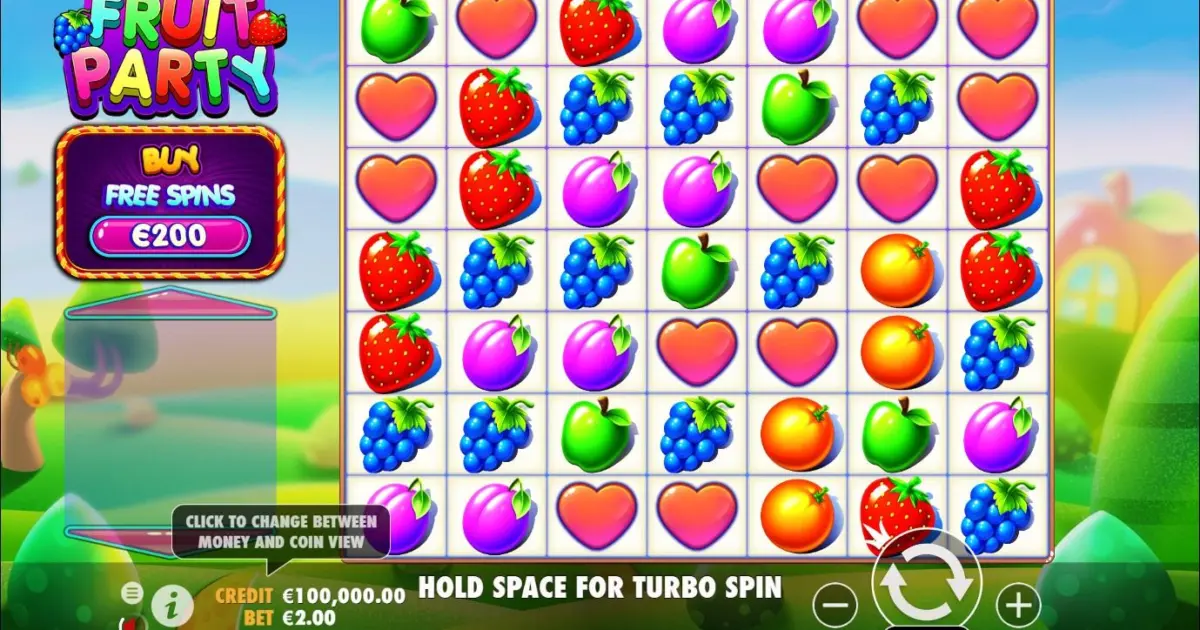
The fruit party slot from Pragmatic Play delivers a 96.47% RTP on a 7-reel grid with high volatility. The maths are honest, but the session experience is punishing for anyone who cannot absorb dry spells.
Who makes Fruit Party
Pragmatic Play developed Fruit Party, and it is one of 739 titles the provider has placed in this review catalogue. That number alone tells you something about the company’s output pace: Pragmatic Play releases slots at a rate that makes cataloguing them a near-continuous project. Across those 739 games, the provider’s average RTP sits at 96.32%, which means Fruit Party’s 96.47% is marginally above house standard but not dramatically so.
The game carries three theme labels: Fruits, 7-Reels, and Earth Day. The fruit classification is self-explanatory in terms of symbol palette, and the 7-reel designation describes the grid geometry. The Earth Day tag is unusual for a slot and likely reflects a promotional tie-in rather than a mechanic. Pragmatic Play has not published a max win multiplier or hit frequency for this title in the data available here, so treat any specific figures quoted elsewhere with caution.
| Provider | Pragmatic Play |
|---|---|
| RTP | 96.47% |
| Volatility | High |
| Reels | 7 |
| Theme | Fruits |
| Bet range | $/£/€0.20 – $/£/€100 |
| Free demo | Yes |
Where Fruit Party sits in the Pragmatic Play catalogue
Rank 107 out of 739 titles places this slot in roughly the top 15% of Pragmatic Play’s own catalogue by popularity, sitting at the 99.5th percentile across the full review corpus. That is a strong position for a fruit-themed game competing against branded titles and cascading-mechanic hits.
If you are comparing Pragmatic Play releases, Gates of Olympus and Sweet Bonanza both return 96.5% and 96.51% respectively — fractions above Fruit Party but with different volatility profiles that produce noticeably different session rhythms. Joker’s Jewels matches at 96.5% RTP and offers a simpler payline structure. The practical question is not which has the higher decimal; it is whether you prefer cluster pays or traditional paylines at that RTP level.
RTP: 96.47% against a 96.32% house average
An RTP of 96.47% means that across an extremely large number of spins, the game returns £96.47 for every £100 wagered. The remaining £3.53 is the theoretical house edge. Over 10,000 spins at £1 per spin, the expected return is approximately £9,647, though actual results will vary wildly because 10,000 spins is nowhere near large enough for RTP to stabilise.
Against the corpus-wide average of 95.71%, Fruit Party is 0.76 percentage points above the field. Against Pragmatic Play’s own 96.32%, it sits 0.15 points above. Neither gap is large enough to matter over a single session. RTP is a long-run property; a 0.15% difference would require tens of thousands of spins before it becomes visible in your balance. What you should care about on any given evening is not whether 96.47 beats 96.32 — it is whether the volatility matches your bankroll.
Volatility and who it suits
High volatility means the game concentrates its returns into infrequent, larger payouts rather than spreading them across many small wins. In practical terms, you should expect long sequences of spins returning less than your stake, punctuated by occasional hits that may be several multiples of your bet.
The 7-reel format matters here. Seven reels create more symbol positions than the standard five, which can increase the number of ways combinations form — but it also means more dead spins where nothing connects across the threshold the game requires. High volatility compounds this: the distribution of outcomes is wide, with a long left tail of losing spins and a long right tail of large wins.
You need a bankroll that can survive the dry periods. At the minimum stake of £0.20 per spin, you have 50 spins per £10 — that is a thin margin for a high-volatility game. A more comfortable session on this title starts around £50 at the lowest stake or £200 at mid-range stakes.
Playing Fruit Party for free
A free demo version of Fruit Party is available, which lets you spin without wagering real money. This is useful for learning how often the game actually pays and how the 7-reel grid behaves under high volatility before committing a budget. It is not, however, a reliable indicator of what your real-money session will look like — demo play and paid play are independent random processes, and a demo session that feels generous tells you nothing about your next real-money sequence.
When you do switch to real stakes, the range runs from £0.20 to £100 per spin. That upper bound is aggressive and suits high-roller sessions, but the lower bound is what most players will use. Set a session budget before you start, treat the money as spent once it is deposited, and stop when it is gone. Players must be 18 or older, and gambling should be entertainment with a price tag, not an income strategy.
Similar picks
If fruit themes interest you, the corpus contains 2,560 games labelled with fruit or closely related categories. Among them, Hot Hot Fruit returns 96.84% RTP — the highest of the three related fruit picks — making it a stronger mathematical proposition if RTP is your primary filter. Trickstar Spins sits at 94.0%, which is 2.47 points below Fruit Party and noticeably below the corpus average; the difference is large enough to be meaningful over extended play. Sevens High has no published RTP in this catalogue, so you cannot compare its mathematical fairness on the numbers available.
For the full picture, check each title’s volatility profile before switching — a high-RTP game with extreme volatility may frustrate more than a slightly lower-RTP game with medium swings.
Verdict
Fruit Party is a competent 7-reel slot with a respectable RTP that edges its provider’s average by a small margin. The high volatility and wide stake range make it a game that rewards patient bankroll management and punishes underfunded sessions. It does not offer any data here — max win, bonus mechanics, hit frequency — that would let you evaluate it beyond the structural numbers.
If you play high-volatility slots as a rule and want a 7-reel format, the maths are fair and the popularity rank suggests the gameplay holds attention. If you prefer frequent small wins, the volatility profile will feel hostile regardless of the RTP. The demo is free, so the cheapest way to answer that question for yourself is to spin 200 times at minimum stake and count how long the longest dead sequence lasts before you decide whether that rhythm is tolerable.
Frequently Asked Questions
Is Fruit Party available to play for free?
Yes, Pragmatic Play's Fruit Party has a free demo version available for testing. You can spin without depositing, which helps you gauge how the high volatility feels over a sample of spins. Demo outcomes do not predict real-money results since each sequence is independent.
What is the RTP of Fruit Party slot?
Fruit Party returns 96.47% RTP, which is 0.15 points above Pragmatic Play's catalogue average of 96.32% and 0.76 points above the corpus average of 95.71%. Over 10,000 spins at one unit per spin, the theoretical return is 9,647 units, though variance on a high-volatility game will dominate in practice.
Is Fruit Party a high or low volatility slot?
Fruit Party is classified as high volatility by Pragmatic Play. This means returns are concentrated into fewer, larger payouts with longer dry spells between hits. You need a bankroll that can absorb losing streaks — at the 0.20 minimum stake, plan for at least 200 to 300 spins to see a representative session.
How many reels does Fruit Party have and what is the stake range?
Fruit Party uses a 7-reel grid with a stake range from 0.20 to 100 per spin in dollars, pounds, or euros. The 7-reel format means more symbol positions than standard five-reel slots, which can produce more combination opportunities but also more empty spins during high-volatility dry periods.
How does Fruit Party compare to Gates of Olympus?
Fruit Party returns 96.47% RTP while Gates of Olympus offers 96.5% — a difference of 0.03 percentage points that is mathematically negligible. Both are Pragmatic Play titles, but they differ in format: Fruit Party uses 7 reels with high volatility, while Gates of Olympus uses a scatter-pays tumble mechanic on a different grid structure.