Casino Web Scripts publishes a 97.5% return for this game, which puts it exactly on the average for the video poker titles in our corpus and about nine tenths of a point below this provider’s own 98.39% average across its eight games. A free demo is available, so you can learn the flow of the hands without staking anything. What the listing does not include is the payout schedule itself, and in this game category the payout schedule is the whole story.
That gap matters more than it would for a slot. Read the in-game pay chart before you commit money.
Texas Holdem Heads-Up Video Poker in one minute
The provider is Casino Web Scripts, the theme label is Cards, and the published return is 97.5%. Free demo play is available. The title sits at rank 21 in our listings with a popularity percentile of 85.7, so a reasonable number of people are finding it.
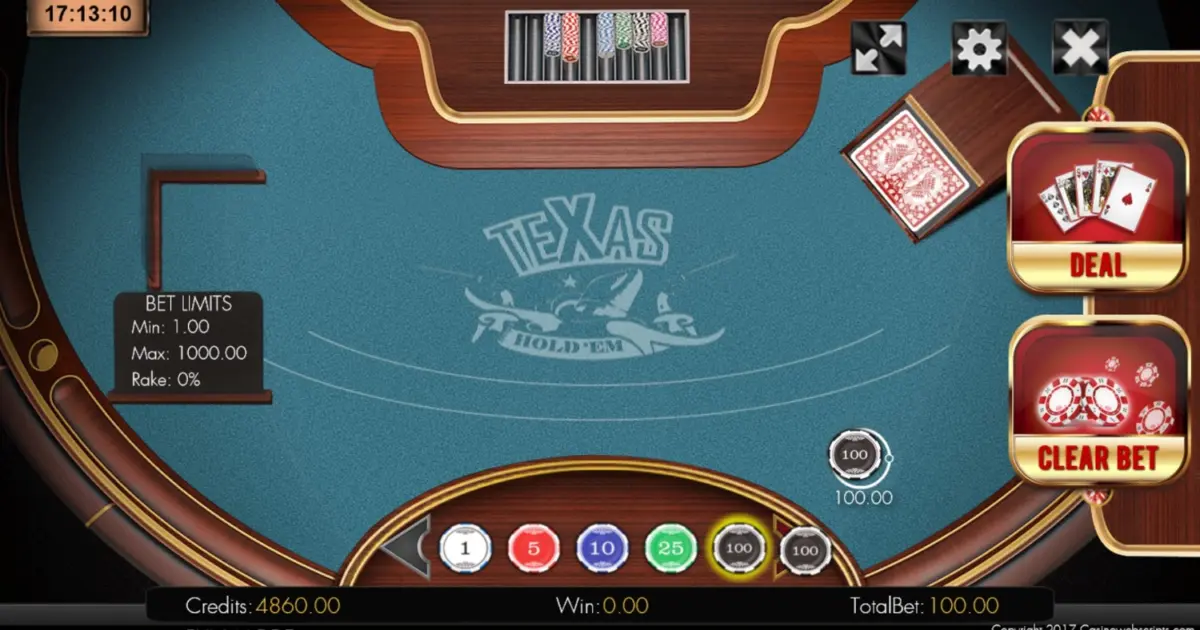
The name signals a heads-up hold’em format rather than a classic five-card draw game, and that is worth flagging honestly: this listing does not include the hand ranks it pays on, the payout multiple for each rank, the ante or raise structure, or the bet sizes available. Those are exactly the numbers that decide your return here. Casino Web Scripts has not published them for this version, so the pay chart inside the game is your only reliable source.
What you can rely on is the deck. Video poker deals from a freshly shuffled 52-card deck every hand. There is no reel weighting and no hidden symbol frequency the way there is in a slot, so the maths is open to inspection once you can see the payout schedule. If you want a variant whose rules are named on the tin, Jacks Or Better Video Poker from the same studio is listed at 98.39% and follows the standard draw format.
What perfect strategy actually means here
In video poker, optimal strategy is a solved hold and discard chart. For a given payout schedule, someone has computed the expected value of every possible way to keep or throw cards from a dealt hand, and the chart tells you which keep is worth the most. It is publishable, checkable, and boring in the best way.
Two things follow from that. First, the chart is specific to the payout schedule, not to the game’s name. Change one payout line and some borderline holds flip. Second, strategy changes which cards you keep and nothing else. It never touches the deck, the shuffle, or the odds behind either. Deviating costs you return; it does not make the next deal behave differently.
Because this game is a heads-up hold’em format rather than a draw game, the decision set differs from a draw chart. You are choosing whether to continue against a dealer hand rather than which five cards to hold. The principle survives the format change: the correct decision at each point is fixed by the payout schedule, and every deal is independent of the one before it. No hand, deck, or machine is ever due.
Where the 97.5% comes from
The 97.5% figure assumes correct play. Every published video poker return does. It is the long-run average across an enormous number of hands, computed from the payout schedule and the assumption that you make the best available decision each time. Play worse than the chart and your realised return sits below the headline number; there is no way to play better than it.
What that number does not tell you is which payout lines produce it. Two games can share a return figure with quite different schedules behind them, and two games with the same name can differ by more than a full percentage point because of two numbers on the chart. Since this listing gives the return but not the schedule, you have the destination without the route.
For context inside the same catalogue, Caribbean Poker is listed at 98.92%, and across the Cards theme the highest figure we hold is 99.55% for a Red Rake Gaming Jacks or Better. Against a 97.5% return, staking 1 unit per hand implies an average theoretical cost of about 2.5 units per 100 units wagered. That is the expected cost of the entertainment, not a prediction of any session.
Paytable differences that change everything
This is the one thing to check before playing any video poker game for money. The classic example is Jacks or Better. On the 9/6 schedule, meaning nine for one on a full house and six for one on a flush, optimal play returns about 99.5%. Move to 8/5 and the same game with the same rules and the same strategy family drops to roughly 97.3%. A 6/5 schedule falls well below 95%.
| Hand rank | 9/6 Jacks or Better | 8/5 Jacks or Better | 6/5 Jacks or Better |
|---|---|---|---|
| Full house | 9 for 1 | 8 for 1 | 6 for 1 |
| Flush | 6 for 1 | 5 for 1 | 5 for 1 |
| Straight | 4 for 1 | 4 for 1 | 4 for 1 |
| Three of a kind | 3 for 1 | 3 for 1 | 3 for 1 |
| Approximate return | 99.5% | 97.3% | Below 95% |
Those are general reference figures for that variant, not this game’s numbers. They are here to show the size of the swing: a two-point difference produced by two lines on a chart. No other casino game category is that sensitive to a detail printed openly in the interface, which is why the habit of reading the pay chart first pays for itself.
Multi-hand and multi-play formats, explained
Multi-hand video poker deals your cards once, then plays your held selection simultaneously across several independent decks. Play five hands and you get five separate draws against the same starting choice. Multi-play works the same way at larger counts.
The important point is that this does not move the per-hand return. Each hand is computed against the same payout schedule, so a 97.5% game stays a 97.5% game whether you play one line or fifty. What changes is variance and speed. Fifty hands per deal means fifty times the stake committed per press and a much wider spread of outcomes, both directions. You reach the long run faster, which cuts both ways in the short term.
This listing does not state whether Texas Holdem Heads-Up offers a multi-hand mode, and the heads-up format would not necessarily support one in the usual sense. If you want to feel the difference between one line and many, a dedicated draw title is the cleaner test. Royal Flush Party Video Poker from the same provider is listed at 98.09% and worth a look for comparison.
Trying the demo first
Free demo play is available, and there is a specific reason to use it here beyond curiosity. The demo is where you can open the pay chart and read the actual payout lines, since the listing does not carry them. Note the payouts, note the ante and raise structure, and work out whether the decisions you are being asked to make are ones you understand.
Demo play does not predict real-money outcomes. A good run in free mode and a bad run with your own money are both just samples from the same independent deals, and neither tells you anything about the next one.
Play is for adults aged 18 or over. Decide what the session is worth to you before you open the game, treat that figure as the price of the entertainment, and stop when it is spent. Video poker is something you pay for, like a cinema ticket, not a source of income. No staking pattern changes that: raising after a loss, flattening after a win, or any other sequence leaves the expected value of each deal exactly where the payout schedule put it.
Who should play Texas Holdem Heads-Up Video Poker
This one suits players who already know heads-up hold’em and want a fixed-odds machine version of it, and who are comfortable checking the pay chart themselves rather than relying on a published summary. The 97.5% return is respectable for a casino card game, though it sits at the corpus average rather than above it.
If you are chasing the best listed return in this category instead, the numbers point elsewhere. Jacks or Better (Red Rake Gaming) is listed at 99.55%, roughly two points better, and it is a standard draw game with a published optimal strategy chart you can print and follow. That is a meaningful difference over any real volume of play.
The honest summary: a solid, transparent-deck card game at an average return, with the one caveat that Casino Web Scripts has not published the payout schedule for this exact version. In a category where the schedule decides the return more than anything else, that is worth ten seconds in the demo before you decide.
Frequently Asked Questions
Can I play Texas Holdem Heads-Up Video Poker for free?
Yes, a free demo is available for this Casino Web Scripts title, so you can play without staking money. Use it to open the in-game pay chart, since the payout schedule is not published in this listing. Demo results are independent deals and tell you nothing about how a real-money session will go.
What is the RTP of Texas Holdem Heads-Up Video Poker?
The published return is 97.5%, which assumes you make the correct decision on every hand. That figure is exactly the average across the video poker games in our corpus and about nine tenths of a point below Casino Web Scripts' own 98.39% average across its eight titles. Playing below optimal lowers your realised return.
Why does the paytable matter so much in video poker?
Because the return is calculated directly from it. In Jacks or Better, a 9/6 schedule returns roughly 99.5% while an 8/5 schedule returns about 97.3%, a two-point swing from two numbers. No other casino category is that sensitive to a detail printed openly in the game, which is why reading the chart comes first.
Who makes Texas Holdem Heads-Up Video Poker?
Casino Web Scripts, which has eight games in our listings at an average return of 98.39%. Others from the studio include Caribbean Poker at 98.92% and Jacks Or Better Video Poker at 98.39%. This provider has not published the payout schedule for this specific heads-up version, so check it in the game itself.
Does any betting pattern improve my results?
No. Every deal comes from a freshly shuffled 52-card deck and is independent of the last one, so raising after a loss or flattening after a win leaves the expected value of each hand exactly where the payout schedule set it. Only your hold and play decisions affect the return, never your stake sequence.