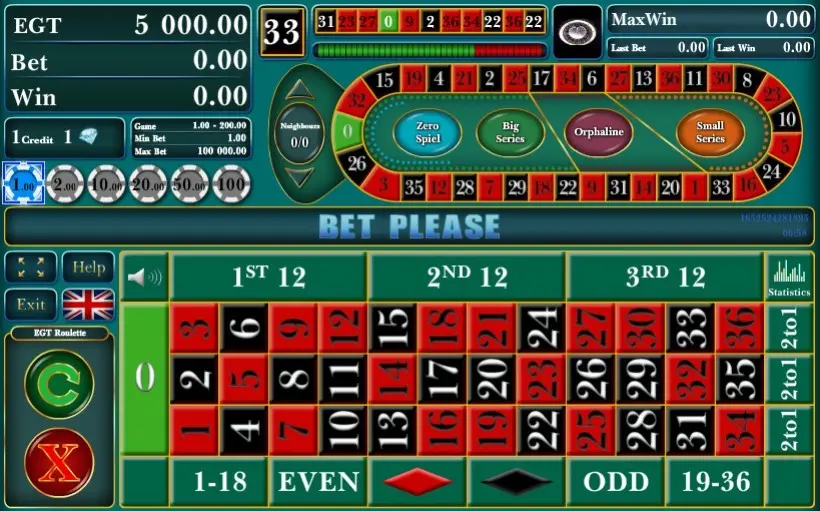
European Roulette (EGT) from Amusnet sits in the 89th popularity percentile, a clean implementation of the single-zero wheel with no multipliers, side bets, or progressive features to change the underlying maths. The title points to a 37-pocket European layout—one zero and numbers 1 through 36—which means a 2.70% house edge on every standard bet. Confirm the pocket count and paytable on the game’s own rules screen before placing real-money stakes, because the RTP figure for this specific table is not published in the facts available here.
How European Roulette (EGT) plays
You place chips on the layout, the wheel spins, the ball settles in a pocket, and winning bets are paid according to the posted odds. Inside bets cover individual numbers or small groups: straight-up (one number), split (two adjacent numbers), street (three-number row), corner (four-number block), and line (six numbers across two rows). Outside bets cover larger sections: red or black, odd or even, low (1–18) or high (19–36), dozens, and columns. Each bet type pays a fixed multiple of your stake if it wins. The presence or absence of features such as a racetrack, neighbour bets, or call-bet shortcuts is not documented in the available facts for this table, so check the interface directly if those matter to your session.
The pocket count is the whole story
A European wheel has 37 pockets. A straight-up bet wins one pocket and loses 36, so true odds are 36 to 1. The table pays 35 to 1. That single-pocket gap is the house edge, and it applies uniformly: every standard bet on a European wheel carries a 2.70% edge. An American wheel adds a second zero, raising the pocket count to 38 and the house edge to 5.26% on most bets (7.89% on the five-number basket). French rules—La Partage or En Prison—return half your stake on even-money bets when zero lands, cutting the even-money edge to about 1.35%, the best standard bet in roulette. The facts for this table do not confirm whether French rules apply, so assume they do not unless the paytable states otherwise.
Reading the RTP figure
RTP is not listed in the available facts for this table. The corpus average across all roulette games in the dataset is 96.97%, but that figure is not this table’s confirmed RTP. A standard European wheel with no rule variations returns 97.30% to the player (100% minus the 2.70% house edge). If this table’s RTP differs from that—because of altered payouts, special rules, or side bets—you will find the number in the game’s own help or paytable screen. Never bet real money without confirming the RTP and pocket count yourself, because the name alone is not a guarantee.
Choosing bets for the session you want
Inside and outside bets have the same expected value on a European wheel—2.70% house edge—but they shape variance differently. A straight-up number pays 35:1 and wins once every 37 spins on average, so you will lose many small bets and hit one large win occasionally. A red or black bet pays 1:1 and wins 18 out of 37 spins, so your bankroll moves more slowly and lasts longer with less volatility. If you want to stretch a session, stick to even-money or dozen bets. If you want the chance of a sharp win and accept running through your budget faster, play inside bets. Neither path changes the house edge; you are trading the speed and shape of variance, not the cost. Dozens and columns pay 2:1 and sit in the middle of that spectrum. Choose the bet that fits the entertainment you want from the session, knowing the maths are fixed either way.
Martingale and friends: the honest answer
Doubling after a loss (Martingale), adding the last two bets (Fibonacci), raising by one unit after a loss (D’Alembert), and waiting for five reds before betting black—all betting systems—do not change expected value. Spins are independent. The wheel has no memory. The probability of red on the next spin is 18 in 37 whether the last five spins were red, black, or alternating. Progressions redistribute variance: Martingale offers frequent small wins in exchange for rare, catastrophic losses when you hit the table limit mid-progression or run out of budget. The house edge applies to every bet in every spin. No staking pattern, no progression, and no “due number” tracking will overcome it. If that answer is disappointing, it is also the only honest one. The internet is full of confident nonsense about systems; roulette maths are completely known and completely unforgiving.
Bankroll and table limits
Table limits are not published in the available facts for this table. Minimum and maximum stakes matter because they set the ceiling on any progression system and determine how many base bets your bankroll can sustain. A low minimum lets you stretch a small budget; a high maximum gives a Martingale sequence more room before it hits the cap. Check the limits in the game interface before you commit real money. Set a budget in advance, treat it as the cost of entertainment, and stop when it is gone. Roulette is a negative-expectation game: over enough spins, the house edge guarantees you will lose more than you win. Play for the session itself, not as income. 18+. Never chase losses.
Verdict on European Roulette (EGT)
Amusnet’s European Roulette (EGT) ranks in the 89th percentile for popularity and offers a free demo, which makes it accessible for practice without financial risk. The title strongly suggests a single-zero wheel—the best standard format in roulette—but the RTP, table limits, and feature set are not confirmed in the available facts, so you must verify those details on the game’s own rules screen before betting real money. If the pocket count is 37 and the straight-up payout is 35:1, you are playing a standard European wheel with a 2.70% house edge, which is as low as roulette gets without French rules. If you prefer a confirmed 97.30% RTP and want to compare, European Roulette (Red Tiger) and European Roulette Pro both publish that figure, and French Roulette (NetEnt) adds La Partage for a 1.35% edge on even-money bets. This table is worth your time if you want a clean single-zero wheel from Amusnet and the demo satisfies you; confirm the numbers yourself, and the maths will do the rest.
| Bet type | Payout | True odds (European) | House edge |
|---|---|---|---|
| Straight-up | 35:1 | 36:1 | 2.70% |
| Split | 17:1 | 17.5:1 | 2.70% |
| Street | 11:1 | 11.33:1 | 2.70% |
| Corner | 8:1 | 8.25:1 | 2.70% |
| Line | 5:1 | 5.17:1 | 2.70% |
| Dozen / Column | 2:1 | 2.08:1 | 2.70% |
| Red / Black / Odd / Even / Low / High | 1:1 | 1.055:1 | 2.70% |
Frequently Asked Questions
Can I play European Roulette (EGT) for free?
Yes, a free demo is available. Free play uses the same wheel and paytable as real-money mode, so you can test the interface and practice bet placement without financial risk, but demo results have no predictive value for real-money outcomes because each spin is an independent random event.
What is the RTP of European Roulette (EGT)?
The RTP for this specific table is not published in the available facts. A standard European wheel with 37 pockets and a 35:1 straight-up payout returns 97.30%, but you must confirm the pocket count, paytable, and any rule variations on the game's own help screen before betting real money.
Does the Martingale system work on this table?
No. Doubling your bet after a loss does not change the house edge or expected value; it only redistributes variance, offering frequent small wins in exchange for rare, catastrophic losses when you hit the table limit or exhaust your bankroll mid-progression. Spins are independent, and the wheel has no memory.
What is the house edge on European Roulette (EGT)?
The title points to a European wheel, which has 37 pockets (one zero, numbers 1–36) and a 2.70% house edge on every standard bet. Confirm the pocket count on the game's rules screen, because the name alone is not a guarantee, and any deviation from the standard layout will change the edge.
How does this compare to French Roulette (NetEnt)?
French Roulette (NetEnt) has a confirmed 97.30% RTP and applies La Partage, which returns half your stake on even-money bets when zero lands, cutting the even-money house edge to 1.35%—the best standard bet in roulette. European Roulette (EGT) does not confirm French rules in the available facts, so assume a uniform 2.70% edge unless stated otherwise.




