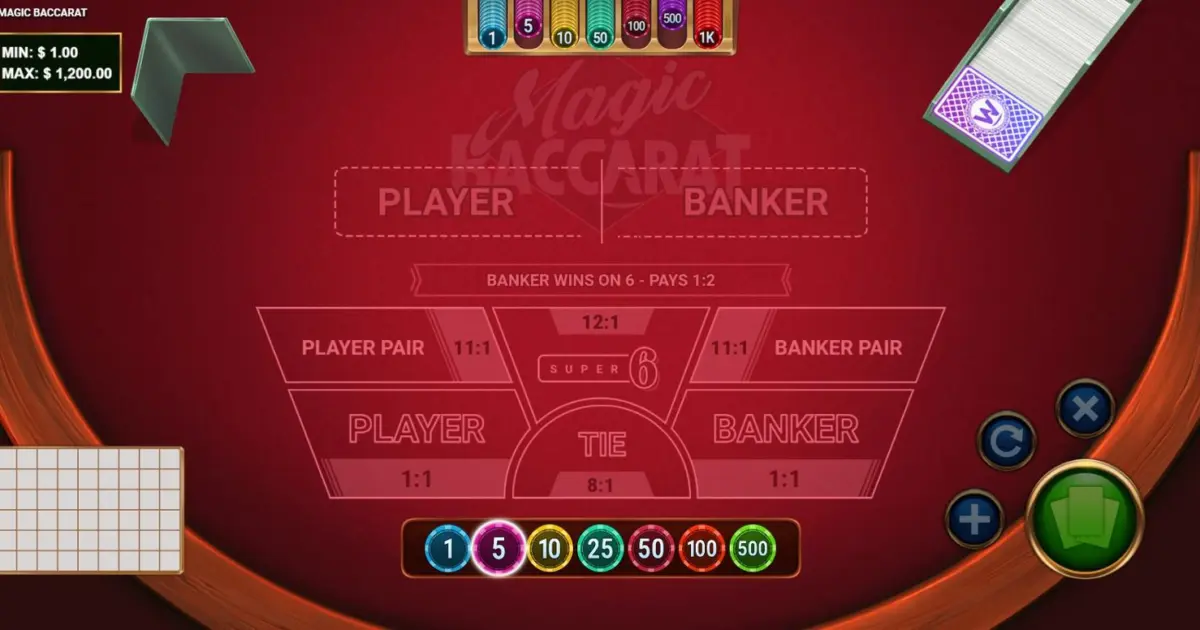
Magic Baccarat is a straightforward Punto Banco table from Wizard Games that posts an RTP of 98.76%. If you want a clean digital baccarat experience with a published return figure above the corpus average, this is a reasonable pick — the game does not try to reinvent the wheel, and that is usually a good thing in baccarat. Here is what the numbers mean for your bankroll and which bets are actually worth placing.
Magic Baccarat in one minute
Baccarat is the simplest table game you will find on any casino floor or demo site. You place one of three bets — Banker, Player, or Tie — and then the cards are dealt according to a fixed tableau. There are no decisions to make after betting, no strategy charts to memorize, and no way to influence which hand wins. Magic Baccarat follows this standard format exactly. Wizard Games has published one provider game in the baccarat category, and this is it. The game runs on a digital RNG engine, meaning each round draws from a freshly shuffled virtual shoe. Scoreboards showing previous results have zero predictive value on an RNG shoe — they exist for entertainment, not information. The name “Magic” refers to the game’s theme, not to any unusual rules or bonus mechanics. What you get is standard Punto Banco with a published RTP that sits slightly above the corpus average of 98.55%, which is about as good as baccarat gets without unusual side bets or commission structures.
Return to player: 98.76%
The RTP of 98.76% is a combined figure across the available bets, weighted by how players typically bet. In standard 8-deck Punto Banco with a 5% commission on winning Banker bets, the individual house edges are well known: roughly 1.06% on Banker, about 1.24% on Player, and around 14.36% on Tie at 8:1. Those numbers mean the theoretical return ranges from about 85.6% if you only bet Tie, up to about 98.9% if you only bet Banker. The published 98.76% sits in that range and suggests the game uses the standard commission structure and paytable — but Wizard Games has not published a full breakdown of the exact Tie payout for this specific table. That matters because Tie at 9:1 versus 8:1 shifts the house edge by a meaningful amount. Before placing real money, check the game’s own rules or paytable screen to confirm the Tie payout. The 98.76% RTP is 0.21 percentage points above the corpus average, which is a small but real edge over the median baccarat game in the database. Over thousands of hands, that difference compounds — but on any single session, variance dwarfs it.
Banker vs Player vs Tie: picking a bet you understand
These are the only three bets available on Magic Baccarat. Understanding the trade-off between them is the entire strategic content of the game.
| Bet | Typical Payout | Approx. House Edge |
|---|---|---|
| Banker | 0.95:1 (5% commission) | ~1.06% |
| Player | 1:1 | ~1.24% |
| Tie | 8:1 or 9:1 | ~14.36% or ~4.85% |
Banker is mathematically the best standard bet in baccarat, even after the 5% commission. The drawing rules give the Banker hand a built-in structural advantage — Banker wins roughly 45.9% of non-tie hands compared to Player’s 44.6%. The commission claws back part of that edge but not all of it. Player is the second-best bet and the one to pick if you simply do not want to deal with commission tracking. Tie is a different animal entirely. At 8:1, the house edge on Tie is roughly 14.36% — one of the worst standard bets in any casino game. Even at the more generous 9:1 payout, the edge is still around 4.85%, which is worse than Banker or Player by a wide margin. The reason people bet Tie is the large payout relative to the stake, but the frequency of ties (roughly 9.5% of hands) does not come close to justifying the odds. If you compare this to a game like Baccarat – Punto Banco, which posts a nearly identical RTP of 98.77%, the bet-type math is the same — the difference is in presentation, not value.
Live, multiplayer or RNG — what the format changes and what it doesn’t
Magic Baccarat is a digital RNG title, meaning a random number generator determines every card drawn from a virtual shoe. There is no physical shoe to track, no dealer timing to exploit, and no shuffle sequence to predict. Each hand is independent. This matters because a lot of baccarat content online treats scoreboards and pattern charts as if they reveal something useful. On an RNG table like this one, they do not. The RNG produces outcomes with the same statistical distribution as a physical shoe, but without any of the physical properties that would make shuffle-tracking theoretically possible (and practically very difficult even in live games). Live-dealer baccarat changes the presentation — you get a real dealer on video, a shared table, and the social element of multiplayer betting — but the underlying Punto Banco rules and odds are identical. If you prefer the atmosphere of a live game, titles from other providers in the related games list may suit you better. If you want fast, clean rounds with no distractions, a digital RNG table like this is the more efficient way to play.
Common baccarat mistakes
The two biggest mistakes in baccarat are chasing Tie bets and ignoring commission structure. Tie bets look appealing because the payout is large, but the house edge is brutal. At 8:1, you are giving up roughly 14 cents on every dollar wagered on Tie over the long run. Even players who know this intellectually often drift toward Tie after seeing a few ties appear in a row on the scoreboard. This is the gambler’s fallacy — previous outcomes do not influence the next hand on an RNG shoe. The second mistake is not understanding how commission works on Banker bets. A 5% commission on winning Banker bets means a 100-unit winning Banker bet returns 95 units of profit, not 100. Some players avoid Banker because of this, preferring the clean 1:1 payout on Player. That is a valid personal choice, but it costs you roughly 0.18 percentage points of house edge compared to betting Banker. The third common error is using a staking system like Martingale and assuming it changes the expected value. It does not. Doubling after losses on a fixed-edge bet just increases variance and the risk of hitting table limits or exhausting your bankroll. Flat betting on Banker is the lowest-edge approach available in this game.
Trying the demo first
Magic Baccarat has a free demo available, and there is no reason not to use it. Since baccarat has no player decisions after the bet is placed, the demo lets you verify the paytable, confirm the Tie payout, and get comfortable with the interface — all without risking money. You can play Magic Baccarat with no download in most browser-based casino review sites, which means you can check the rules screen and betting limits before committing. Demo play does not predict real-money outcomes, but it does let you see the game’s pace and confirm that the RTP and commission structure match what you expect. This is especially useful for baccarat because the difference between an 8:1 and 9:1 Tie payout is not always obvious until you open the rules. Play responsibly: set a budget before you switch to real money, treat gambling as entertainment you pay for rather than income, and stop when the budget is gone. You must be 18 or older to play for real money.
Who should play Magic Baccarat
Magic Baccarat is best suited for players who want a standard digital Punto Banco table with a published RTP above the corpus average. If you are looking for live-dealer atmosphere or multiplayer features, this is not the right pick — look at Baccarat (Habanero) or other live options instead. If you want the lowest possible house edge on a baccarat table, the Banker bet here at roughly 1.06% is as good as standard baccarat gets. The 98.76% combined RTP from Wizard Games is 0.21 points above the database average, which is a small but consistent advantage. Players who bet Tie regularly will not benefit from any baccarat table, and this one is no exception — the math is the math regardless of the theme. For comparison, Baccarat Supreme posts a 95.65% RTP, which is notably lower and suggests either a different commission structure or less favourable paytable. If you value a clean, no-frills digital experience with confirmed RTP, Magic Baccarat earns its place in the rotation.
Frequently Asked Questions
Can I play Magic Baccarat for free without downloading anything?
Yes, Magic Baccarat has a free demo available on this site. You can play it directly in your browser with no download required, which lets you check the paytable and rules before risking any real money.
What is the RTP of Magic Baccarat?
The published RTP for Magic Baccarat is 98.76%, which is slightly above the corpus average of 98.55%. This figure is a combined return across all three bets — your actual return depends on which bet you place most often.
Which bet gives the best value in Magic Baccarat — Banker, Player, or Tie?
Banker is the best-value bet in standard baccarat, with a house edge of roughly 1.06% after the 5% commission. Player is second at about 1.24%, and Tie is significantly worse at approximately 14.36% at 8:1 payout.
Can pattern-reading or scoreboards help me win at Magic Baccarat?
No. Magic Baccarat uses a digital RNG that draws from a fresh virtual shoe each round. Previous outcomes have no influence on future hands, so scoreboards and bead plates provide entertainment only, not predictive information.
How does Magic Baccarat compare to Baccarat Supreme?
Magic Baccarat from Wizard Games posts a 98.76% RTP, while Baccarat Supreme returns 95.65%. That gap of over 3 percentage points means Magic Baccarat offers better long-term value on equivalent bets, assuming similar commission structures.