Pharaoh (Gameplay Int.) has drawn enough spins to place it 25th overall by session volume, a level of attention shared by fewer than one slot in a thousand. That rank exists alongside a notable absence: Gameplay Interactive has not published an RTP figure for this title, so you cannot calculate expected loss per hundred spins, compare it to the provider’s 96.69% average, or budget your session with any statistical foundation. The gap is material.
| Specification | Value |
|---|---|
| Provider | Gameplay Interactive |
| RTP | Not published |
| Volatility | Not published |
| Free demo | Yes |
| Popularity rank | 25 (99.9th percentile) |
| Provider average RTP | 96.69% |
First look at Pharaoh (Gameplay Int.)
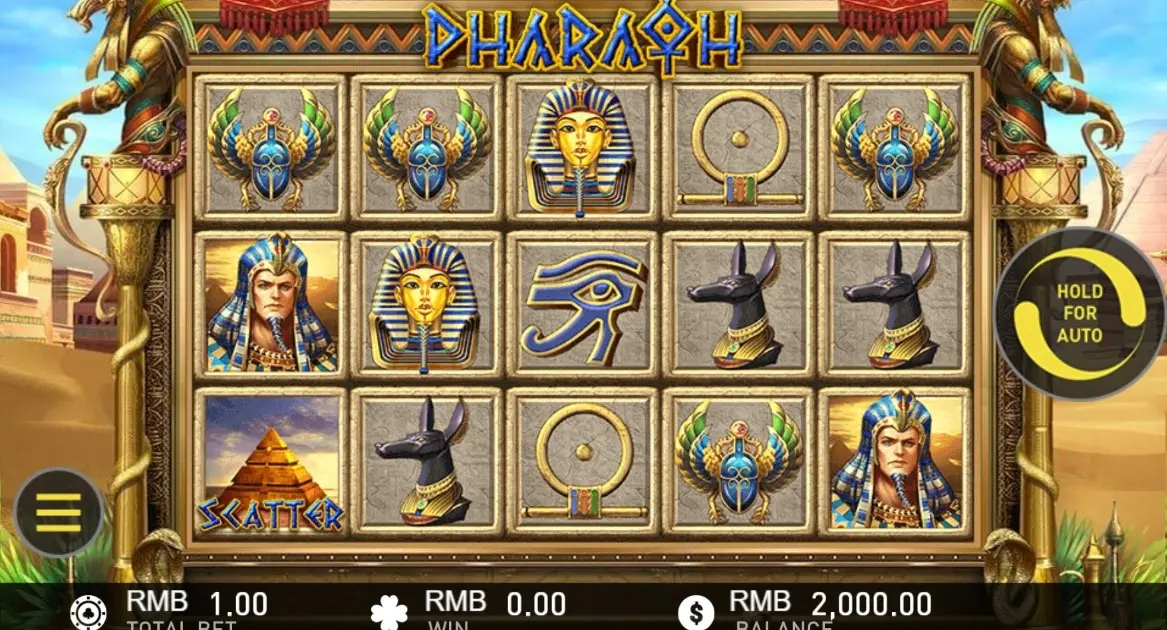
The theme draws on ancient Egypt—pharaohs, pyramids, the iconography that has anchored hundreds of slots over the last two decades. The label alone does not tell you whether the execution leans toward detailed historical art or simplified cartoon glyphs, nor does it reveal which specific symbols populate the reels. What you can confirm is that Gameplay Interactive built this game as one of 118 titles in their catalogue, and that it has found an audience large enough to place it in the top 0.1% by session count across the entire corpus tracked here.
A free demo is available, which lets you observe reel behaviour, symbol frequency, and the pattern of wins and dead spins without committing funds. Demo play uses the same random number generator and paytable as real-money mode, so the distribution of outcomes matches, but it cannot predict your personal results and it cannot pay cash. Use it to confirm whether the pacing and variance feel tolerable before you stake real money.
How a round plays out
Gameplay Interactive has not disclosed the reel array dimensions, payline structure, or whether the game uses fixed lines or a ways-to-win mechanic. That means you cannot count the number of ways a winning combination might land, nor can you compare line density to other slots you know. The stake you select per spin buys you access to whatever win-pattern system the game employs, but without published details you are left to infer the structure from observation during play.
Most modern slots include wild symbols that substitute for other symbols to complete wins, and scatter symbols that trigger bonus features when you land a threshold number anywhere on the screen. Whether Pharaoh (Gameplay Int.) implements these mechanics, and if so how many scatters are required or how many free spins are awarded, is not documented in the material available here. If you encounter a bonus round during demo play, note its frequency and the size of the pays it delivers relative to your stake—that lived experience is the only reliable guide you have in the absence of published hit frequency or feature specifications.
Reading the unpublished return figure
RTP is the percentage of all wagered money a slot is programmed to return as wins over millions of spins. A game set to 96.50% returns £96.50 per £100 staked across a sample large enough for variance to flatten out—typically tens of millions of rounds. Your single session of a few hundred or a few thousand spins will not converge on that figure; short-term results are dominated by volatility, not RTP. But RTP still determines the size of the house edge: at 96.50% the casino keeps £3.50 per £100; at 94.00% it keeps £6.00.
Gameplay Interactive has not released an RTP value for Pharaoh (Gameplay Int.). The provider’s catalogue average is 96.69%, and the corpus average across all tracked slots is 95.71%, but neither figure is a safe proxy for this specific game. Without a published RTP you cannot calculate expected loss per hour, compare value against alternatives, or weight the game’s popularity against its statistical generosity. Treat any RTP number you see quoted on third-party sites with caution unless it cites a verifiable regulatory filing or provider data sheet.
For context, Fountain of Fortune from the same provider carries a published 97.0% RTP, returning £97 per £100 wagered in the long run. That 97.0% figure gives you a concrete edge comparison and a baseline for bankroll planning; Pharaoh (Gameplay Int.) offers no equivalent anchor.
Why undisclosed volatility changes your bankroll maths
Volatility describes how a slot distributes its programmed RTP across individual spins. Low volatility means frequent small wins that keep your balance relatively stable; high volatility means longer stretches of losses punctuated by occasional large pays. Two games with identical RTP can deplete a bankroll at radically different speeds depending on their volatility profile.
Gameplay Interactive has not published a volatility rating for Pharaoh (Gameplay Int.), so you cannot estimate typical drawdown, the session length a given bankroll will support, or how often you should expect a win large enough to recover a string of dead spins. In practice that means you cannot set a realistic stop-loss or compare the game’s risk profile to others in the same theme. If the game is high volatility and your bankroll is modest, you may burn through your budget in a few dozen spins without ever triggering the feature that delivers the bulk of the RTP. If it is low volatility, those same few dozen spins might feel uneventful but give you more time at the reels.
The only way to gauge volatility in the absence of a published rating is to track your own results over a statistically meaningful sample—several hundred spins at minimum—and calculate the standard deviation of wins. Most players will not do that work, which leaves you relying on subjective feel during demo play. Pay attention to how often the balance swings, how many consecutive spins return nothing, and whether feature triggers feel rare or routine.
Bet sizing from an undisclosed floor upwards
Gameplay Interactive has not published the minimum or maximum stake per spin for Pharaoh (Gameplay Int.). The stake range determines whether the game accommodates cautious bankroll management at the low end or high-roller appetite at the top. A floor of £0.10 per spin lets a £20 bankroll stretch across 200 spins, assuming no wins; a floor of £1.00 cuts that to twenty. At the upper end, a ceiling of £100 per spin opens the game to players chasing large absolute wins, while a £10 cap does not.
Without knowing the range you cannot calculate cost per hour, set a session budget with precision, or confirm that the game even accepts the stake level you prefer. Check the stake panel during demo play to identify the available increments before you fund an account intending to play this title for real money.
Where Pharaoh (Gameplay Int.) sits among ancient Egypt slots
The theme data set supplied here contains zero other slots tagged with the same taxonomy as Pharaoh (Gameplay Int.), which means no direct theme-based comparison is available within the tracked corpus. Ancient Egypt as a creative territory is one of the most densely populated in slot design, but the absence of related games in this data set reflects either a tagging gap or a narrow filter applied upstream.
What you can compare is performance within the Gameplay Interactive catalogue. The provider has released 118 slots; of those tracked here, Fountain of Fortune carries a 97.0% RTP and Monsters Cash and Bikini Beach both have unpublished RTP figures, the same transparency gap that Pharaoh (Gameplay Int.) exhibits. Fountain of Fortune gives you a known comparison point: if statistical visibility matters to your decision, it is the safer pick from the same studio.
Pharaoh (Gameplay Int.) has reached rank 25 by popularity, a position that reflects sustained session volume across the player base. Popularity does not correlate reliably with RTP—players are drawn by theme, feature design, brand familiarity, and casino promotion strategies, none of which change the mathematical edge. The rank confirms the game has found an audience; it does not confirm the audience is making a statistically informed choice.
The honest verdict
Pharaoh (Gameplay Int.) has attracted enough play to place it in the 99.9th percentile by popularity, but Gameplay Interactive has withheld the RTP figure, the volatility rating, and the stake range. That combination leaves you without the three data points you need to plan a session, compare value, or assess risk. The free demo lets you observe reel behaviour and feature frequency, but no amount of demo play substitutes for published mathematics.
If you prioritise statistical transparency, Fountain of Fortune from the same provider offers a published 97.0% RTP and a concrete basis for comparison. If you are drawn to the theme or the popularity rank and accept that you are spinning without a published edge figure, set a strict loss limit before you start and treat the session budget as the cost of entertainment, not as an investment with a calculable expected return.
You must be 18 or over to play. Set a budget you can afford to lose, treat slots as paid entertainment rather than income, and walk away when you hit your limit. Every spin is independent; no pattern or progression changes the house edge.
Frequently Asked Questions
Can I try Pharaoh (Gameplay Int.) slot for free before I stake real money?
Yes, a free demo is available. The demo uses the same random number generator and paytable as real-money mode, so the frequency and size of wins will match what you would see with cash staked. Demo play cannot pay out real money and it cannot predict your personal results, but it does let you observe reel behaviour, symbol frequency, and feature triggers without risk. Use it to confirm the pacing feels tolerable and that the volatility profile, whatever it is, suits your bankroll before you fund an account.
What is the RTP of Pharaoh (Gameplay Int.) and what does it mean for my session?
Gameplay Interactive has not published an RTP figure for Pharaoh (Gameplay Int.). RTP is the percentage of all staked money returned as wins over millions of spins; at 96.50% a slot returns £96.50 per £100 wagered in the very long run, giving the house a £3.50 edge. Without a published RTP you cannot calculate expected loss per hour, compare the game's value to alternatives, or weight its popularity against its statistical generosity. The provider's catalogue average is 96.69%, but that is not a safe substitute for this game's actual programmed return.
Who made Pharaoh (Gameplay Int.) and what else have they released?
Gameplay Interactive developed Pharaoh (Gameplay Int.) as one of 118 slots in their catalogue. The provider's average RTP across tracked titles is 96.69%, slightly below the 97.0% figure published for Fountain of Fortune but above the 95.71% corpus average. Other Gameplay Interactive releases include Monsters Cash and Bikini Beach, though neither of those has a published RTP either. If statistical transparency matters to your choice, Fountain of Fortune is the standout from this studio because it gives you a concrete 97.0% return figure to plan around.
What volatility is Pharaoh (Gameplay Int.) and how does that affect my bankroll?
Gameplay Interactive has not disclosed a volatility rating for Pharaoh (Gameplay Int.). Volatility determines how a slot distributes its RTP—low volatility delivers frequent small wins and stable balance swings, while high volatility means longer losing streaks broken by occasional large pays. Without a rating you cannot estimate session length, typical drawdown, or how often a feature win might recover a string of dead spins. The only way to gauge it is to play several hundred demo spins and track how often your balance swings and how many consecutive spins return nothing.
Does demo play on Pharaoh (Gameplay Int.) give the same results as real money mode?
Demo play uses the same random number generator, reel configuration, and paytable as real-money mode, so the distribution of wins, the frequency of features, and the volatility profile are identical. What differs is that demo spins cost nothing and pay nothing—you cannot withdraw demo winnings and you cannot lose your own money. Demo results do not predict what will happen when you stake cash because every spin is independent, but the long-run statistical behaviour is the same. Use the demo to observe how the game feels, not to forecast your personal session outcome.