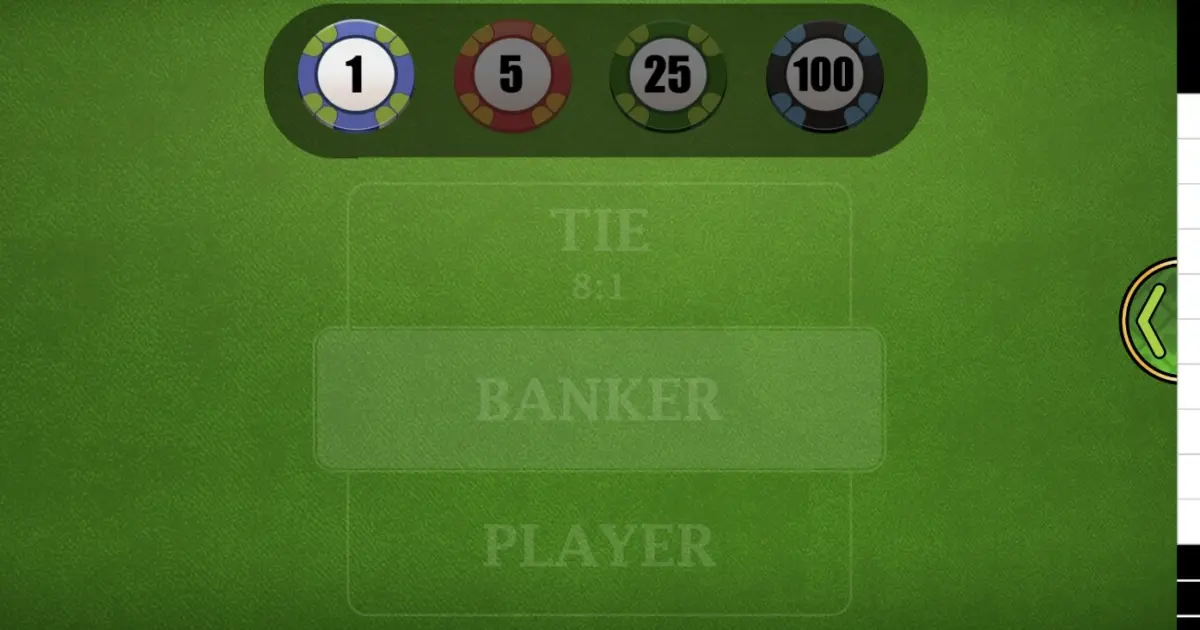
Baccarat (Multislots) is a clean, no-frills take on Punto Banco from MultiSlot. There are no side bets, no novel drawing rules, and nothing to distract from the core question of which bet you place and what it costs you over time. If you want a digital baccarat table that sticks to the standard rules, this one fits that brief — and you can try it in free demo mode without downloading anything.
What kind of baccarat is Baccarat (Multislots)?
This is a standard eight-deck Punto Banco game rendered as a digital RNG table by MultiSlot. Every card is drawn from a freshly shuffled virtual shoe on each hand, so there is no physical shoe to read and no pattern on a scoreboard that predicts anything about the next deal. The name does not signal any commission-free twist or variant rule, so the default assumption is the standard version: a 5% commission on winning Banker bets, even-money payouts on Player, and 8:1 or 9:1 on Tie.
Because MultiSlot has not published the exact Tie payout or detailed rule sheet for this specific table, you should confirm both on the game’s own rules screen before committing real money. The difference between an 8:1 and a 9:1 Tie payout shifts the house edge on that bet by several percentage points, so it matters even if you never plan to bet Tie regularly.
| Provider | MultiSlot |
|---|---|
| Free demo | Yes |
| Site-wide average RTP | 98.55% |
The maths of a single hand
Baccarat has exactly three bets — Banker, Player, and Tie — and the player makes no decisions after placing the wager. The third-card draw follows a fixed tableau that the software executes automatically, so there is no skill element and no strategic choice beyond bet selection. In the standard eight-deck version that this title appears to follow, the Banker hand wins roughly 45.86% of decisions, the Player hand wins about 44.62%, and Tie results land about 9.52% of the time. Those percentages exclude Tie hands from the Banker and Player win rates, as is conventional, and they are the foundation for every edge calculation.
Because Banker wins more often than Player, the natural payout would give the Banker bet a significant advantage. The 5% commission on winning Banker wagers brings the expected value back toward parity, but Banker still comes out ahead of Player after commission. In concrete terms, a standard Banker bet carries a house edge of about 1.06%, Player sits at roughly 1.24%, and Tie sits in a completely different neighbourhood — anywhere from about 14.36% to worse, depending on whether it pays 8:1 or 9:1. These are the well-known general figures for Punto Banco; without a published RTP from MultiSlot for this exact table, they are the best reference point you have.
Where the RTP comes from
The RTP on a baccarat bet is simply one minus the house edge, expressed as a percentage. A Banker bet with a 1.06% edge returns about 98.94% over the long run; Player returns roughly 98.76%; and Tie returns somewhere in the neighbourhood of 85.64% to 86%+, depending on payout. MultiSlot has not disclosed a specific RTP figure for Baccarat (Multislots), which means you cannot pin down the exact long-run return for this table. The general Punto Banco numbers above are your best guide, but the provider’s silence on the detail is worth noting — other studios, like Habanero with its Baccarat (Habanero) table, also leave RTP unpublished, while some list it explicitly.
What an RTP number does not do is predict your session outcome. RTP is a long-run statistical average measured over hundreds of thousands of hands. In any single session of fifty or a hundred hands, variance dominates: you can win big on Player, lose everything chasing Tie, or grind out a small profit on Banker and walk away. The number tells you which bets are more efficient over time, not what will happen in your next ten minutes.
Commission, payout and the Tie trap
The commission structure is the single most important rule difference between baccarat variants, and it is the detail you should confirm on this game’s rules screen before betting real money. In the standard version, every winning Banker bet pays even money but a 5% commission is deducted from the profit. On a 10-unit bet, a winning Banker hand returns 19.5 units — your original stake plus 9.5 units of profit. Commission-free variants exist across the industry and typically compensate by paying only half on a Banker win when the hand totals six, which shifts the edge calculation meaningfully. Baccarat (Multislots) does not advertise itself as commission-free, so the standard 5% structure is the safe assumption.
The Tie bet deserves plain language: it is the worst standard wager in baccarat by a wide margin. An 8:1 Tie payout gives the house an edge of roughly 14.36%, and even the friendlier 9:1 payout still leaves the house at about 4.84%. By comparison, the worst blackjack side bets rarely cross 10%, so the Tie sits in rare company for bad value. The temptation is obvious — a single-digit number paying out at eight or nine to one looks attractive — but the roughly one-in-eleven hit frequency means you will lose far more often than you win, and each loss is a full bet. If you want to stretch a session and play efficiently, stick to Banker or Player.
How Baccarat (Multislots) compares to other tables
Baccarat (Multislots) sits at rank 29 on this site with a popularity percentile of 39.1, and it is the only baccarat title MultiSlot currently offers here. MultiSlot’s corpus average RTP across all its games is 98.55%, but that figure blends slots and table games and does not tell you the RTP of this specific baccarat table. By contrast, Baccarat – Punto Banco lists an RTP of 98.77%, which is consistent with a standard Banker-heavy bet mix and gives you a concrete number to compare against.
If you are weighing options, Baccarat Supreme posts an RTP of 95.65%, which is noticeably lower and likely reflects either a different commission structure, a less generous Tie payout, or the presence of side bets that drag the blended return down. Without a published RTP or confirmed paytable for Baccarat (Multislots), you cannot make a precise numerical comparison, but the absence of side bets in this title works in its favour: fewer exotic wagers means fewer ways to accidentally bet into a high-edge proposition. If a specific number matters to you, the Punto Banco table linked above gives you one to work with.
Free demo and staying in control
Baccarat (Multislots) is available as a free demo on this site with no download required, so you can open it and run through a few dozen hands to see the interface and confirm the payout rules before you risk anything. Demo play uses the same RNG and the same rules as the real-money version — the odds do not change — but it removes the financial consequence, which makes it useful for learning where the commission is deducted and how the interface handles the tie result.
Set a budget before you play real money and treat it as the price of entertainment, not an investment with a return. Baccarat has a lower house edge than most table games, but “lower” still means the house wins more often over time, and no betting pattern, streak-chasing, or scoreboard analysis changes that. If you are in the UK and aged 18 or older, you can use responsible gambling tools such as deposit limits and session reminders. If gambling stops being fun, stop playing.
Final verdict
Baccarat (Multislots) is a serviceable digital Punto Banco table that sticks to the standard rules without adding side bets or novel twists. Its main limitation is transparency: MultiSlot has not published the exact Tie payout or an RTP figure for this specific game, so you are working with the well-known general Punto Banco numbers rather than a confirmed, table-specific stat. For most players, that is fine — the standard maths does not change — but if you want a concrete RTP to compare, a table like Baccarat – Punto Banco at 98.77% gives you a verified benchmark.
The free demo is the right starting point: confirm the paytable, check whether Banker pays the standard 5% commission or something else, and decide whether the interface and pace suit you. Baccarat is a simple game with three bets and fixed rules, so the review ultimately comes down to whether the table plays straight and whether the maths is what you expect. On both counts, this MultiSlot title appears to deliver the standard Punto Banco experience — nothing more, nothing less.
Frequently Asked Questions
Can I play Baccarat (Multislots) for free without downloading anything?
Yes. Baccarat (Multislots) is available as a free demo on this site with no download required. You can open the game in your browser and play through hands using virtual credits to see how the interface works and confirm the payout rules before betting real money.
What is the RTP of Baccarat (Multislots)?
MultiSlot has not published an exact RTP for this table. In standard eight-deck Punto Banco, Banker returns roughly 98.94% and Player about 98.76%, but you should open the game's own rules screen to confirm the Tie payout, since that figure determines whether the blended return matches these general numbers.
Which bet — Banker, Player, or Tie — is the best value?
Banker is the best standard bet in baccarat by the numbers, with a house edge of about 1.06% even after the 5% commission. Player is close behind at roughly 1.24%. Tie is far worse — around 14.36% at 8:1 — and is the highest-variance, lowest-value option on the table.
Do scoreboards, pattern tracking, or any system actually work in this game?
No. Baccarat (Multislots) draws from a freshly shuffled virtual shoe on every hand, so previous outcomes have no statistical influence on the next deal. Scoreboards and pattern-tracking are entertainment features, not prediction tools, and no staking system changes the expected value of a fixed-edge bet.
How does Baccarat (Multislots) compare to Baccarat - Punto Banco?
Baccarat - Punto Banco on this site lists an RTP of 98.77%, giving you a concrete number to compare. Baccarat (Multislots) has not published an RTP, so you are working with general Punto Banco estimates. MultiSlot's title has no side bets, which keeps the bet selection simple, but the lack of a verified RTP makes direct comparison imprecise.