Baccarat (Evoplay) is worth your time if you want a clean, no-frills Punto Banco table to practise bet selection without side bets or presentation getting in the way. Evoplay has not published a specific RTP, commission rule or Tie payout for this version, so you should treat the demo as a way to check the rules screen rather than as a confirmed paytable. If the table uses the standard 8-deck rules, baccarat (evoplay) plays like any other digital baccarat game: you choose Banker, Player or Tie and the cards draw themselves.
Baccarat (Evoplay) at a glance
This is a digital baccarat title from Evoplay. The FACTS file for this table lists the provider as Evoplay and confirms a free demo is available, but it does not include a published RTP, a Tie payout, table limits, or any side bets. The theme and presentation details are also not specified in the available data, so this review cannot describe the visuals beyond the standard digital baccarat format.
Evoplay is listed with one baccarat title in this corpus, and this table sits at rank 24 with a popularity percentile of 50.0. That places it in the middle of the catalogue for this sub-category rather than at the very top or bottom on play volume. The corpus average RTP across baccarat games is 98.55%, which reflects how low the house edge is on the main bets in general, but it is not the RTP for this specific table and should not be treated as such.
Because the name does not include a format label such as Speed, 3D, Multiplayer or Commission-Free, there is no strong hint in the title about presentation or rule changes. If you open the demo and see a different rule on winning Banker hands, for example a reduced payout on a winning Banker 6, that would indicate a commission-free variant, but you need to confirm that on the game’s own rules screen before betting real money. For a quick comparison on standard rules, Baccarat – Punto Banco is a useful reference point because its paytable is published.
Banker, Player or Tie: the three bets explained
Baccarat has exactly three bets. You back Banker, Player or Tie before any cards are dealt, and then every draw follows a fixed tableau. There are no hitting or standing decisions for you to make, no way to influence the draw, and no strategy in the blackjack sense. The choice is purely which of the three bets to make and how much to stake.
The two main bets are Banker and Player. Both pay even money when they win in standard commission baccarat, except that winning Banker bets are charged a 5% commission, so a winning 10-unit Banker bet returns 10 units profit minus 0.5 units commission. Player pays 1:1 with no commission. Tie is the third option and is a bet that the two hands will finish equal. It is the highest-variance bet on the table and is usually offered at 8:1, with some tables paying 9:1. The payout matters a great deal because it moves the edge by several percentage points.
The provider has not published the exact Tie payout for this table, and it moves the edge by several percentage points, so check the paytable before you bet on it. The same applies to commission: this review cannot confirm whether this table charges the standard 5% on Banker or uses a commission-free structure, so verify that on the rules screen. If you want to see how different baccarat paytables compare, Baccarat Supreme lists its own RTP of 95.65% and is a clear example of how paytable changes move the numbers.
| Bet | Standard payout | Approximate house edge in standard 8-deck Punto Banco |
|---|---|---|
| Banker | 1:1 minus 5% commission | about 1.06% |
| Player | 1:1 | about 1.24% |
| Tie | 8:1 (some tables 9:1) | about 14.36% at 8:1, lower at 9:1 |
The table above shows well-known general figures for standard Punto Banco. They are not confirmed for Baccarat (Evoplay) and are included only to explain the trade-off between the three bets. The only numbers that matter for expected value on this specific table are the ones shown in its own rules.
What RTP means at the baccarat table
No RTP has been published for Baccarat (Evoplay) in the data supplied for this review. That absence matters, because RTP in baccarat is not a single game number. It is the return for a specific bet at a specific paytable. Banker, Player and Tie each have their own RTP, and a change to Tie from 8:1 to 9:1 or a change to the Banker commission changes the figures materially.
In general terms, RTP is the long-run average return per unit staked if you made the same bet repeatedly over a very large number of hands. A 98.94% RTP on Banker with 5% commission corresponds to the well-known about 1.06% house edge. A 98.76% RTP on Player corresponds to about 1.24% house edge. Tie at 8:1 has an RTP around 85.64%, which is a house edge of about 14.36%. Those are useful anchors for understanding why Tie costs you more, but they do not tell you what this Evoplay table pays.
Because the exact paytable is not in FACTS, the responsible way to read this table is to treat the published corpus average of 98.55% as context about the category, not as a promise for this table. Open the demo, open the help or paytable screen, and note two lines: the commission on Banker and the payout for Tie. Those two lines determine the real expected value. If either line is missing or unclear, do not assume the standard numbers apply.
Why Banker is usually the better bet, even with commission
In standard 8-deck Punto Banco with 5% commission on Banker, Banker is mathematically the best of the three standard bets. The drawing rules give the Banker hand a small acting advantage, because it draws after seeing the Player’s third card when one is drawn. That positional edge is enough that even after the house takes 5% on winning Banker bets, Banker still retains a slightly lower house edge than Player.
The difference is not large per hand, but it is consistent. With the well-known general figures, Banker costs you about 1.06 units per 100 staked over a long run, Player about 1.24 units per 100 staked. Tie, by contrast, costs roughly 14 to 15 units per 100 staked at 8:1. That gap is why reviews describe Tie as the worst-value standard bet by a wide margin. It is not a cautious bet or a hedge for the main bets, it is a separate high-variance wager with a much higher cost.
Commission-free variants change this comparison. They typically remove the 5% commission but pay a winning Banker hand on a total of 6 at 1:2 instead of even money. That rule pushes the Banker edge back up and makes the calculation less straightforward than standard commission baccarat. The name Baccarat (Evoplay) does not point to a commission-free format, which usually announces itself in the title, but the absence of a label is not a confirmed paytable. Check the rules screen. If the table does charge 5% on Banker and pays Tie at 8:1, the general ranking of Banker ahead of Player ahead of Tie will apply. If it uses a different structure, recalculate from the numbers shown.
Third-card rules and why there is no real strategy
After you bet, baccarat plays itself. Two cards are dealt to Player and two to Banker. Totals are counted with face cards and tens as zero, aces as one, and all other cards at face value, with the total taken modulo 10, so 9 is the best hand. A natural 8 or 9 on the first two cards ends the coup immediately. Otherwise, a fixed tableau decides whether Player draws a third card and, if so, whether Banker draws.
The tableau is deterministic. Player draws on 0-5 and stands on 6-7. Banker then follows a more detailed set of rules that depend on its own total and, when Player has drawn, on the value of Player’s third card. You do not choose to hit or stand, you do not decide to split or double, and you cannot improve the odds by changing how you act after the bet is placed. In that sense there is no strategy, only bet selection before the deal.
That has two practical consequences. First, no staking system changes expected value. Martingale, flat betting, or any progression still faces the same fixed house edge on each hand. Second, pattern-reading has no effect on a digital RNG shoe. This is a digital baccarat game that draws from a freshly shuffled virtual shoe for each round, so there is no physical shoe to track. Scoreboards and bead plates may display history, but the next hand on a fresh RNG shuffle has no memory of the last one. The best you can do is pick the wager with the lower cost and stake at a level that lets you play the session you planned.
Playing the Baccarat (Evoplay) demo
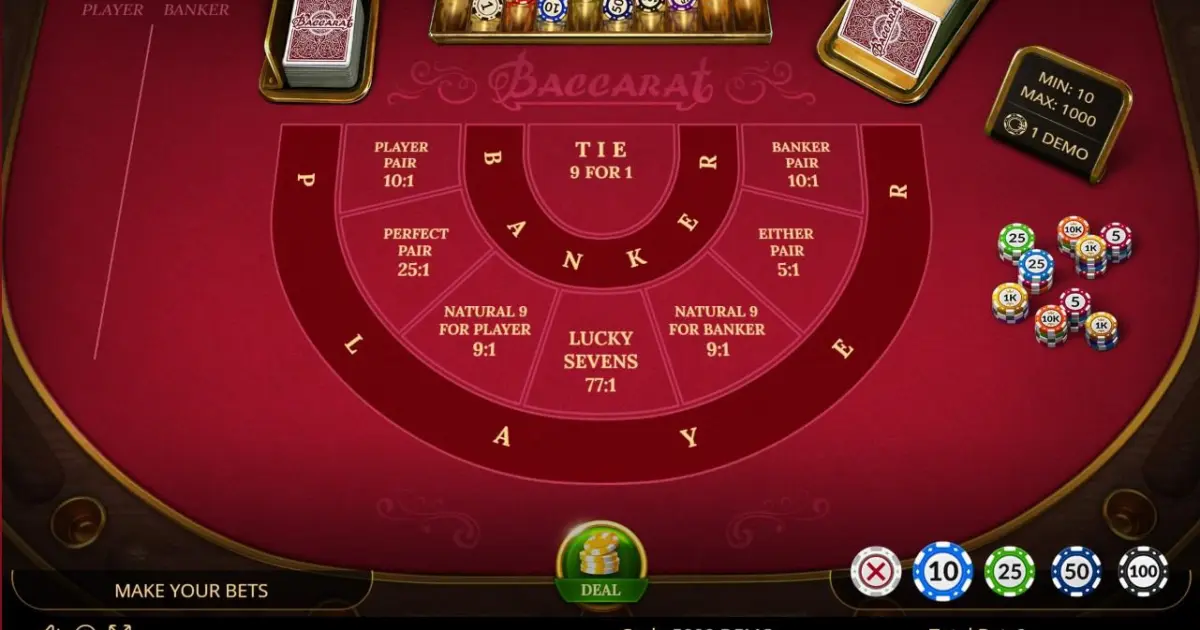
The free demo for this table is available, and it is the most useful tool you have when the paytable is unpublished. Use it to answer three questions before considering real money: what is the commission on Banker, what does Tie pay, and are any side bets present that change the layout. The FACTS for this table do not list side bets such as Player Pair, Banker Pair or Dragon Bonus, so do not assume they are present. If you see them in the demo, treat each as a separate bet with its own, typically much higher, edge.
The Baccarat (Habanero) demo is listed without a published RTP as well, which is a reminder that many baccarat tables leave these details to the in-game help file rather than the lobby. The Baccarat (Evoplay) free demo works the same way: the value is in opening that help file and reading the exact lines, not in spinning a few hands and judging by results. Demo play does not predict real-money outcomes, and short-term wins or losses in the demo tell you nothing about the long-run edge.
If you play, do it on a budget set in advance and treat it as entertainment you pay for, not income. Only players aged 18 and over should play, and any baccarat table, even one with a low edge on Banker, still has a house advantage that means the expected result over time is a loss. Decide on a session limit in money and time before you start, and stop when you reach it. If you need to step back, use the responsible-gambling tools offered by your operator.
Verdict: who should play Baccarat (Evoplay)
Baccarat (Evoplay) suits players who want standard Punto Banco without extras. If you already understand that Banker is the lower-cost main bet and you are comfortable checking the paytable yourself, the lack of published data is less of a barrier: open the demo, confirm commission and Tie payout, and you will know exactly what you are paying per bet.
It is less suited to players looking for confirmed numbers in the lobby, for side-bet variety, or for a live-dealer presentation. For those, a live or explicitly labelled variant with a published paytable will be a clearer fit. As a free-demo table to learn how Banker, Player and Tie behave and to practise disciplined bet selection, this Evoplay table does the job, provided you verify the two key lines on its own rules screen before you stake real money.
Frequently Asked Questions
Can I play Baccarat (Evoplay) for free without downloading anything?
Yes. FACTS confirms the free demo for Baccarat (Evoplay) is available. You can load it on this page to check the rules, commission and Tie payout before playing for real. Demo play uses virtual credits and does not predict real-money outcomes.
What is the RTP of Baccarat (Evoplay)?
No RTP has been published for this specific table in the data supplied. The corpus average for baccarat games is 98.55%, but that is a category average, not this table's figure. Check the in-game paytable for the actual commission and Tie payout, which determine the real RTP per bet.
Which bet is best value — Banker, Player or Tie?
In standard 8-deck Punto Banco with 5% commission, Banker has about a 1.06% house edge and Player about 1.24%, making Banker the better value despite the commission. Tie is far worse, about 14.36% at 8:1. For this Evoplay table the exact ranking depends on its own paytable, so confirm those numbers.
Is there a strategy or pattern system that works on this digital baccarat game?
No. Baccarat draws are fixed by the tableau, so you make no decisions after betting and no staking pattern changes expected value. As a digital RNG game it shuffles a virtual shoe each round, so scoreboards and streak-tracking have no effect on the next hand.
How does Baccarat (Evoplay) compare to Baccarat - Punto Banco?
Baccarat - Punto Banco lists a published RTP of 98.77% and represents a standard commission paytable, while Baccarat (Evoplay) has no published RTP or Tie payout in the available data. Use the Evoplay demo to compare commission, Tie payout and any side bets before choosing.