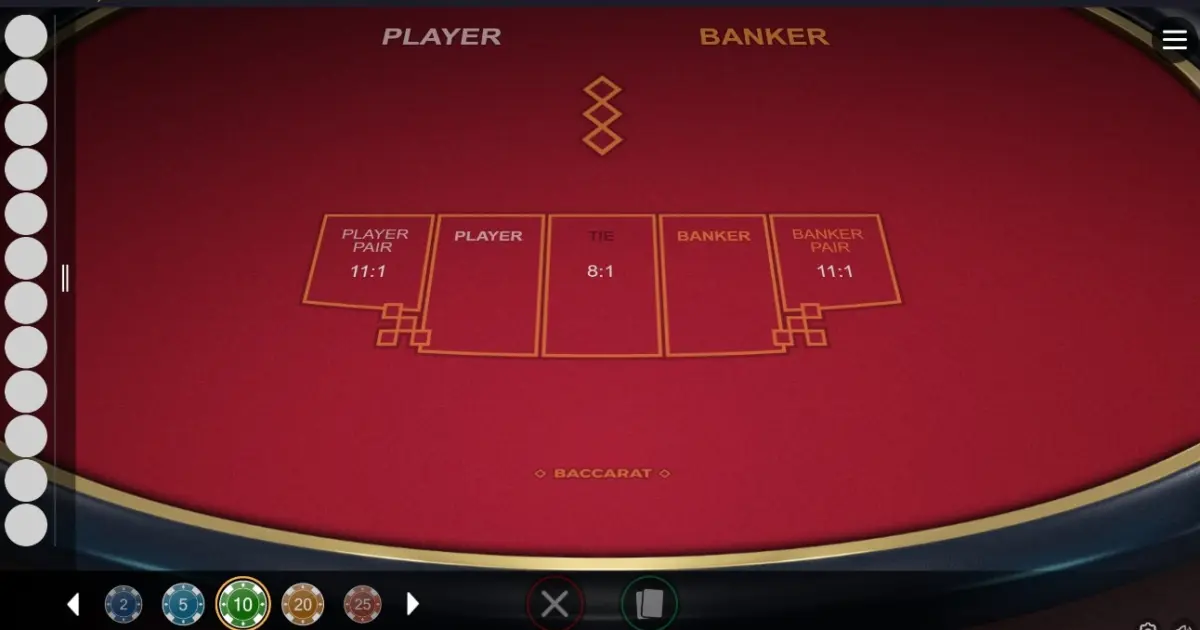
This is a straightforward digital baccarat table from Switch Studios with a published return of 98.9%, which sits a little above the 98.55% average across the tables reviewed on this site. A free demo is available, so you can work through the drawing rules and the three bet types without staking anything. The value in a table like this is the numbers, not the presentation — baccarat gives you one decision per round, and that decision is which of three bets to place.
Baccarat and the Switch Studios table range
Switch Studios has two baccarat titles in the catalogue here, and the pair averages 98.85% RTP between them. This one, simply called Baccarat, is the standard build. The other is No Commission Baccarat, and its name signals the difference: commission-free formats normally drop the 5% cut on winning Banker bets and instead pay a winning Banker hand that totals six at 1:2. That trade changes the edge arithmetic, so the two tables are not interchangeable even though they come from the same studio and sit within 0.1% of each other on paper.
Nothing in the published information for this table says it is commission-free, so treat it as a standard Punto Banco game with commission on Banker wins until the game’s own rules screen tells you otherwise. If you want a wider comparison, Baccarat – Punto Banco lists 98.77%, close enough that presentation and table limits will matter more to your choice than the decimal.
The 98.9% figure, and the assumption behind it
A single RTP number on a baccarat table is shorthand, because baccarat does not have one return — it has three, one per bet. In a standard eight-deck Punto Banco shoe with 5% commission, the house edge is roughly 1.06% on Banker, roughly 1.24% on Player, and somewhere around 14.36% on Tie depending on whether the Tie pays 8:1 or 9:1. Read backwards, those are returns of about 98.94%, 98.76% and roughly 85% to 86%.
So 98.9% lines up closely with flat Banker betting. It does not describe what happens if you spread your money across all three bets, and it certainly does not describe a session spent on Tie. Switch Studios has not published a bet-by-bet breakdown or a confirmed Tie payout for this table, and the Tie payout alone moves that bet’s edge by more than a percentage point, so check the paytable in the game before you put money on it.
| Bet | Typical payout | Approximate house edge |
|---|---|---|
| Banker | 1:1 less 5% commission | About 1.06% |
| Player | 1:1 | About 1.24% |
| Tie | 8:1 or 9:1 | Roughly 14.36%, varies with payout |
These are the well-known general figures for a standard eight-deck game, not confirmed numbers for this specific table.
How the third-card rules actually work
Once your chips are down you make no further decisions. Two cards go to Player, two to Banker. Tens and picture cards count zero, aces count one, and only the last digit of the total matters, so a seven and a six make three. An eight or nine on either side is a natural and the hand ends immediately.
Otherwise a fixed tableau decides everything. Player draws on a total of zero to five and stands on six or seven. Banker’s rule then depends on both its own total and, if Player drew, the value of that third card — Banker stands on seven, always draws on zero to two, and the cases in between are conditional. You never choose. That asymmetry is exactly why Banker wins slightly more often than Player, and why the house takes 5% commission on Banker wins: without it, the bet would favour you.
The practical consequence is that there is no strategy to learn beyond bet selection. Nothing you do after placing a chip changes the result.
Side bets: the maths behind the temptation
Switch Studios has not published a side-bet list for this table, so treat this section as a warning rather than a description of confirmed features. If pair bets, Perfect Pair, Dragon Bonus or similar wagers appear on the layout when you open the game, look up each one’s own paytable before betting.
The pattern across baccarat side bets is consistent: they pay in multiples, which feels generous, and they carry house edges several times worse than the main game. Where Banker costs you around one unit per hundred staked in the long run, a typical pair side bet costs several, and some run into double figures. They are priced as entertainment, not value.
Tie belongs in the same mental category even though it is a main bet. At roughly 14.36% it is the worst standard wager on the table by a wide margin, and its appeal is entirely the size of the payout rather than its expected return.
Variance at the baccarat table
Baccarat is low-variance on Banker and Player and extremely high-variance on Tie. Banker and Player each resolve close to a coin flip, hand after hand, which means short sessions cluster near the average and long runs of one side are ordinary noise rather than signals.
That last point matters here. This is a digital table, so each round is dealt from a freshly shuffled virtual shoe. There is no physical shoe to track and no card-removal effect carrying forward. Scoreboards and bead-plate patterns describe what already happened and tell you nothing about the next hand. No bet is ever due, hot or cold, and no staking pattern — Martingale, flat progression, chasing a streak — alters expected value on a wager with a fixed house edge. Progressions change the shape of your results, making small wins more common and losses larger when they arrive. They do not change the price.
Ties, when they hit on Banker or Player bets, are usually pushes rather than losses, which is part of why the flat bets feel so steady.
Playing responsibly
Play is restricted to players aged 18 or over. Decide what you are willing to lose before you open the table, treat it as money spent on entertainment rather than a way to earn, and stop at the number you set rather than the one a session talks you into. A 1.06% edge is small, but it is permanent and it applies to every hand.
The free demo is a genuinely useful tool for learning the drawing tableau and the layout at no cost. It will not predict how a real-money session goes — demo results are just another short sample from the same maths.
Verdict on Baccarat
A clean, no-frills table with a published 98.9% RTP that maps neatly onto flat Banker play. If you bet Banker and ignore everything else, you are getting close to the best price available anywhere in a casino, and this table delivers it without complications.
Two things to confirm in-game rather than take from a review: the Tie payout, which the provider has not published and which swings that bet’s edge noticeably, and the table limits, which are equally unpublished here. If you specifically want the commission-free structure, the sister table is the one to look at. If you want a busier presentation, Baccarat Supreme is popular, though its 95.65% listing is well below what this table offers. For a plain Punto Banco game at a good price, this one does the job.
Frequently Asked Questions
Can I play Baccarat by Switch Studios for free?
Yes, a free demo is available for this table, so you can practise the third-card drawing rules and get used to the layout without staking money. Demo play uses the same rules and the same fixed odds, but results from a demo session tell you nothing about how a real-money session will go.
What does the 98.9% RTP on this table actually mean?
It describes one bet rather than the whole table. Baccarat has three separate returns, and 98.9% lines up closely with flat Banker betting in a standard eight-deck game. Player returns roughly 98.76%, and Tie sits somewhere near 85% to 86% depending on the payout offered.
Which bet gives the best value, Banker, Player or Tie?
Banker, at an approximate 1.06% house edge, even after the 5% commission on wins. Player costs about 1.24%, and Tie runs to roughly 14.36% depending on whether it pays 8:1 or 9:1. Switch Studios has not published this table's Tie payout, so check the paytable first.
Does tracking previous hands or using a betting system help?
No. This is a digital table dealing from a freshly shuffled virtual shoe each round, so past results carry no information forward and scoreboard patterns predict nothing. Staking systems such as Martingale change how your wins and losses are distributed, but they never change the fixed house edge.
How does it compare to No Commission Baccarat from the same studio?
They are the two Switch Studios baccarat tables here, listed at 98.9% and 98.8% respectively. The name of the second signals a commission-free structure, which usually means a winning Banker six pays 1:2 instead of even money. Confirm that on the game's own rules screen before betting.