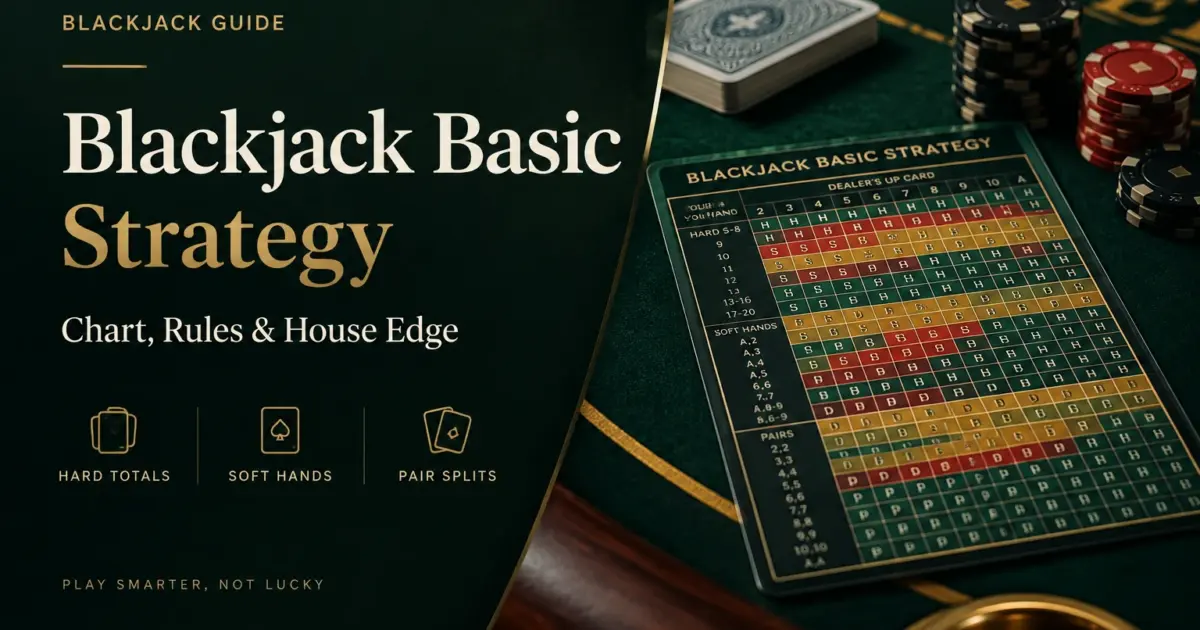
- A blackjack basic strategy chart is a mathematically solved table, not a betting system
- Using it correctly reduces the house edge to roughly 0.5% under favourable rules
- Hard totals from 12 to 16 are where most players make costly errors
- Small rule differences like soft-17 hit or stand change only a handful of decisions
- Basic strategy cannot overcome the structural house edge and should not be treated as a winning method
A blackjack basic strategy chart is a table of optimal plays, one for every combination of your hand and the dealer’s upcard. It was derived by running computer simulations of millions of hands to find the single decision—hit, stand, double, split, or surrender—that gives you the highest expected return in each situation. It is not a betting system, a streak-following method, or a way to beat the house. It simply tells you the statistically correct move so you stop giving away money through guesswork.
The phrase “basic” can be misleading. There is nothing basic about memorising the chart, and the edge it recovers is significant: a player who uses it correctly cuts the house advantage to roughly 0.5% under favourable rules, compared to 2–4% for an average casual player. That difference compounds over hundreds of hands.
You will see the term “composition-dependent strategy” in advanced books. Those charts add a handful of extra decisions—like standing on 16 against a 10 if your total is a four and a twelve rather than a ten and a six—but the difference in house edge is a few hundredths of a percent. For any practical purpose, the standard chart is all you need.
Hard totals: when to hit, stand or double
Hard totals are hands without an ace, or with an ace counted as one to avoid busting. This is the most common situation you will face. The table below shows the standard play for a multi-deck game where the dealer stands on soft 17—the most widely available rule set.
| Your total | vs 2–3 | vs 4–6 | vs 7–8 | vs 9 | vs 10 | vs Ace |
|---|---|---|---|---|---|---|
| 5–8 | Hit | Hit | Hit | Hit | Hit | Hit |
| 9 | Hit | Double | Hit | Hit | Hit | Hit |
| 10 | Double | Double | Double | Double | Double | Hit |
| 11 | Double | Double | Double | Double | Double | Hit* |
| 12 | Hit | Stand | Hit | Hit | Hit | Hit |
| 13–16 | Stand | Stand | Hit | Hit | Hit | Hit |
| 17–21 | Stand | Stand | Stand | Stand | Stand | Stand |
A few patterns make this easier to remember. With 8 or less, always hit—there is no bust risk. At 9, double only when the dealer shows weakness. At 10 and 11, you are doubling aggressively because a strong total is likely. From 12 upward, the decision hinges on whether the dealer might bust (showing 2 through 6) or probably will not (7 through Ace). The 12 to 16 range is where most players lose money through hesitation: standing on a 14 against a dealer’s nine feels wrong, but busting yourself feels worse in the long run.
Soft totals: why an ace changes everything
A soft total includes an ace counted as 11 without the risk of busting on the next card. This freedom changes your decisions significantly compared to the equivalent hard total. The same principle applies: the dealer’s upcard determines how aggressive you can be.
Soft 13 and soft 14 (A-2 and A-3): hit against 2 through 4, double against 5 and 6, hit against everything else.
Soft 15 and soft 16 (A-4 and A-5): hit against 2 and 3, double against 4 through 6, hit against 7 or higher.
Soft 17 (A-6): hit against 2, double against 3 through 6, hit against 7 or higher.
Soft 18 (A-7) is the tricky one: stand against 2, 3, 7, and 8; double against 4 through 6; hit against 9, 10, and Ace. The reason you hit soft 18 against a 9 or 10 is that those dealer upcards make a strong hand likely, and you need to improve despite the low bust risk.
Soft 19 and above: always stand. The only exception is a surrender rule allowing you to give up soft 18 against a dealer 10, which saves a small amount in expected loss.
Pairs: when splitting is worth it
Splitting means separating two same-value cards into two independent hands, each receiving an additional card. It costs an extra bet, so the decision must clearly beat playing the total as one hand.
- Always split aces and eights. Two aces together are soft 12; apart they are two chances at a strong 21. Two eights are hard 16—the worst total in the game; apart they are two hands with room to improve.
- Never split tens or fives. A pair of fives is a hard 10, a prime doubling hand. Tens are already 20, one of the best totals. Splitting either destroys a strong position.
- Twos and threes: split against dealer 2 through 7, hit against 8 or higher.
- Fours: never split under standard rules (hit as a hard 8), except in a specific double-after-split scenario some charts recommend against dealer 5 and 6.
- Sixes: split against dealer 2 through 6, hit against 7 or higher.
- Sevens: split against dealer 2 through 7, hit against 8 or higher.
- Nines: split against dealer 2 through 6 and 8 through 9; stand against 7, 10, and Ace. Standing against 7 is a common mistake—your 18 beats the dealer’s likely 17.
The logic is consistent: split when both resulting hands have a better expected value than the combined total. With low pairs against weak dealer cards, you are essentially taking the opportunity to play two hands with a statistical edge against a likely bust.
How the chart changes with dealer rules
The table above assumes the dealer stands on soft 17 (the abbreviation is S17). When the rule flips to the dealer hitting soft 17 (H17), a few specific decisions change:
- Hard 11 against an Ace becomes a double instead of a hit.
- Soft 18 against a dealer 2 becomes a double instead of a stand.
- Soft 18 against dealer 9 and Ace become hits instead of stands.
- Hard 15 against a dealer Ace may become a surrender if that option is available.
Number of decks has a small but measurable effect. Each additional deck adds roughly 0.02% to the house edge, and the chart barely changes—most multi-deck games (4 to 8 decks) share the same strategy. Single-deck games have slight variations, such as doubling on soft 18 against dealer 2 becoming correct in some versions.
Double after split (DAS) is another factor. If the rules allow it, splitting becomes slightly more attractive, and some borderline doubles (like hard 11 against an Ace under H17) become more clearly correct.
Surrender is the biggest modifier. If your game offers late surrender, consult a surrender-enabled chart. You surrender hard 16 against 9, 10, and Ace; hard 15 against 10 and Ace; and a few soft hands. This alone reduces the house edge by about 0.07%.
Why basic strategy can’t beat the house edge, only minimise it
Even played perfectly, blackjack carries a house edge under standard rules. That edge exists because of one structural asymmetry: the player busts before the dealer acts. Every time you draw a card and exceed 21, you lose immediately—even if the dealer would have busted too. The chart reduces the frequency of that scenario, but it cannot eliminate it.
The remaining 0.5% edge under good rules is the sum of several small advantages: the dealer acts last, double downs have restrictions in some situations, and splits have limits. No rearrangement of when you hit or stand removes that structural disadvantage, because the order of operations is fixed.
This is why card counting exists as a separate discipline. Counting does not change what you play—it changes when you increase your bet and when you sit out. It is a method for identifying the rare deck compositions where the edge genuinely flips to the player’s side. Basic strategy is the prerequisite for counting; without it, the count is meaningless because you are giving back more in playing errors than you recover from the count.
Treat the chart as what it is: the minimum level of competence for a game where the house edge is already small enough to make playing worth your time. It is not a winning system. Over thousands of hands, you will still lose approximately 50 cents for every hundred dollars you wager. Play within a budget, set a time limit, and treat the session as entertainment you are paying for, not income.
Frequently Asked Questions
Does basic strategy change if I play with fewer decks?
The changes are minor. A single-deck game has one or two different decisions compared to a six-deck shoe, and most online games use four or six decks with identical charts. The larger impact of deck count is on the house edge itself rather than on which play is correct, so for practical purposes a single chart works across all common deck counts.
Can I memorise basic strategy in one weekend?
You can learn the logical structure in a weekend but true fluency takes longer. The key is understanding why each decision is made rather than rote memorisation. Practise with a free blackjack trainer app that flags errors, and focus first on hard totals, then soft hands, then pairs. Most players need three to four weeks of regular practice before they stop hesitating.
Is blackjack basic strategy legal in casinos?
Yes. Basic strategy is simply the mathematically optimal way to play each hand. It is available in published books and printable charts, and casinos do not restrict its use. Players may even consult a strategy card at the table in most jurisdictions. What casinos do restrict is electronic devices used for analysis during play.
How is basic strategy different from card counting?
Basic strategy tells you the correct play for any given hand assuming no knowledge of future cards. Card counting modifies your bets and a few playing decisions based on whether the remaining deck is rich or poor in high cards. You must use basic strategy as a foundation before adding a count; the two systems address different problems.
Should I deviate from basic strategy when I have a gut feeling?
No. Gut feelings in blackjack are pattern-recognition errors your brain imposes on random sequences. The chart already accounts for all known information about the current hand and the dealer's upcard. A deviation that feels right after a bad beat is almost always the one that produced the bad beat. Trust the math.
