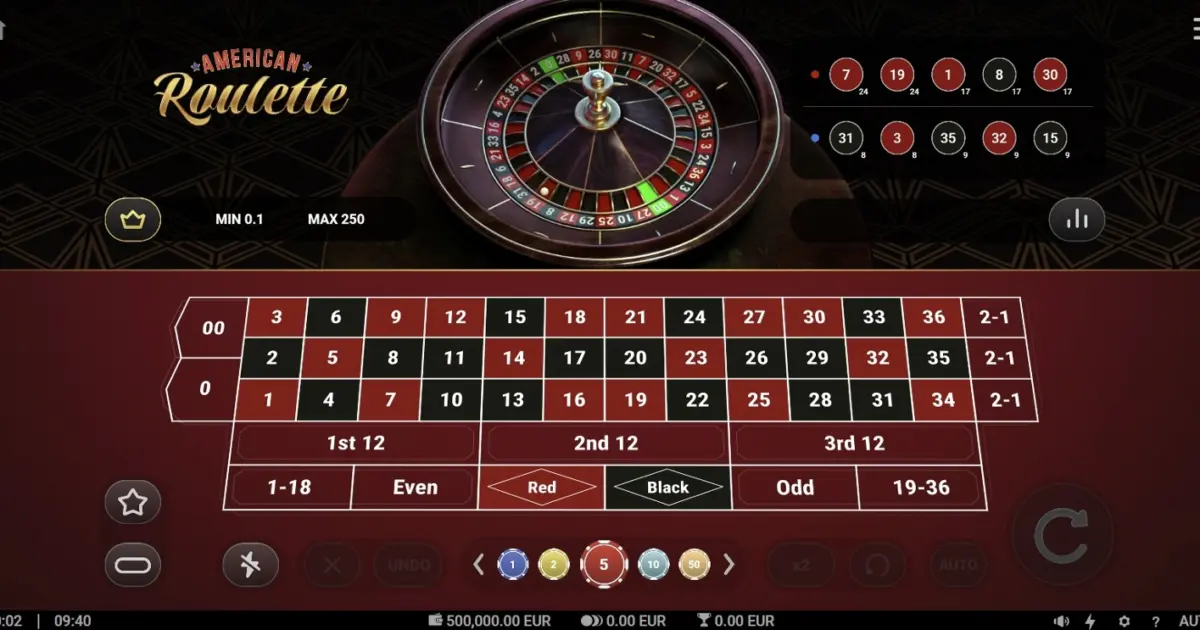
American Roulette (TrueLab) is a double-zero wheel with a confirmed 94.74% RTP, which translates to a 5.26% house edge on every standard bet you place. That edge is baked into the pocket count: 38 numbers instead of 37 means the gap between what a straight-up bet pays (35:1) and its true odds (37:1) widens. If you’re shopping for the best value in roulette, this is not it—but if you know the trade and still want the American layout, TrueLab’s execution is clean and the demo is open.
How American Roulette (TrueLab) plays
The wheel carries 36 red and black numbers plus a green 0 and 00. You place chips on the felt—inside bets on individual numbers or small groups, outside bets on red/black, odd/even, high/low, dozens, or columns—and the ball lands where it lands. Payouts follow the standard American table: straight-up pays 35:1, splits 17:1, streets 11:1, corners 8:1, six-lines 5:1, dozens and columns 2:1, and even-money bets pay 1:1. The interface gives you neighbour and racetrack shortcuts if you want to cover wheel sectors quickly. Spins resolve in seconds; there is no live dealer, no waiting for other players, and no social theatre. It is RNG roulette at software speed.
The pocket count is the whole story
The American wheel’s 38 pockets create a structural disadvantage. A straight-up bet on a single number has a 1-in-38 chance of winning but pays only 35:1. That two-pocket shortfall—37:1 true odds versus 35:1 payout—produces a house edge of 5.26% on every standard bet. European roulette, with 37 pockets and a single zero, cuts that edge to 2.70%. French roulette with La Partage or En Prison rules drops the even-money edge to about 1.35%, the best standard offer in the game. American Roulette (TrueLab) does not offer La Partage, and the 94.74% RTP confirms the double-zero penalty is in full effect. The maths is unforgiving: over 100 spins at £1 per spin, you can expect to lose £5.26 on average. Variance will mask that figure in any single session, but the expectation never changes.
Reading the 94.74% figure
The 94.74% RTP is the long-run average proportion of total stakes returned to all players across millions of spins. It is not a session guarantee and it does not predict your next hundred spins. In practice, it means that for every £100 wagered, the game returns £94.74 on average and keeps £5.26 as house margin. That figure applies equally to red/black, a single number, or a corner bet—variance changes, expected value does not. The RTP sits 2.23 percentage points below the average for the roulette corpus tracked on this site, which is 96.97%. TrueLab’s other roulette offering, European Roulette (TrueLab), returns 97.3%, a direct reflection of the single-zero advantage. If RTP is your decision variable, the European wheel is the rational pick every time.
Choosing bets for the session you want
Inside and outside bets carry the same 5.26% house edge, but they shape variance differently. A straight-up bet on a single number wins once every 38 spins on average and pays 35:1, producing high volatility—long losing runs punctuated by large wins. Red/black and other even-money bets win roughly half the time and pay 1:1, smoothing the ride but keeping the same negative expectation. If you want your bankroll to last, outside bets extend playing time. If you want a shot at a sharp upswing, inside bets concentrate risk. Neither changes the maths: the house edge is locked to the wheel, not the bet type. The only American bet to avoid outright is the five-number basket (0, 00, 1, 2, 3), which has a 7.89% house edge—worse than every other option on the table.
Martingale and friends: the honest answer
No betting system—Martingale, Fibonacci, D’Alembert, Labouchère, waiting for five reds then doubling on black—changes the house edge or your expected loss. Spins are independent events. The wheel has no memory and past results carry no predictive power. Martingale doubles your stake after every loss, intending to recover all previous losses plus one unit when you win. It works until you hit a losing streak long enough to exhaust your bankroll or breach the table limit, at which point the cumulative loss is catastrophic. The strategy does not reduce risk; it trades frequent small wins for rare, enormous losses. Progression systems redistribute variance across your session but never alter expected value. If you enjoy the structure of a system, play it with your eyes open—but do not mistake a short winning run for proof that the maths has bent.
Bankroll and table limits
The FACTS provided for this review do not include minimum or maximum bet limits, so check the game’s own rules screen before committing real money. Table limits matter most when you are running a progression system: if your starting bet is £1 and you double six times, you will need to place a £64 bet to continue, and many tables cap single bets well below that threshold. For flat betting, your session budget should cover at least 50 to 100 bets to give variance room to move. A £100 bankroll with £1 bets gives you a hundred spins; the same £100 with £5 bets runs dry fast if the first twenty spins go cold. Roulette is entertainment, not income. Set your budget in advance, accept that the house edge means you will lose it on average, and walk when the limit is reached. This is a game for adults aged 18 and over; if the session feels compulsive rather than recreational, stop and seek support.
Verdict on American Roulette (TrueLab)
American Roulette (TrueLab) is a technically sound execution of an expensive format. The 94.74% RTP is honest to the double-zero wheel, and the game delivers clean software roulette without gimmicks. But the 5.26% house edge is nearly double what you pay on European Roulette (Red Tiger) or European Roulette Pro, both of which return 97.3% and give you 37 pockets instead of 38. Unless you specifically want the American layout for its own sake—perhaps because you learned on a double-zero wheel or prefer the sector distribution—there is no mathematical reason to choose this table over a European alternative. The free demo is available, which lets you confirm the interface and pace before risking real money. If you do play, go in knowing the cost: every spin carries that 5.26% toll, and no system, pattern, or progression will reduce it.
| Bet Type | Payout | True Odds (38 pockets) | House Edge |
|---|---|---|---|
| Straight-up (single number) | 35:1 | 37:1 | 5.26% |
| Split (two numbers) | 17:1 | 18:1 | 5.26% |
| Street (three numbers) | 11:1 | 11.67:1 | 5.26% |
| Corner (four numbers) | 8:1 | 8.5:1 | 5.26% |
| Six-line (six numbers) | 5:1 | 5.33:1 | 5.26% |
| Dozen / Column | 2:1 | 2.17:1 | 5.26% |
| Even-money (red/black, odd/even, high/low) | 1:1 | 1.11:1 | 5.26% |
| Five-number basket (0, 00, 1, 2, 3) | 6:1 | 6.6:1 | 7.89% |
Frequently Asked Questions
Is American Roulette (TrueLab) available to play for free?
Yes, a free demo is available. You can test the interface, bet types, and pacing without depositing real money, which is the sensible way to confirm whether you like the feel of the software before committing a bankroll to a wheel with a 5.26% house edge.
What is the RTP of American Roulette (TrueLab)?
The confirmed RTP is 94.74%, which reflects the 5.26% house edge on standard bets created by the 38-pocket American wheel layout with both 0 and 00. That edge is nearly double the 2.70% you pay on a European single-zero wheel.
Does the Martingale system work on this table?
No. Martingale and all other progression systems leave the house edge unchanged at 5.26% per spin. Spins are independent; the wheel has no memory. Doubling after losses trades frequent small wins for rare, severe losses when a long streak exhausts your bankroll or hits the table limit.
What is the house edge difference between American and European roulette?
American roulette has a 5.26% house edge due to 38 pockets (0 and 00); European roulette has 2.70% with 37 pockets (single 0). TrueLab's European version returns 97.3% RTP compared to 94.74% on this American table, making the European wheel the better mathematical choice.
Which bet gives the best chance of winning on American Roulette (TrueLab)?
All standard bets carry the same 5.26% house edge, so no bet is "better" in expected value. Even-money bets like red/black win more often and smooth variance; straight-up bets win rarely but pay 35:1. Avoid the five-number basket bet, which has a 7.89% edge—the worst on the table.




