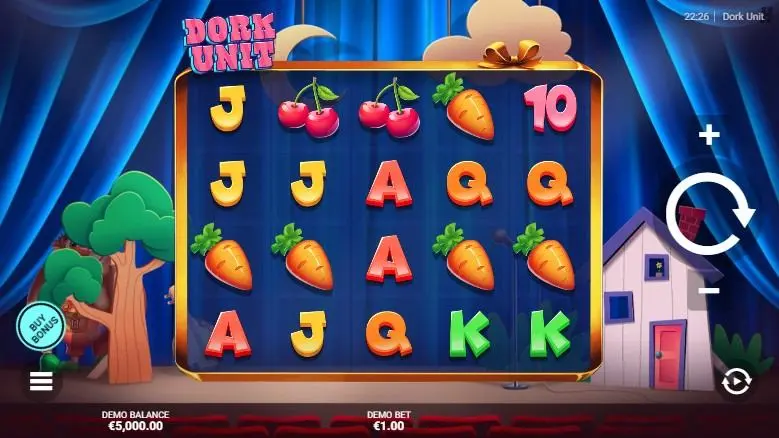
Dork Unit Slot is a high-volatility release from Hacksaw Gaming that sits 0.57 percentage points above the average RTP found across our full game library. Whether that edge is worth the risk profile depends on how you plan your session, what you do with the free demo, and whether the math matches your tolerance for dry spells between payouts.
Dork Unit Slot versus the average slot
The clearest number on the table is the return-to-player rate. At 96.28%, this game returns £96.28 for every £100 wagered over a sufficiently large sample — a statistical average that describes nothing about any individual session. Against the corpus-wide average of 95.71%, that gives a spread of 0.57 percentage points in the player’s favour. In practical terms, for every £1,000 you cycle through the reels across many sessions, the house edge is roughly £5.70 thinner than an average slot.
Compared to Hacksaw Gaming’s own portfolio average of 96.1%, Dork Unit sits 0.18 points above the studio’s house norm. That places it in the upper-middle band of the provider’s output — not the best-paying title they publish, but comfortably above the level where a reviewer might warn you about a below-average return.
Popularity data adds a second lens. With a rank of 338 across the full corpus and a 98.3rd-percentile position, this is one of the more-searched games in the library despite not leading on RTP. That suggests players are drawn to something about the experience beyond the return figure alone — the volatility shape, the stake ceiling, or simply Hacksaw Gaming’s brand recognition in the high-variance market.
One structural limitation worth noting: there is no published max-win multiplier or hit-frequency figure available in the data we hold. Hacksaw Gaming has not provided those numbers for this title, so treat any specific claim you encounter elsewhere — on forums, in YouTube thumbnails, on other review sites — with healthy scepticism unless it cites the provider’s own paytable documentation.
| Provider | Hacksaw Gaming |
|---|---|
| RTP | 96.28% |
| Volatility | High |
| Reels | 5 |
| Paylines | 16 |
| Bet range | $/£/€0.10 – $/£/€100 |
| Free demo | Yes |
RTP breakdown: 96.28% in context
Understanding what 96.28% actually means requires separating the theoretical rate from the experience of playing. The RTP figure is a long-run arithmetic result calculated across millions or billions of simulated spins. It does not describe a single trip to the reels, and it does not guarantee that £100 wagered tonight returns £96.28 tonight.
A useful mental model: imagine a graph where the red line (your balance) oscillates wildly around a slowly trending blue line (the expected outcome). The slope of that blue line at 96.28% is set by the math. The amplitude of the red line’s oscillation is set by the volatility — and on this game, that amplitude is large.
The 16-payline, 5-reel structure gives each spin sixteen independent opportunities for a winning combination. More lines generally mean more frequent small wins, which slightly smooths variance compared to a 5-line game at the same RTP. However, with high volatility listed here, that smoothing effect is overwhelmed by the underlying payout distribution: many spins return nothing or very little, and a minority carry outsized values that pull the long-run average up to 96.28%.
For session planning, the RTP gap between this game and a typical 94% slot is larger than it sounds. A player cycling through £5,000 in total bets over several weeks would expect to lose roughly £100 more on a 94% title than on this one, purely from the difference in house edge.
Volatility profile
High volatility is the most consequential label on this game’s spec sheet. It shapes everything about how a session feels: the length of dead stretches between wins, the size of the swings when those wins do land, and the minimum bankroll needed to survive variance without depleting your budget before the mathematics have room to assert themselves.
On a high-volatility slot, expect long sequences where nothing of meaningful size appears. Your balance can drop 50–70% from the starting point during a rough stretch even when the theoretical RTP remains unchanged, because the payouts that are “owed” to you by the math are simply sitting in a future spin that hasn’t come yet. No strategy, timing, or bet adjustment accelerates their arrival — every spin is independent.
The stake range of $0.10 to $100 per spin interacts directly with volatility. At the minimum bet, a £20 session budget gives you 200 spins — enough to sample the variance but not enough to be comfortable when a cold run stretches past 60 or 80 spins with negligible return. At higher stakes, the absolute swings magnify proportionally.
If you are new to high-variance games, the practical recommendation is to treat your bankroll as if it were 50–100 times your chosen bet per spin. That cushion doesn’t change the expected loss, but it prevents premature exit before the session reaches a representative length.
Hacksaw Gaming as a studio
Hacksaw Gaming publishes 156 titles in this corpus with an average portfolio RTP of 96.1%. Dork Unit’s 96.28% sits modestly above that house average, which is typical for a mid-catalogue release from a studio that has already front-loaded its best return figures into flagship products.
The studio’s catalog skews heavily toward high volatility. Wanted Dead or a Wild combines that same variance band with a 96.38% RTP — 0.10 points above Dork Unit — making it a closer match on return if you enjoy the Western-adjacent format. Strength of Hercules sits at 96.31%, also above this game, and demonstrates that Hacksaw consistently publishes in the 96.2–96.5 band rather than varying wildly from title to title.
Le Bandit at 96.34% follows the same pattern. What distinguishes games within Hacksaw’s output is rarely the RTP — it is the volatility level, the stake range, and the feature architecture underneath. Since no feature details are published for Dork Unit in our data, comparing it directly to those three titles on mechanics is not possible; the numbers say all four land in the same narrow return corridor.
Three 5-Reels alternatives worth comparing
The theme tag “5-Reels” applies to Dork Unit as a structural descriptor — five reels, sixteen paylines — rather than a genre category. In our corpus, no other game carries this exact tag in the related-themes field, so there are no filtered recommendations to surface here. That absence is itself informative: if you are searching specifically for games that advertise a 5-reel, 16-line format, you will find that virtually every slot provider uses that layout, meaning the tag captures almost nothing that is distinctive about this particular title.
What to do instead: use the provider links above. All three Hacksaw alternatives share the 5-reel structure and offer comparable or slightly better RTP, so they fill the gap that the empty theme category cannot. If reel-and-line count is genuinely your filtering criterion, you are looking at a format that describes the vast majority of the market, which makes it a poor differentiator.
The honest summary is that the “5-Reels” theme label adds no meaningful information to a comparison. The volatility profile, the stake range, and the provider’s specific payout distribution are the variables that actually separate games from one another.
Getting the most out of the free demo
A free play session costs nothing and teaches you things no number can communicate: how often the reels actually produce a visible win at your chosen stake, how the hit frequency feels when you are not risking money, and whether the pace of the game holds your attention. The demo is available, so use it as a stress test before committing a single coin.
Set the same bet you intend to use for real play. If you plan to spin at $5 per turn, demo at $5 — the variance pattern you observe at $0.10 is proportionally identical but feels nothing like the emotional experience of the higher stake. Run at least 200–300 spins before drawing conclusions; short bursts tell you nothing about a high-volatility distribution.
Demo results do not predict real-money outcomes. The random number generator produces independent events, and the sequence you see in free play has no influence on what happens when you deposit. That said, the demo remains the single best tool for confirming that you find the game’s tempo and volatility profile personally tolerable before money enters the equation.
Remember that all real-money play should be treated as paid entertainment with a fixed budget you have already decided to spend. You must be 18 or older, and you should never wager funds that serve another purpose in your life.
Should you play Dork Unit?
Here is the decision framework in three questions. First: do you want an above-average RTP from a provider you already trust? At 96.28%, this clears both criteria — it is 0.57 points above the corpus average and 0.18 above Hacksaw’s own mean. If that is your filter, the math does not object.
Second: can you tolerate high volatility? This is the make-or-break factor. If losing £50 from a £80 starting bankroll over 100 spins without a single meaningful return would make you tilt, stop, or chase, then the game’s variance shape is wrong for you regardless of how good the RTP number looks. High volatility is not a feature to be endured; it is a trade-off that buys the possibility of larger single-event payouts in exchange for longer, deeper dry spells.
Third: do you need detailed bonus-feature information before committing? If yes, you will find this game frustrating because no feature breakdown, max-win figure, or hit frequency is published in the available data. The spec sheet gives you the return rate, the variance label, the layout, and the stake range — and that is where the confirmed information ends.
The verdict: a solid mid-pack Hacksaw title on RTP with the studio’s characteristic high-variance profile. Worth a demo session to gauge your personal tolerance for its swing pattern before you assign real stakes to it.
Frequently Asked Questions
What is the RTP of Dork Unit?
The game's return-to-player rate is 96.28%, which places it 0.57 percentage points above the 95.71% average across the full slot corpus and 0.18 points above Hacksaw Gaming's portfolio average of 96.1%. That makes it a slightly above-average title within the provider's catalogue of 156 games.
Is there a free demo for Dork Unit Slot?
Yes, a free demo version is available for play without registration or deposit. The demo uses the same game math as the real-money version, so you can observe the volatility pattern and feature frequency at your chosen stake before playing with actual funds, though results in demo mode carry no predictive relationship to real-money outcomes.
What volatility does Dork Unit have?
The game is classified as high volatility, meaning wins arrive less frequently but with a wider size distribution than medium- or low-variance titles. Your balance can experience significant swings in either direction during a typical session, so bankroll sizing relative to your per-spin stake becomes more important than RTP alone when planning your play.
What is the stake range for Dork Unit?
Bets start at $0.10 and reach a maximum of $100 per spin, giving a thousand-fold range. The minimum stake provides roughly 200 spins from a $20 budget, while the ceiling accommodates high-rollers who want maximum exposure per turn on a 5-reel, 16-payline layout.
How does Dork Unit compare to Wanted Dead or a Wild?
Wanted Dead or a Wild carries a 96.38% RTP, which is 0.10 percentage points higher than Dork Unit's 96.28%. Both are Hacksaw Gaming titles with the same 5-reel format. The RTP difference is negligible in practical terms, so your choice between them should rest on the volatility feel and theme preference rather than the return figure.




