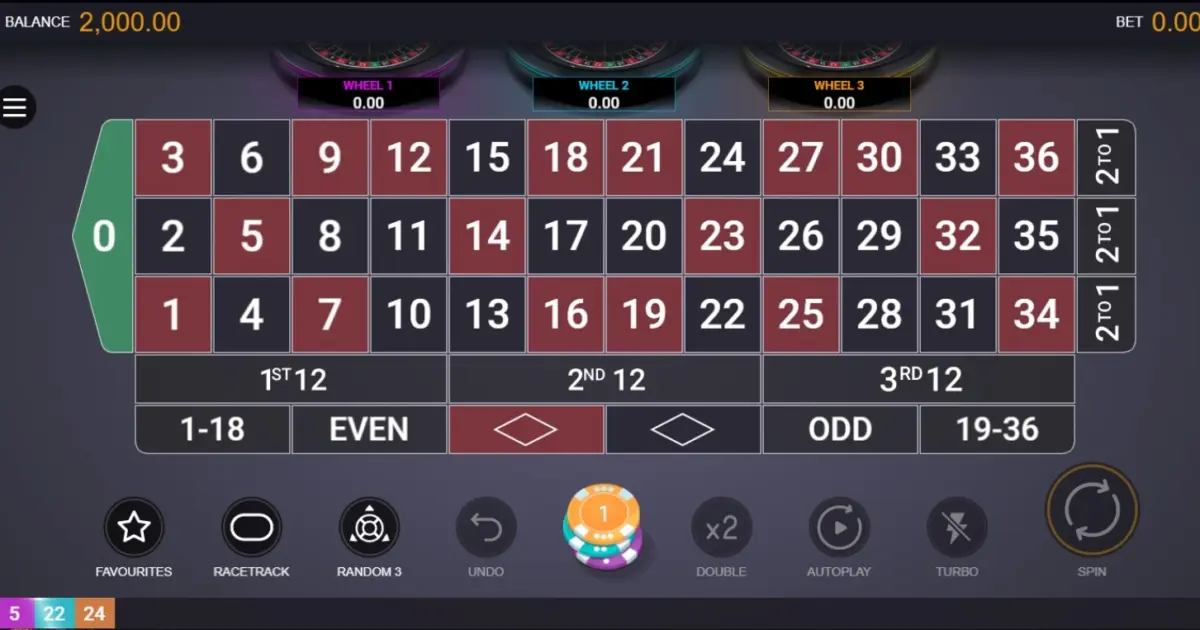
If you want the short version: Three Wheel Roulette carries a published RTP of 97.3%, which is marginally better than the 96.97% average across the roulette tables covered on this site, and Switch Studios makes a free demo available so you can learn the layout without staking anything. What FACTS does not tell us is the wheel configuration itself, and that gap matters more than the RTP number, so this review is honest about where the information ends.
Three Wheel Roulette in one minute
The title comes from Switch Studios, a studio with 16 games in the catalogue here, averaging 97.33% RTP across them. This table sits right on that studio average at 97.3%. It ranks 177th by popularity in the roulette section, placing it around the 21st percentile, so it is a smaller-traffic table rather than a headline release.
The name suggests three wheels rather than one, which would be a multi-wheel format where a single bet is replicated across several spins. That is an inference from the title, not a confirmed rule. The number of pockets on each wheel, whether the stake is divided or multiplied across wheels, the table limits and any bonus or side-bet mechanics are all absent from the information available here. None of that is guesswork territory: it is printed on the game’s own rules and paytable screens, and you should read them before your first real-money spin. In a multi-wheel format especially, the way your stake is split determines your cost per round, and that is the single most important thing to check.
| Provider | Switch Studios |
|---|---|
| RTP | 97.3% |
| Free demo | Yes |
The maths of a single spin
Roulette is the one casino game where the arithmetic is completely closed. On a single-zero wheel there are 37 pockets. A straight-up number pays 35 to 1, while the true odds against it are 36 to 1. That one-pocket gap is the entire house edge, and it works out at 2.70% on every standard bet on that wheel — corners, splits, columns, red or black, all of them.
A double-zero wheel has 38 pockets and the same payouts, so the edge roughly doubles to 5.26%, with the five-number basket bet worse still at 7.89%. That is why the pocket count is the first thing to establish on any table.
Inside and outside bets do not change this. A straight-up number and a red/black bet on a European wheel carry the identical 2.70% expected cost per unit staked. What changes is the shape of your session: one hits about once every 37 spins and pays 35 units, the other hits just under half the time and pays one. Same expectation, wildly different swings. Choosing between them is a choice about volatility tolerance, not about value.
Where the 97.3% comes from
An RTP of 97.3% is the mirror image of a 2.7% house edge, and 2.70% is precisely the figure a standard single-zero wheel produces. That correspondence is a strong signal that the underlying wheels here are European-style with 37 pockets each — but a signal is all it is. RTP figures can also be produced by blended paytables, or averaged across bet types, and a multi-wheel format has more room for that than a classic table does.
So treat the number this way: 97.3% is the long-run return the studio publishes, measured across millions of spins, not a promise about your afternoon. Over 100 spins of £1 you might be up, down, or nowhere near the average — that is variance doing its job. The figure is useful for comparing tables against each other, and useless for predicting a session.
What FACTS does not confirm is whether that 97.3% applies uniformly to every bet type or only to a subset. If the paytable on the game screen shows a reduced straight-up payout, the return is being redistributed somewhere else. Read it.
Even-money bets and the zero problem
Zero is where the house takes its cut on even-money bets, and it is also where the best rule in roulette lives. Under La Partage, when zero lands your even-money bet loses only half its stake rather than all of it. En Prison is the alternative: the bet is frozen for one spin and released if it wins next time. Either rule cuts the even-money house edge from 2.70% to roughly 1.35%, which is the lowest standard edge available anywhere in the game.
That halving is significant. It does not turn a losing bet into a winning one, but it is a genuine, mathematically real reduction in cost per spin, and it applies only to red/black, odd/even and high/low.
Whether either rule is active on this table is not stated in the information available, and it is not something the name or the RTP figure settles. A 97.3% headline figure is consistent with a plain single-zero wheel with no partage at all. Check the rules screen for the words La Partage, En Prison or “half back”. If they are absent, your even-money bets cost the full 2.70%, and it is worth knowing that before you build a session around them.
How three wheel roulette compares to other online roulette
At 97.3%, this table sits 0.33 percentage points above the 96.97% average across the roulette games reviewed here. In practical terms that is about 33p per £100 wagered — real over a long span, invisible over an evening.
Switch Studios keeps its roulette RTPs tightly clustered, which makes comparison within the studio straightforward. Sweep&Win Roulette also runs at 97.3%, so if you prefer a single-wheel layout without giving up return, that is the like-for-like swap. Low Stakes Roulette matches the same figure and is built around smaller minimum bets, which is the more sensible starting point if you are stretching a modest budget across more spins. For something with an added mechanic on top of the base game, Extreme Multifire Roulette is the studio’s multiplier-style option, though multiplier formats fund their top payouts by trimming the base straight-up return, so read that paytable rather than assuming it behaves like a classic wheel.
The honest summary: on RTP alone there is nothing to choose between these four. Pick on format and stake size instead.
Playing responsibly
Roulette is 18+ entertainment, not income. Decide what you are willing to lose before you open the table, treat that amount as the price of the entertainment, and stop when it is gone rather than reaching for more. Set a time limit alongside the money limit, since long sessions erode judgement faster than they erode a bankroll.
One thing worth stating flatly: no betting system works. Martingale, Fibonacci, D’Alembert, waiting for five reds before backing black — none of them change the expected value of a single spin, because spins are independent and the wheel has no memory. What progressions do is redistribute variance, converting many small wins into one large loss, and they run into table limits exactly when they need one more double. No number, colour or sector is ever due, hot or cold on an RNG wheel. Tracking previous results tells you what happened, not what is coming.
Demo play is genuinely useful for learning the interface and bet placement. It does not predict real-money results, and demo balances do not carry the emotional weight that real ones do.
Verdict
Three Wheel Roulette is a reasonable, unspectacular choice. The 97.3% RTP is slightly above the field average, the studio is consistent across its 16 titles, and the free demo removes any reason to learn the layout with money on the table. The multi-wheel angle is the interesting part and also the part with the least documentation available here.
Before staking real money, confirm three things on the game’s own screens: the pocket count on each wheel, how your stake is divided or multiplied across the wheels, and whether La Partage or En Prison applies to even-money bets. Those three answers determine your actual cost per spin far more than the headline RTP does. If the wheels are single-zero with partage active, your even-money bets cost about 1.35% per spin. Without it, 2.70%. That is the difference worth checking for.
Frequently Asked Questions
Can I play Three Wheel Roulette free with no download?
Yes. A free demo is available for this Switch Studios table, and it runs in the browser with no download or registration needed. The demo uses play-money chips, so you can learn the bet layout and the multi-wheel controls at no cost. Demo results carry no predictive value for real-money sessions.
What is the Three Wheel Roulette RTP?
Switch Studios publishes 97.3% for this table. That sits exactly on the studio's 16-game average of 97.33% and 0.33 percentage points above the 96.97% average across roulette games reviewed here. RTP is a long-run figure measured over millions of spins, so it tells you nothing reliable about a single session.
What is the house edge, and is this a European or American wheel?
A 97.3% RTP corresponds to a 2.7% house edge, which is exactly what a single-zero 37-pocket wheel produces. That is a strong hint rather than confirmation, since the pocket count is not stated in the available information. Check the game's rules screen before betting — a double-zero wheel would carry 5.26%.
Does any betting system work on this table?
No. Martingale, Fibonacci, D'Alembert and pattern-based approaches leave expected value unchanged, because each spin is independent and the wheel has no memory. Progressions only reshape variance, trading frequent small wins for occasional large losses, and they collide with table limits at the worst moment. No number or colour is ever due.
How does it compare to other Switch Studios roulettes?
Identically on return. Sweep&Win Roulette, Low Stakes Roulette and Extreme Multifire Roulette all publish 97.3%, the same as this table, so RTP is not a tiebreaker within the studio. Choose on format instead: Low Stakes Roulette for smaller minimums, Extreme Multifire for multipliers, this one for the multi-wheel layout.




