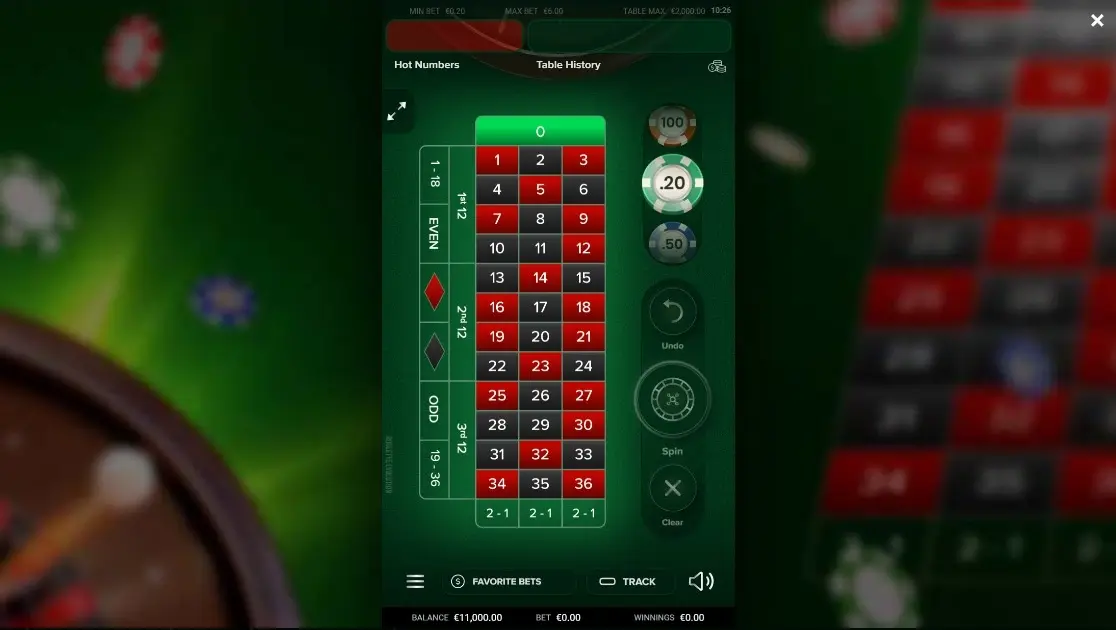
Roulette Evolution is a Darwin gaming table with a published RTP of 97.3% and a free demo you can open without registering. That figure sits close to what a single-zero wheel returns, which is a good sign, but the FACTS available for this table do not confirm the pocket count, the zero rules, the table limits or whether a racetrack for call bets is present.
So the honest summary is this: the numbers that are published look competitive, and everything that decides how the table actually plays needs a look at the in-game rules screen. The demo makes that free to do.
Roulette Evolution at a glance
Here is everything that is documented for this table, and nothing beyond it.
- Provider: Darwin gaming, a studio with two roulette titles listed in this corpus.
- Published RTP: 97.3%, matching the provider’s average across their catalogue.
- Category: roulette.
- Free demo: available.
- Popularity: ranked 174, in the 22nd percentile of tables here, so it is a niche release rather than a lobby staple.
What is not documented matters just as much. There is no confirmed information here on the number of pockets, whether La Partage or En Prison apply to even-money bets, minimum and maximum stakes, side bets, or multiplier features. Each of those changes either your expected loss or how quickly you reach a limit, so none of them should be assumed. A table with a 97.3% RTP and La Partage on the even-money bets is a materially better proposition than the same table without it, and the difference is not visible from the RTP number alone.
Which wheel is this, and what it costs you
The title gives no wheel family away, and the FACTS block carries no variant hint, so the wheel type here is genuinely unconfirmed. What you can do is match the published RTP against the known families and see where it lands.
A single-zero European wheel has 37 pockets and a house edge of 2.70% on every standard bet, which puts its RTP at 97.30%. A double-zero American wheel has 38 pockets, a house edge of 5.26% on standard bets and 7.89% on the five-number basket, giving an RTP near 94.74%. French rules layer La Partage or En Prison on top of a single-zero wheel: when zero lands, half your even-money stake comes back, dropping the even-money house edge to roughly 1.35% and making it the best standard bet in the game.
The 97.3% figure published for this table is the exact arithmetic result of a 37-pocket wheel with no zero refund. That is a strong indication, not a confirmation, and the RTP could also be a rounded average across mixed bet types. Open the rules screen, count the pockets on the wheel graphic, and check what happens to an even-money bet when zero hits. Two minutes in the demo settles it.
What a 97.3% RTP means per spin
RTP is a long-run average, not a per-session promise. A 97.3% return means the house edge is 2.7%, so across a very large number of spins the table is expected to keep 2.7 units of every 100 staked. Turnover is what drives it: if you place 1 unit per spin and spin 100 times, you have staked 100 units and the theoretical cost is 2.7 units, regardless of whether you bet red or a straight-up number.
That is the part people misread. The 2.7% applies per unit wagered, not per session or per hour, so betting on three numbers at 1 unit each costs three times as much in expectation as betting one number at 1 unit. Progression systems raise turnover sharply, which is exactly why they raise expected loss.
For context, 97.3% is above the 96.97% average across the tables catalogued here — a gap of 0.33 percentage points. It also matches Darwin gaming’s average across their two titles, and it is the same figure carried by Roulette Evolution VIP, the studio’s higher-limit companion table. If you want a documented single-zero comparison at the same return, European Roulette (Red Tiger) is a more widely played option at 97.3%.
Inside versus outside bets
Inside and outside bets do not change your expected value on a standard wheel. They change variance: how large the swings are and how often they happen. Every standard bet on a single-zero wheel carries the same 2.70% edge because every payout is short of true odds by the same proportion. The table below assumes a 37-pocket wheel; if the rules screen shows a double zero, every true-odds column shifts and the edge rises to 5.26%.
| Bet | Numbers covered | Payout | True odds (37 pockets) | Win chance |
|---|---|---|---|---|
| Straight up | 1 | 35:1 | 36:1 | 2.70% |
| Split | 2 | 17:1 | 17.5:1 | 5.41% |
| Street | 3 | 11:1 | 11.33:1 | 8.11% |
| Corner | 4 | 8:1 | 8.25:1 | 10.81% |
| Line | 6 | 5:1 | 5.17:1 | 16.22% |
| Column or dozen | 12 | 2:1 | 2.08:1 | 32.43% |
| Red, black, odd, even, high, low | 18 | 1:1 | 1.11:1 | 48.65% |
The straight-up row shows the whole mechanism. You are paid 35:1 against true odds of 36:1, and that single missing pocket is the house edge in its entirety.
Why no betting system changes the maths
No betting system alters expected value. Not Martingale, not Fibonacci, not D’Alembert, not waiting for five reds before backing black. Spins on an RNG wheel are independent events and the wheel has no memory, so the probability of red on the next spin is identical whether the last five results were red, black or a mix.
What progressions do is redistribute variance. Martingale converts a pattern of small frequent wins into a rare catastrophic loss, and it runs into the table maximum exactly when you need the next double most. Doubling from 1 unit, a run of ten losses requires a 1,024-unit stake to chase 1 unit of profit. Flat betting keeps the same 2.7% cost per unit staked with far less chance of a session-ending swing.
Because the table limits for this game are not documented, you cannot calculate how many progression steps it would even allow. That alone is a reason to treat any doubling plan here as untested. Tracking previous results has no predictive value, and no number, colour or sector is ever due.
Playing the Roulette Evolution demo
A free demo is confirmed for this table, which is the practical route to filling the gaps in the record. Load it and check four things: the pocket count on the wheel, what happens to an even-money bet when zero lands, the stake range, and whether a racetrack or call bets are offered. Those four answers tell you more about the table than any published RTP figure.
Demo play uses play-money balances and cannot predict real-money outcomes. A run of good results in a demo is variance, nothing more, and the 2.7% edge implied by the RTP applies identically in both modes.
Roulette is 18+ entertainment, not a way to make income. Decide a budget before you open the game, treat it as the cost of the session rather than a stake you expect to recover, and stop when it is gone. If the amount you are betting stops feeling like entertainment, that is the signal to close the table.
Verdict
Roulette Evolution publishes a 97.3% RTP, slightly above the catalogue average, and offers a free demo. That is a reasonable starting position for a roulette table, and the return is identical to Darwin gaming’s other listing and to well-known single-zero tables such as European Roulette Pro.
The reservation is documentation rather than quality. Wheel type, zero rules, limits and any extra bets are all unconfirmed here, and those are the details that decide whether the effective edge on your preferred bet is 2.70% or 1.35%. Use the demo to confirm them, favour flat stakes over progressions, and treat the published RTP as a long-run average rather than a per-session expectation.
Frequently Asked Questions
Can I play Roulette Evolution free with no download?
Yes. A free demo is confirmed for this table, so you can spin it in the browser without registering or installing anything. Use the session to check the details that are not published: the pocket count, what happens to even-money bets when zero lands, and the stake range. Demo results never predict real-money outcomes.
What is the Roulette Evolution RTP?
The published RTP is 97.3%, which implies a 2.7% house edge on the amount you stake. That is 0.33 percentage points above the 96.97% average across the roulette tables catalogued here. RTP is a long-run average across very many spins, not a target for any individual session.
Is Roulette Evolution a European or American wheel?
That is not confirmed in the available information for this table, and it matters. A 37-pocket single-zero wheel carries a 2.70% edge on standard bets; a 38-pocket double-zero wheel carries 5.26%, rising to 7.89% on the five-number basket. The 97.3% RTP is consistent with single zero, but confirm it on the in-game rules screen.
Does the Martingale system work on Roulette Evolution?
No. Martingale and every other progression leave expected value unchanged, because spins are independent and the wheel has no memory. Doubling redistributes variance into rare large losses and hits the table maximum fastest when you most need another double. Table limits are not documented here, so you cannot even calculate how many steps it allows.
Which bet is best if I want the longest session?
Even-money bets on red, black, odd, even, high or low win roughly 48.65% of the time on a 37-pocket wheel, so they produce the smallest swings and the longest playing time per unit staked. They do not lower the 2.7% cost per unit. If the rules screen shows La Partage, that even-money edge drops to about 1.35%.




