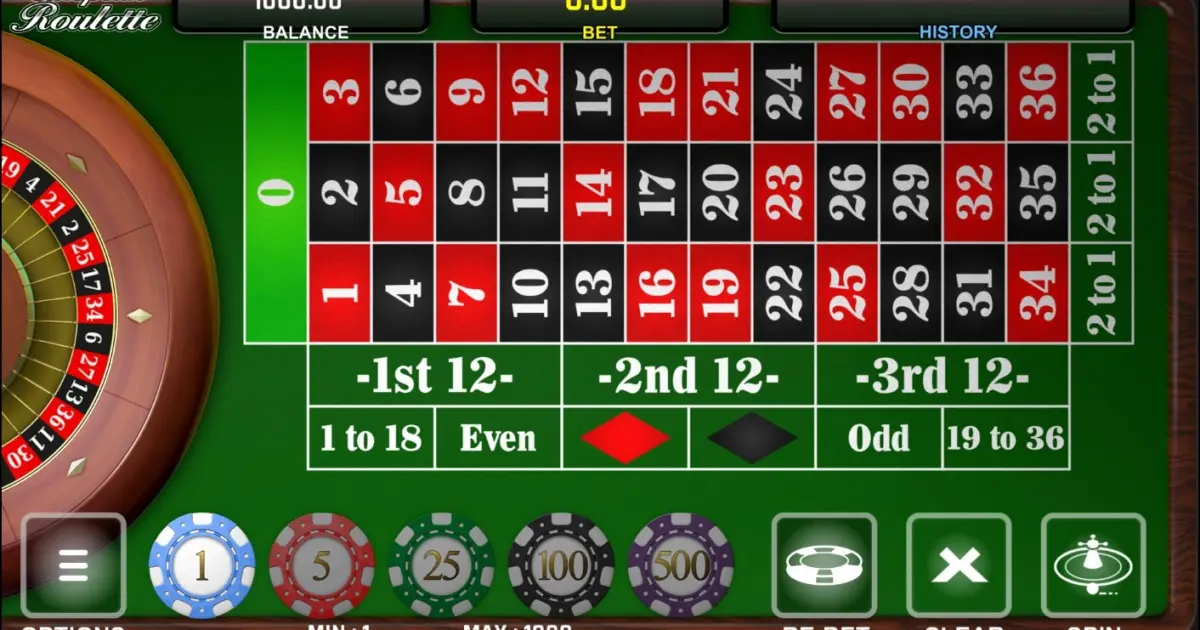
European Roulette (Cogg Studio) is a stripped-back single-zero roulette table from a small studio with only one title in its catalogue. The math is straightforward: 37 pockets, a 97.3% RTP, and a 2.70% house edge on every standard bet. If you want classic European roulette without flashy gimmicks, this is a clean example — but the thin product range from Cogg Studios means you are relying on one release with limited community feedback.
How European Roulette (Cogg Studio) plays
The core gameplay here is the same roulette you already know. You pick a chip value, place it on the layout — inside bets on specific numbers or small groups, outside bets on broader outcomes like red/black or odd/even — and spin. The wheel has 37 pockets numbered 0 through 36, with the single zero giving the house its edge. Every spin is independent; the wheel does not remember previous results.
Based on the title and the RTP figure, this appears to follow standard European rules, but Cogg Studios does not publish detailed rules or feature lists in our FACTS. Before playing for real money, check whether the game offers La Partage or En Prison rules on even-money bets, because those features would halve the house edge on those bets to roughly 1.35%. Without confirmation from the game’s own rules screen, assume the standard 2.70% edge applies to all bets. The interface likely includes a racetrack or call-bet panel if it follows common European roulette layouts, but this is not confirmed — look for it in the free demo.
| Provider | Cogg Studios |
|---|---|
| RTP | 97.3% |
| Free demo | Yes |
The pocket count is the whole story
Everything about a roulette game’s mathematics flows from one number: how many pockets are on the wheel. European Roulette (Cogg Studio) uses the name “European,” which points to a single-zero wheel with 37 pockets. The RTP of 97.3% is exactly consistent with this — a single-zero wheel produces a house edge of 1/37, or approximately 2.70%, on every standard bet. That means the expected return is 97.3 cents back for every dollar wagered over the long run.
Compare this to a double-zero American wheel: 38 pockets push the house edge to 5.26%, meaning this European version gives back roughly 2.56 cents more per dollar wagered. That gap is small on any single spin but compounds across sessions. The pocket count also determines the true odds of each bet. A straight-up bet on a single number faces true odds of 36:1 against winning, but pays 35:1. That single-pocket gap is the entire house edge. Every other standard bet works the same way — the payout is always slightly less than the true probability demands.
Reading the 97.3% figure
The 97.3% RTP (Return to Player) for European Roulette (Cogg Studio) means that over millions of spins, the game is mathematically designed to return 97.3% of total money wagered back to players collectively. The remaining 2.7% is the house edge — the casino’s built-in profit margin. This is not a guarantee for any individual session. Short-term results vary wildly: you might walk away up, down, or even.
A useful way to think about RTP is in concrete terms. Bet $100 total across a session and, on average, the maths expects you to have $97.30 left. But “on average” is doing enormous work in that sentence. Standard deviation in roulette is high — on straight-up bets, a single session can swing hundreds of percent either way. The RTP figure is a long-run mathematical fact, not a prediction for tonight. It is also worth noting that this 97.3% RTP is right at the expected value for a standard single-zero European wheel. It does not suggest anything unusual or enhanced about this particular release.
Choosing bets for the session you want
Every bet on a standard European wheel carries the same house edge of 2.70%, so choosing between inside and outside bets is not about finding better value — it is about choosing your variance profile. Outside bets (red/black, odd/even, high/low, dozens, columns) win more frequently but pay smaller amounts relative to the stake. Inside bets (straight-up, split, street, corner, line) win rarely but pay much more relative to the stake.
A straight-up bet on a single number pays 35:1 but hits roughly once every 37 spins. A red-or-black bet pays 1:1 and hits just under half the time (18 out of 37 numbers are red, but the zero is green). If you want longer sessions with smaller swings, stick to outside bets. If you want the possibility of a large payout from a small stake, straight-up bets deliver that — but your bankroll will fluctuate much more aggressively. The payouts for each bet type on this table follow standard European roulette conventions, though the exact paytable is not listed in our FACTS. Check the game’s info screen to confirm, especially if any unusual side bets appear. For comparison, tables like French Roulette (NetEnt) add La Partage rules that specifically favour even-money bets.
Martingale and friends: the honest answer
No betting system changes the expected value of roulette. Martingale — doubling your bet after each loss on an even-money bet — is the most popular system, and it works perfectly on paper for exactly the same reason it fails in practice. On a table with no limits and infinite money, you would always eventually recover your losses plus one unit. But tables have maximum bet limits, your bankroll is finite, and a losing streak long enough to hit the limit or drain your funds is not a rare event — it is a mathematical certainty given enough spins.
Fibonacci, D’Alembert, Labouchère, and every other progression system share the same fundamental flaw. They redistribute the variance of outcomes — spreading small wins across more spins while occasionally producing a catastrophic loss — but they cannot alter the 2.70% house edge. The wheel has no memory. Spins are independent. Tracking previous results for patterns on an RNG wheel has zero predictive value. If you use a system for entertainment value, set a strict loss limit before you start. But do not mistake the structure of a system for an edge over the maths. Consider trying European Roulette (Red Tiger) if you want to compare the feel of different providers’ implementations of the same wheel.
Bankroll and table limits
Setting a bankroll before you play and sticking to it is the single most important decision you make at any roulette table. The 2.70% house edge means the longer you play, the more you are statistically likely to lose — so a fixed budget with a clear stop point is essential. Decide what you can afford to lose, treat it as entertainment spending, and walk away when it is gone. Do not chase losses by dipping into money set aside for bills, rent, or other obligations.
Table limits matter because they determine how long a progression system or any reactive betting strategy can last before you are forced to stop. While specific table limits for European Roulette (Cogg Studio) are not provided in our FACTS, online roulette tables typically set minimum bets low enough for casual play and maximums that cap the casino’s exposure. For context, European Roulette Pro is another single-zero option with the same 97.3% RTP if you want to compare providers. This is a free demo — use it to understand the game’s pace and layout before committing real money. Play only with money you can afford to lose, never chase losses, and remember that roulette is entertainment, not a source of income. You must be 18 or older to play for real money.
Verdict on European Roulette (Cogg Studio)
European Roulette (Cogg Studio) is a textbook single-zero roulette game with a 97.3% RTP and a 2.70% house edge — mathematically identical to dozens of other European roulette tables from larger studios. It does what it sets out to do, and the maths are fair and standard. The lack of confirmed bonus features, side bets, or La Partage rules means it is unlikely to offer anything that sets it apart from more established alternatives.
The main consideration is that Cogg Studios has only one game in its catalogue, which means there is limited track record and community feedback to draw on. The 97.3% RTP sits just above the corpus average of 96.97%, but that reflects standard European roulette maths rather than any studio-specific advantage. If you are looking for a clean, no-frills European roulette experience, this delivers exactly that. If you want La Partage rules or a more established provider, French Roulette (NetEnt) offers a lower house edge on even-money bets. For a free demo session to learn the layout and pace of play, this is a perfectly serviceable option — just confirm the rules screen before putting real money down.
Frequently Asked Questions
Can I play European Roulette (Cogg Studio) for free?
Yes, a free demo of European Roulette (Cogg Studio) is available on this page. You can try it without downloading anything or risking real money, which is the best way to learn the layout and bet types before committing actual funds.
What is the RTP of European Roulette (Cogg Studio)?
The published RTP for European Roulette (Cogg Studio) is 97.3%. This is the standard expected return for a single-zero European roulette wheel and means the house edge is 2.70% on every standard bet.
What house edge does this roulette table have?
European Roulette (Cogg Studio) has a house edge of 2.70%, which comes from the single-zero wheel with 37 pockets. This is the standard edge for European roulette — lower than the 5.26% edge on American double-zero wheels.
Does any betting system work on European Roulette (Cogg Studio)?
No. Martingale, Fibonacci, D'Alembert, and every other progression system fail to change the expected value. Spins are independent and the wheel has no memory. These systems redistribute variance and can accelerate losses, especially when table limits or bankroll constraints kick in.
How does European Roulette (Cogg Studio) compare to French Roulette (NetEnt)?
Both use a single-zero wheel with a 97.3% RTP on standard bets, but French Roulette (NetEnt) from NetEnt offers La Partage rules that return half your stake on even-money bets when zero lands, reducing the house edge on those bets to roughly 1.35% — significantly better than this table's confirmed 2.70%.




