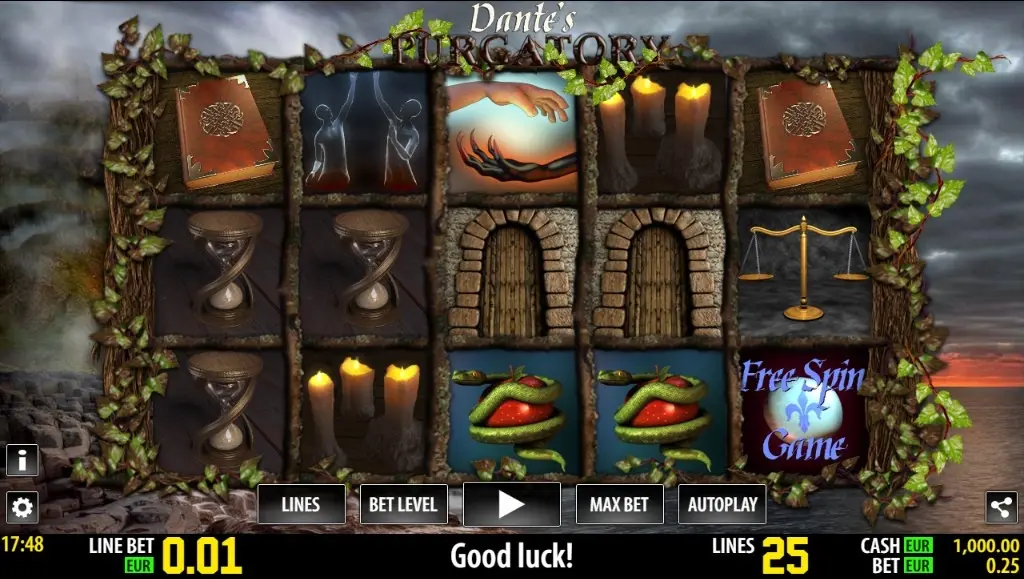
Dante Purgatory is a 5-reel astrology-themed slot from Worldmatch, a provider with 112 titles in our index. The game holds a 95.16% RTP, which places it 0.55 percentage points below the corpus average of 95.71%. Its popularity percentile of 98.5 means it attracts more plays than the vast majority of titles catalogued here, despite that below-average return figure.
Dante Purgatory at a glance
The numbers tell a straightforward story before you spin once:
| Detail | Value |
|---|---|
| Provider | Worldmatch |
| RTP | 95.16% |
| Reels | 5 |
| Primary theme | Astrology |
| Popularity rank | 306 (98.5th percentile) |
| Free demo | Available |
| Volatility rating | Not published |
| Max win | Not published |
| Stake range | Not published |
Three of the most decision-critical fields — volatility, maximum win multiplier, and stake range — are absent from Worldmatch’s public documentation for this title. That gap matters, and sections below explain exactly how it affects planning. What is confirmed: a 5-reel grid, an astrology theme, and a theoretical return that trails both its own provider and the broader market. If you are comparing this against other Worldmatch releases, Monte Carlo Jewels offers 96.2% RTP, over a full point higher, from the same studio.
What a 95.16% RTP actually returns
RTP is a long-run statistical average calculated across millions of simulated spins. It does not predict what any individual session will produce. That said, the arithmetic tells you the expected cost of playing this title over a meaningful volume of spins.
At 95.16% RTP, every £100 you wager is expected to return £95.16 across a sufficiently large sample. The house edge is 4.84%. Compare that to the corpus average of 95.71%: the gap is 0.55 percentage points. Over 1,000 spins at £1 per spin — a total stake of £1,000 — the theoretical difference amounts to £5.50 less returned on Dante Purgatory than you would expect at a corpus-average game. At £2 per spin across the same 1,000 spins, that shortfall doubles to £11.00.
Against Worldmatch’s own provider average of 95.61%, Dante Purgatory sits 0.45 points below. The provider’s 112 titles span from Blue Diamond at 93.31% up to Monte Carlo Jewels at 96.2%, so this game occupies the lower-middle band of the portfolio. A below-average RTP does not guarantee losses in any single session, but it shifts the long-run mathematics against you relative to higher-RTP alternatives on the same platform.
Missing volatility rating and what your session will feel like
Worldmatch has not published a volatility rating for Dante Purgatory. This is the single most consequential omission in its documentation, because volatility — not RTP — governs how a session actually feels minute to minute.
Low-volatility games return small wins frequently, draining or growing your balance in gradual steps. High-volatility games produce long dry spells punctuated by large hits, swinging your balance violently in both directions. Medium sits between the two. Without knowing which category this title falls into, you cannot predict how long your session will last at a given stake, how deep your losing streaks might run before a payout, or what bankroll size you need to survive variance.
Some players use the demo to gauge volatility empirically by recording win frequency across 100 or 200 free spins. That is a reasonable workaround, but it carries a clear limitation: a sample of a few hundred spins tells you almost nothing about a game’s tail behaviour. A title with a rare high-multiplier feature could present as low-volatility across your test and still hide a distribution you never encountered. Treat any session-length estimate you build from demo play as a rough lower bound, not a reliable forecast.
The 5-reel layout and how wins are counted
Dante Purgatory uses a 5-reel configuration, the most common grid in modern online slots. Worldmatch does not specify a payline count or a ways mechanic in the available data, so the exact method for forming winning combinations is undocumented from the provider.
In general terms, a 5-reel layout means five vertical columns of symbols, each displaying between three and five positions depending on the specific design. Traditional payline games require matching symbols on defined lines across those columns. Ways games — sometimes labelled as 243, 1024, or more — award a win for any matching symbols landing on adjacent reels regardless of their vertical position. The latter tends to produce more frequent but smaller individual hits, which affects how the same RTP figure is delivered across a session.
The astrology theme places Dante Purgatory alongside Cosmic Cash, another space- and star-aligned title that returns 96.55% RTP — 1.39 points above this game. If the visual atmosphere is what draws you to the category, Cosmic Cash pairs that mood with a meaningfully better return.
Stake range and sizing a bankroll without published data
No minimum or maximum stake figure is available for Dante Purgatory from Worldmatch’s documentation. Stake range determines whether a game fits your budget at all, and how many spins your total bankroll can cover before variance exhausts it.
As a planning framework that applies to any slot: divide your total session budget by the per-spin cost to find your spin count. At £0.50 per spin, a £50 budget gives you 100 spins. At £5 per spin, the same budget lasts only 10. One hundred spins is still a small sample for any game — you can easily exhaust that budget without seeing a single bonus feature if one exists. Many experienced players suggest a 200-to-400-spin budget as the minimum threshold for evaluating a new title, which at £0.50 means £100 to £200 committed.
Without volatility data, you cannot even estimate what multiple of your stake the maximum single-spin loss streak might reach before a payout lands. That uncertainty argues for a more conservative budget than you might allocate to a game with published volatility figures.
Playing the Dante Purgatory demo before you commit
A free demo version is available for this title. Demo play uses simulated credits with no financial risk, and it is the responsible way to evaluate whether the game’s presentation, pace, and bonus structure (if any) hold your interest before you wager money.
One clear limitation: demo outcomes carry no predictive value for real-money sessions. The random number generator operates identically, but the psychological experience is fundamentally different when real funds are at stake. Losses that feel abstract with fake credits carry emotional weight when they come from your own budget. Do not mistake an exciting demo session for a signal about how your first real-money evening will unfold.
This is a game for adults 18 and over. Set a budget before you begin, treat it as payment for entertainment rather than an investment, and stop when you have spent that amount. No slot — including one at 95.16% RTP — should be played with money you cannot afford to lose.
Verdict: who should play the Dante Purgatory slot
Dante Purgatory is a below-average RTP title with missing volatility, max win, and stake data. The combination means you face a slightly steeper expected cost than the market norm and carry more uncertainty about session behaviour than with well-documented alternatives.
The 98.5th-percentile popularity rank suggests players find the presentation engaging, and if the astrology theme genuinely appeals to you, that entertainment value is legitimate in its own right. But if you are optimising strictly for return or for a predictable session experience, Monte Carlo Jewels from the same provider returns 96.2% and gives you a full point of RTP advantage to play with. For a higher-return option in a related theme, Cosmic Cash at 96.55% is a stronger mathematical choice.
Frequently Asked Questions
What is the RTP on the Dante Purgatory slot?
Dante Purgatory carries a 95.16% RTP according to Worldmatch's published data. That means the game is expected to return £95.16 for every £100 wagered across a very large number of spins. It sits 0.55 percentage points below the corpus average of 95.71% found across all games indexed here.
Is there a free demo version of Dante Purgatory?
Yes, a free demo is available for this title. Demo play uses virtual credits with no real money at stake, letting you evaluate the game's pace and presentation before committing funds. Remember that demo outcomes reflect the same random number generator but carry no predictive value for real-money sessions.
What is the volatility rating for Dante Purgatory?
Worldmatch has not published a volatility rating for this game. That omission matters because volatility — not RTP — determines session length, swing size, and the bankroll you need to weather losing streaks. Without that figure, you cannot reliably plan how many spins your budget will cover.
How does Dante Purgatory compare to Monte Carlo Jewels?
Monte Carlo Jewels is another Worldmatch title with a 96.2% RTP, which is 1.04 percentage points higher than Dante Purgatory's 95.16%. Over 1,000 spins at £1 each, that gap translates to roughly £10.40 in additional theoretical returns from Monte Carlo Jewels.
Who makes the Dante Purgatory slot?
Worldmatch develops Dante Purgatory. The provider maintains 112 games in this index with a portfolio average RTP of 95.61%, placing Dante Purgatory slightly below its own provider's mean. The catalogue spans varied themes and mechanics, from Blue Diamond at 93.31% up to Monte Carlo Jewels at 96.2%.




