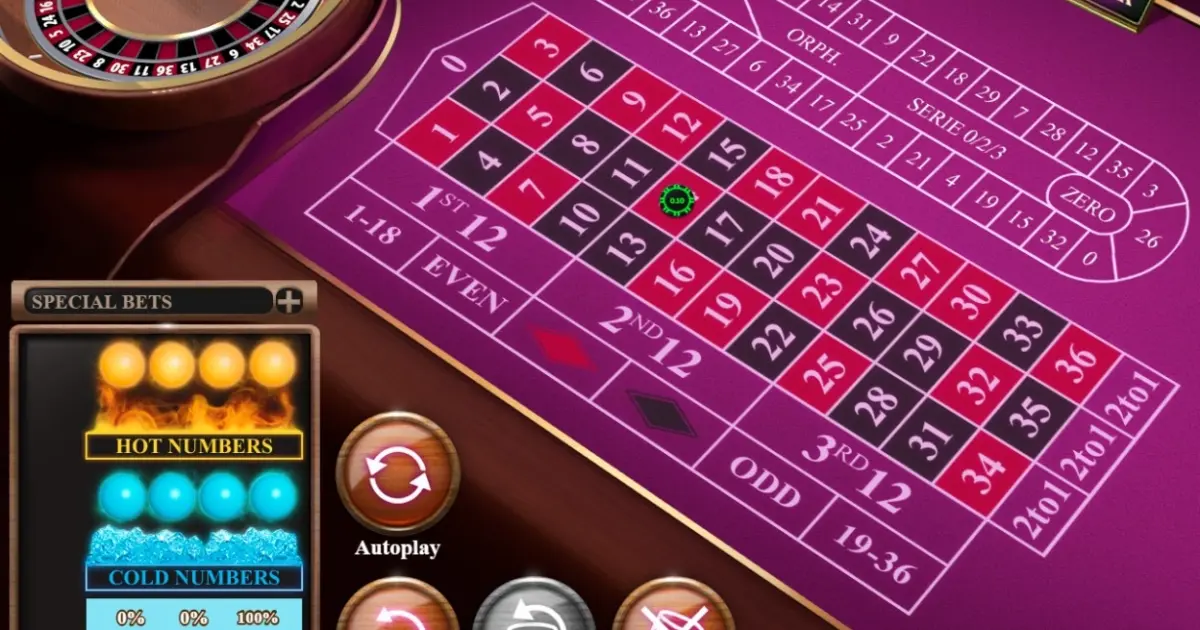
Neon Roulette is a Fugaso table with a stated RTP of 97.3% and a free demo you can open without depositing. That RTP figure is the number that matters most, and it sits slightly above the 96.97% average across the roulette titles catalogued here.
What the data does not confirm is the wheel layout itself — pocket count, whether La Partage applies, table limits and any racetrack or call bets are all absent from the information available for this table. Those gaps are worth closing on the game’s own rules screen before you commit money, and the sections below explain exactly why each one changes your maths.
Is Neon Roulette worth your spins?
If you want a straightforward roulette table with a published RTP and a no-cost demo, this one qualifies. The 97.3% figure is the highest-value fact on the page: it means the game is expected to return 97.30 units for every 100 staked over a very long run, leaving a 2.70% theoretical cost to the player. That number is not a promise about your session — short-run results swing widely in both directions — but it is the correct basis for comparing tables.
Where you should hold back is on anything the data does not state. There is no confirmed pocket count for this table, no confirmed French rule, no listed minimum or maximum bet, and no confirmed side bets or multiplier mechanic. A missing table limit matters more than it sounds: limits determine how much of the board you can cover and how quickly any staking plan runs out of room. A missing rules confirmation on zero handling matters because it is the difference between a 2.70% and a 1.35% cost on even-money bets. Open the demo, read the paytable, then decide.
Fugaso and this wheel
Fugaso has two roulette titles in this catalogue, both carrying the same 97.3% RTP, which gives the studio a small but internally consistent roulette line rather than a sprawling one. That consistency is useful information in itself: it suggests a single underlying maths model applied across the range rather than a mix of wheel types with different edges.
The companion title is Lucky Spin Euro Roulette, which shares the identical RTP and names its wheel family in the title — handy if you want the same expected return with less ambiguity about the layout. If you prefer a table from a larger studio at the same figure, European Roulette (Red Tiger) is one of the more played options at 97.3%.
Fugaso’s small roulette footprint means there is less community documentation floating around than for the big-studio wheels. That is a reason to lean on the in-game rules screen rather than on forum summaries, which frequently describe the wrong version of a game with a similar name.
House edge: 2.70%, 5.26% or 1.35%?
Roulette maths is exact, and there are only three numbers you need to recognise.
A single-zero (European) wheel has 37 pockets. A straight-up number pays 35:1 against true odds of 36:1, and that one-pocket gap produces a house edge of 2.70% on every standard bet. A double-zero (American) wheel has 38 pockets, which pushes the edge to 5.26% on every standard bet — and to 7.89% on the five-number basket bet, the worst wager on any roulette layout. A French-rules wheel applies La Partage or En Prison, returning half your stake on even-money bets when zero lands. That single rule halves the even-money edge to roughly 1.35%, the best standard bet available in the game.
Which applies here? The published 97.3% RTP corresponds arithmetically to a 2.70% house edge, which is the single-zero figure. That is a strong indication of a 37-pocket wheel, but the pocket count is not stated in the data available for this table, and neither is any French rule. Treat 2.70% as the likely figure and confirm it on the game’s own rules screen before betting real money. If a La Partage rule is present, your even-money bets are cheaper than the headline RTP suggests; if the wheel turns out to have two zeros, the RTP figure and the layout would not agree, which is exactly the kind of contradiction the rules screen resolves.
Bet types, payouts and true odds
The table below shows the standard bets on a 37-pocket single-zero wheel, the layout the 97.3% RTP points to. Every line carries the same 2.70% cost — the differences are in hit frequency and swing size, not in expected value.
| Bet | Numbers covered | Payout | True odds | Win chance |
|---|---|---|---|---|
| Straight up | 1 | 35:1 | 36:1 | 2.70% |
| Split | 2 | 17:1 | 17.5:1 | 5.41% |
| Street | 3 | 11:1 | 11.33:1 | 8.11% |
| Corner | 4 | 8:1 | 8.25:1 | 10.81% |
| Line | 6 | 5:1 | 5.17:1 | 16.22% |
| Column or dozen | 12 | 2:1 | 2.08:1 | 32.43% |
| Red/black, odd/even, high/low | 18 | 1:1 | 1.06:1 | 48.65% |
Read the right-hand columns together. A straight-up number lands under 3% of the time and pays 35 units, so a short session is mostly blanks punctuated by one large hit. An even-money bet lands just under half the time and pays one unit, so the ride is far smoother. Neither is a better bet in expected-value terms on a single-zero wheel. Choose based on how much variance you want to absorb.
What experienced players actually do
They stake flat. The same amount every spin, chosen so that a losing run does not force a decision. Progressive systems — Martingale, Fibonacci, D’Alembert, “wait for five reds then bet black” — do not change expected value by a single decimal. Spins are independent and the wheel has no memory. What progressions do is concentrate your risk: doubling after losses means a modest cold run demands a stake far larger than you planned, and the table maximum eventually blocks the recovery bet the system depends on. That is not a low-risk approach, it is the same edge with a worse failure mode.
They also ignore result history. On an RNG wheel, the last twenty numbers tell you nothing about the next one. No pocket, colour or sector is ever due.
Beyond that, the habits are unglamorous: set the session budget before opening the game, decide in advance how long you are playing, and if a French rule is confirmed on the rules screen, put your even-money action there because 1.35% is genuinely cheaper than 2.70%. With no table limits published for this game, check the minimum and maximum in the demo so you know how many spins your budget actually buys.
Free play before real money
A free demo is available for this table, so you can load it with no download and no deposit, then use it as a rules reader rather than a trial run. Confirm the pocket count, check whether zero returns half on even-money bets, note the minimum and maximum stake, and see whether a racetrack or call-bet panel exists. Those four checks take a couple of minutes and close most of the gaps in the published data.
One thing the demo cannot do is forecast your real-money results. Demo credits produce the same 2.70% underlying maths but they carry no financial consequence, and a warm demo run is not evidence of anything.
Play only if you are 18 or over. Set a budget before you start, treat it as spent the moment you sit down, and never stake money you need for something else. Roulette is entertainment, not income, and the house edge applies to every spin regardless of how the last one went.
Final take
Neon Roulette’s headline is a clean one: 97.3% RTP, matching a 2.70% house edge and the highest figure Fugaso lists across its two roulette tables. That puts it modestly above the 96.97% catalogue average and on par with widely played wheels like European Roulette Pro.
The caveat is documentation rather than maths. Pocket count, zero handling, table limits and any extra bet types are unconfirmed here, and each of those changes either your cost per spin or your ability to bet the way you intend. Load the free demo, spend two minutes on the rules screen, and you will know more about this table than any review can tell you. If the wheel turns out to run a La Partage rule, keep your even-money bets there and enjoy the cheapest standard wager in roulette.
Frequently Asked Questions
Can I play Neon Roulette for free?
Yes. A free demo is available, so you can load the table with no download and no deposit. Use it to confirm the details the published data leaves out — pocket count, zero handling, and the minimum and maximum stake — before deciding whether to play with real money.
What is the Neon Roulette RTP?
Fugaso lists 97.3%, meaning a theoretical return of 97.30 units per 100 staked over a very long run and a 2.70% house edge. That is slightly above the 96.97% average across the roulette tables in this catalogue. It describes long-run maths, not any individual session.
Which wheel is this and what is the house edge?
The 97.3% RTP corresponds arithmetically to a 2.70% edge, which is the single-zero, 37-pocket figure. The pocket count is not confirmed in the available data, though, so check the rules screen. A double-zero wheel would cost 5.26%, and a French La Partage rule would drop even-money bets to about 1.35%.
Does the Martingale system work on this table?
No. No progression changes expected value — the edge stays identical on every spin. Spins are independent and the wheel has no memory, so past results carry no predictive value. Martingale simply shifts risk: stakes escalate fast during losing runs and the table maximum eventually blocks the doubling the system relies on.
How does it compare to other 97.3% roulette tables?
It matches them exactly on RTP. Fugaso's other roulette title, Lucky Spin Euro Roulette, carries the same 97.3%, as do widely played options like European Roulette (Red Tiger) and European Roulette Pro. The practical difference is that those titles name their wheel family, while this one leaves the layout to the rules screen.




