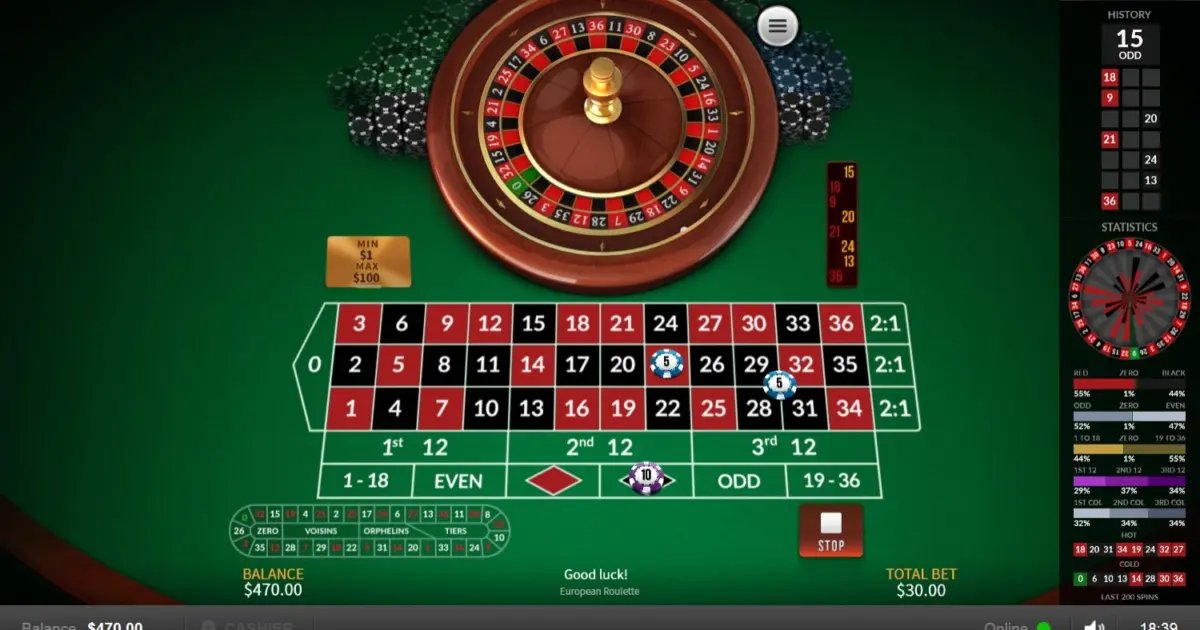
If you want a roulette table where the numbers are already settled, european roulette (skywind) is a reasonable place to spend an hour. The published RTP is 97.3%, which is precisely the figure a 37-pocket single-zero wheel returns, and Skywind Group offers a free demo so you can read the paytable and rules screen before committing anything. What FACTS does not tell us is the table limits, whether a racetrack or call bets are included, or whether any La Partage rule applies to even-money bets when zero lands — and those gaps matter, so check them in the client.
How European Roulette (Skywind) plays
This is a standard RNG roulette table from Skywind Group, one of only two roulette titles the provider has in this corpus. You place chips, the wheel spins, the ball lands in one pocket, and winning bets pay according to the paytable. There is no dealer, no other players, and no timer beyond whatever the interface imposes.
The name points to a single-zero wheel, and the published RTP of 97.3% is consistent with that. Treat the naming as a strong hint rather than a confirmed fact: open the rules screen and count the pockets before you bet real money. Titles get reused across studios, and layouts occasionally differ from what the label implies.
The free demo is the useful part here. It costs nothing to load the game, look at the felt, check which bet types are on offer, and find out whether the table gives you a racetrack for neighbour and call bets. FACTS does not list those features, so the demo is your source. One caution: demo play tells you about the interface and the rules, not about your future results. The maths is identical in both modes, and short sessions in either one say nothing about the next session.
The pocket count is the whole story
Roulette’s house edge comes from one structural gap. On a single-zero wheel there are 37 pockets, so a straight-up number has a true probability of 1 in 37. The payout is 35:1, which means you get back 36 units on a 37-outcome event. That missing unit, spread across every spin, is a 2.70% house edge on every standard bet on a European wheel.
A double-zero wheel has 38 pockets and pays the same 35:1, which pushes the edge to 5.26% — nearly double — and its five-number basket bet is worse still at 7.89%. This is why the single-zero versus double-zero question is the only wheel-selection decision that actually changes your expected cost.
The third case is French rules. Where La Partage or En Prison applies, a zero returns half your even-money stake instead of taking it all, cutting the even-money edge to roughly 1.35%. That is the best standard bet available anywhere in roulette. FACTS does not say whether this table applies La Partage, and it makes a real difference: on red/black or odd/even, French rules halve your long-run cost. Look for it on the rules screen. If it is absent, treat the even-money edge as 2.70% like everything else.
Reading the 97.3% figure
An RTP of 97.3% is the arithmetic complement of a 2.70% house edge, so the published figure and the single-zero structure agree with each other. Over a very large number of spins, the table returns 97.3 units for every 100 staked. Over one session, it returns whatever it returns.
That 97.3% sits 0.33 points above the 96.97% average across the roulette titles tracked here, which is a modest but real advantage — and it comes entirely from the wheel type, not from anything Skywind Group has done. Every single-zero table without La Partage lands on the same number. Skywind Group’s two roulette games both average 97.3%, so the studio is consistent, and the sibling Roulette (Skywind Group) carries the same figure if you want to compare interfaces at identical maths.
One thing the RTP figure cannot tell you is variance. Two tables with identical 97.3% RTP can feel completely different depending on which bets you use. That is a choice you make, not a property of the game.
Choosing bets for the session you want
Every standard bet on a single-zero wheel costs the same 2.70% in expectation. What changes between them is the distribution of outcomes — how often you win and how much you win when you do.
| Bet | Pockets covered | Payout | True odds (37 pockets) |
|---|---|---|---|
| Straight up | 1 | 35:1 | 36:1 |
| Split | 2 | 17:1 | 17.5:1 |
| Street | 3 | 11:1 | 11.33:1 |
| Corner | 4 | 8:1 | 8.25:1 |
| Line (six) | 6 | 5:1 | 5.17:1 |
| Dozen / column | 12 | 2:1 | 2.08:1 |
| Red / black, odd / even, high / low | 18 | 1:1 | 1.06:1 |
The pattern is uniform: each payout is short by the same proportion. If you want a long session on a fixed budget, even-money bets win about 48.6% of spins and drain slowly. If you want a chance at a large result and accept that most spins lose, straight-up numbers hit 2.7% of the time. Neither is smarter. They are different shapes of the same cost.
Martingale and friends: the honest answer
No betting system changes the expected value of roulette. Martingale, Fibonacci, D’Alembert, Labouchere, waiting for five reds before backing black — none of them work, and this is not a matter of opinion. Each spin is independent. The wheel has no memory of the last result, and an RNG has no memory either.
What progressions actually do is rearrange variance. Martingale doubles after each loss, so it converts a large number of small wins into an occasional catastrophic loss. The expected cost per unit staked stays at 2.70%; you simply stake far more units and run into the table maximum, at which point the recovery chain breaks and the accumulated loss lands in one piece.
The same logic disposes of pattern-tracking. No number, colour or sector is ever due, hot or cold. A run of ten reds does not make black more likely on the next spin, because the eleventh spin does not know the previous ten happened. Any tool or scoreboard suggesting otherwise is showing you history, not prediction. If you came here looking for a system, the useful answer is that the maths forecloses it — and knowing that saves more money than any progression could ever make.
Bankroll and table limits
FACTS does not list this table’s minimum or maximum stakes, and that is a genuine gap. Limits determine whether your intended bet size is even available, and the maximum caps how far any progression can run before it collapses. Check both in the demo before you deposit.
A workable approach is to decide your total session budget first, then size bets so the budget covers enough spins to be entertaining. At 2.70%, a 100-unit bankroll loses about 2.7 units per 100 units wagered on average, though real sessions swing widely either side of that.
Roulette is entertainment, not income. Play only if you are 18 or over, set a budget in advance that you can afford to lose entirely, and stop when it is gone rather than chasing it. If gambling stops feeling like a game, step away and use the operator’s deposit limits, time-outs or self-exclusion tools.
Verdict on European Roulette (Skywind)
The maths is fine. A 97.3% RTP on a single-zero wheel is the standard you should expect, and it beats any double-zero table by a wide margin. Skywind Group is a small presence in roulette with two titles, both at the same figure, so there is no internal trade-off to weigh.
What you are choosing here is presentation and rules detail, not value. Confirm the pocket count and check whether La Partage applies to even-money bets, because that one rule is the difference between 2.70% and roughly 1.35% on red/black. If you want to compare the same maths in other interfaces, European Roulette (Red Tiger) and European Roulette Pro both publish 97.3% as well. Load the free demo, read the rules screen, and decide from there.
Frequently Asked Questions
Can I play European Roulette (Skywind) free with no download?
Yes. A free demo is available, and it runs in the browser with no download and no deposit needed. Use it to read the rules screen, check which bet types and any racetrack are offered, and confirm the table limits before wagering real money. Demo results say nothing about future real-money sessions.
What is the RTP of European Roulette (Skywind)?
The published RTP is 97.3%. That sits 0.33 points above the 96.97% average across the roulette titles tracked here, and it matches exactly what a 37-pocket single-zero wheel returns. Both of Skywind Group's roulette games average 97.3%, so the figure is consistent across the studio's small roulette range.
What is the house edge and which wheel is this?
The 97.3% RTP corresponds to a 2.70% house edge, the standard figure for a European single-zero wheel with 37 pockets. The title points that way too, but FACTS does not confirm the layout or whether La Partage applies, so count the pockets and check the rules screen before betting.
Does the Martingale system work on this table?
No. Martingale, Fibonacci, D'Alembert and pattern-tracking all leave expected value unchanged at 2.70% per unit staked. Spins are independent and the wheel has no memory, so no number or colour is ever due. Progressions only reshape variance, trading frequent small wins for rare large losses against the table maximum.
Which bet should I pick for a long session?
Even-money bets — red/black, odd/even, high/low — cover 18 of 37 pockets and win about 48.6% of spins, so they drain a bankroll slowly. Straight-up numbers pay 35:1 but land 2.7% of the time. Both cost the same 2.70% in expectation; only the shape of the swings differs.




